House Agriculture Committee Chairman Glenn (GT) Thompson plans to 1) include the pesticide liability waiver and 2) kill California’s Prop 12 in the “Skinny Farm Bill” that must be passed this year
House Agriculture Committee Chairman Glenn (GT) Thompson plans to 1) include the pesticide liability waiver and 2) kill California’s Prop 12 in the “Skinny Farm Bill” that must be passed this year
Once the government gets back to work the Farm Bill could be dumped on Congress at any time, with only 48 hours to respond

You know all about the pesticide liability waiver, which would create long delays in the ability to update warning labels on all pesticide products (about 50,000 products)—in order to evade lawsuits for failure to warn about the risks of the products.
This includes pesticides, herbicides, rodenticides, virucides, fungicides, etc. “Cide” means kill. Just like Homicide or Suicide. Any product that is designed to kill will certainly induce side effects when humans, pets or livestock are exposed to it in sufficient amounts.
A new name that I suggest you use when you talk about this bill is the “Cancer Gag Act.” This name is a lot more explicit than “Section 453 of an Appropriations bill.”
Bayer’s Cancer Gag Act could find its way into other bills—wherever Bayer thinks it might be able to sneak through. I will alert you if this occurs.
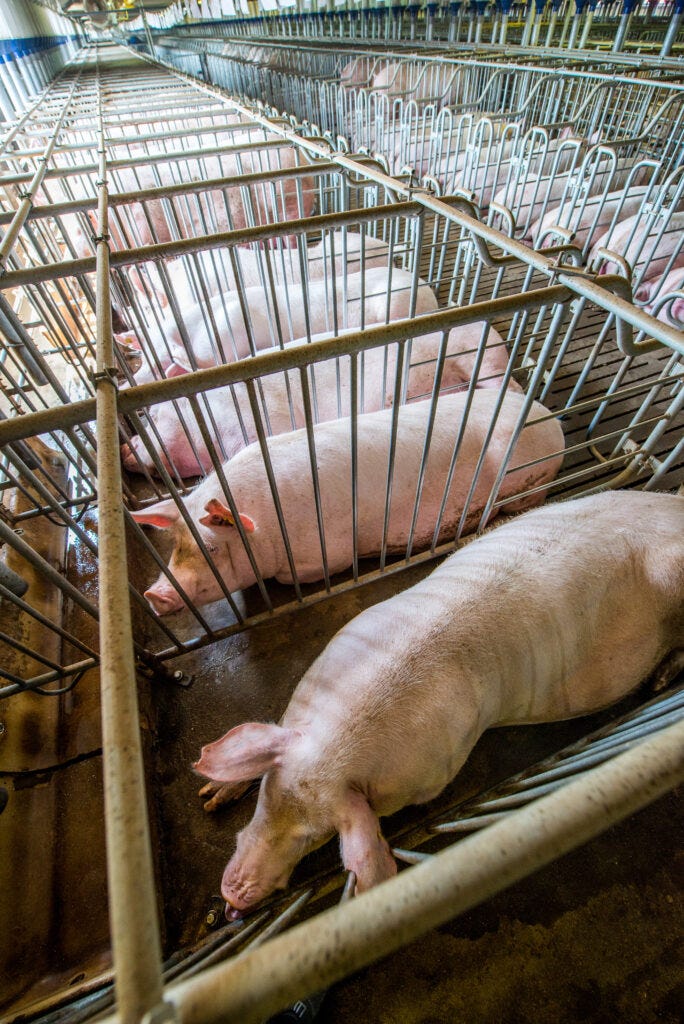
In addition to this poisonous bill, there is another bill that the Big Pig industry and Chairman Glenn Thompson want to pass. Let me remind you that the biggest pork and pig producing company in the US and the world is Smithfield, and they grow hogs in CAFOs—and have turned hundreds of hog farmers into serfs on their own land, growing the hogs as Smithfield requires inside metal buildings with no room to move, feeding them what Smithfield provides. Smithfield has been owned by China since 2013. The company has sold its products under multiple brand names, including Cook’s, Eckrich, Gwaltney, John Morrell, Krakus, and Smithfield.
California’s citizens passed Proposition 12 in a referendum, and it went into effect last year. It requires hogs and chickens being grown for food to have a minimum amount of room to move in. So all pork products being sold in California currently must meet these minimum requirements for the welfare of the animals and the quality of their meat.
This has allowed small family farms to compete with Smithfield and the other big guys, who cannot sell in California without changing their business model (squeezing the animals and squeezing the farmers)—and has saved many small farms from closing down. Glenn Thompson and his Big Ag sponsors do not believe the people should be able to have a say in how their meat animals are raised.
And they have come up with a name for their bill to overturn Prop 12 deliberately crafted to confuse the public: it is called the Save Our Bacon Act. The New Lede has a story about it here. The Senate in April proposed a similar measure with a similarly confusing name, the Food Security and Farm Protection Act. From The New Lede:
Brent Hershey, a sixth-generation farmer who raises pigs in Pennsylvania for a multi-state meat distributor, said his operation is “living proof” that Proposition 12 doesn’t hurt farmers., He has chosen to stop using gestation crates, a feature of the California law, with little downside for his operation, saying the practice is being phased out in the pork industry.
“We’re trying to have Congress understand that there’s this huge group of family farmers who are for Prop 12, it’s been a good step for them,” he said. “We do not want Congress to roll it back and destroy that market.”
Several hundred state and local laws could be nullified if the new federal legislation becomes law, according to Humane World for Animals. The USDA estimates that about 27% of US pork producers are now Prop 12-compliant.
The federal efforts against the states measures follow several failed attempts to preempt state standards on farm animals and meat products, including the 2023 “Ending Agricultural Trade Suppression Act” (EATS Act) and the 2018 King Amendment, neither of which made it into a Farm Bill.
“We stand at a crossroads,” said ButcherBox’s Hilovsky. “One path upholds a system in which the cheapest production methods win, regardless of the consequences to our health, the wellbeing of the animals, farmer livelihoods and rural economies. The other path leads to a more resilient, humane and nutritious system.”
Chairman Thompson wants to bypass the Tenth Amendment, which says states should have control over matters not given to the federal government in the Constitution, which includes agriculture. His plan is to prevent states from passing laws that impose stricter regulations than the federal government has imposed.
Here is what farmers have to say about Proposition 12:
https://farmaction.us/prop-12-farmers-voices/
WHY PROP 12 MATTERS
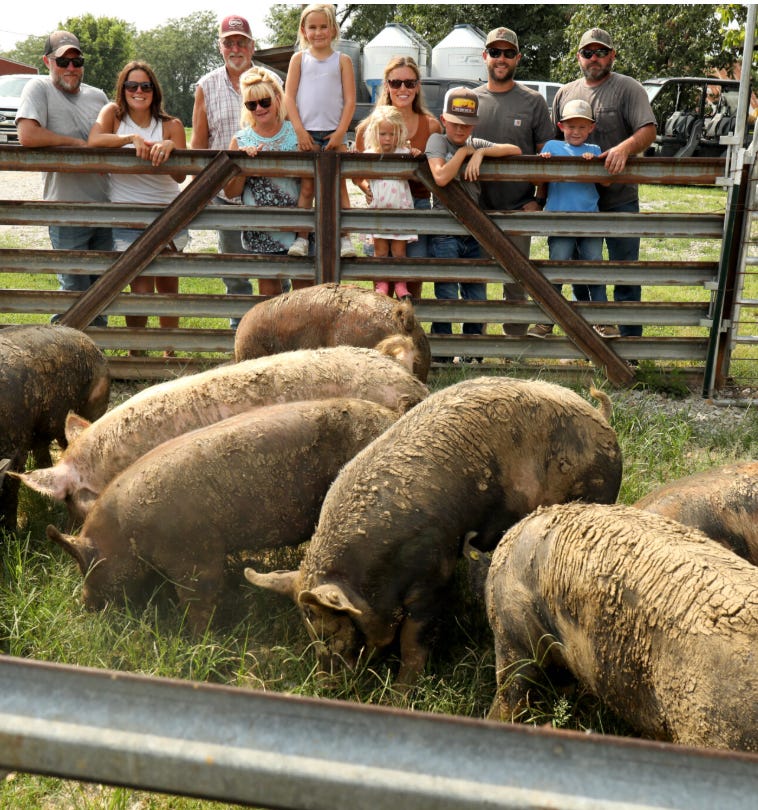
Independent hog farmers raising crate-free pork found a lifeline under California’s Prop 12—a voter-approved law that sets basic space requirements for breeding pigs. Prop 12 created a market that gives family-run farms like ours a fighting chance in a highly consolidated industry.
THE THREAT
Big Ag, including China-owned Smithfield Foods, is pressuring Congress to dismantle Prop 12 in the upcoming Farm Bill. If they succeed, the Prop 12 market—and a vital income stream for family farms—will disappear. This rollback would protect corporate pork giants while undermining independent farmers, reversing animal welfare progress, and stripping states of their right to set food standards.
FARMERS IN ACTION
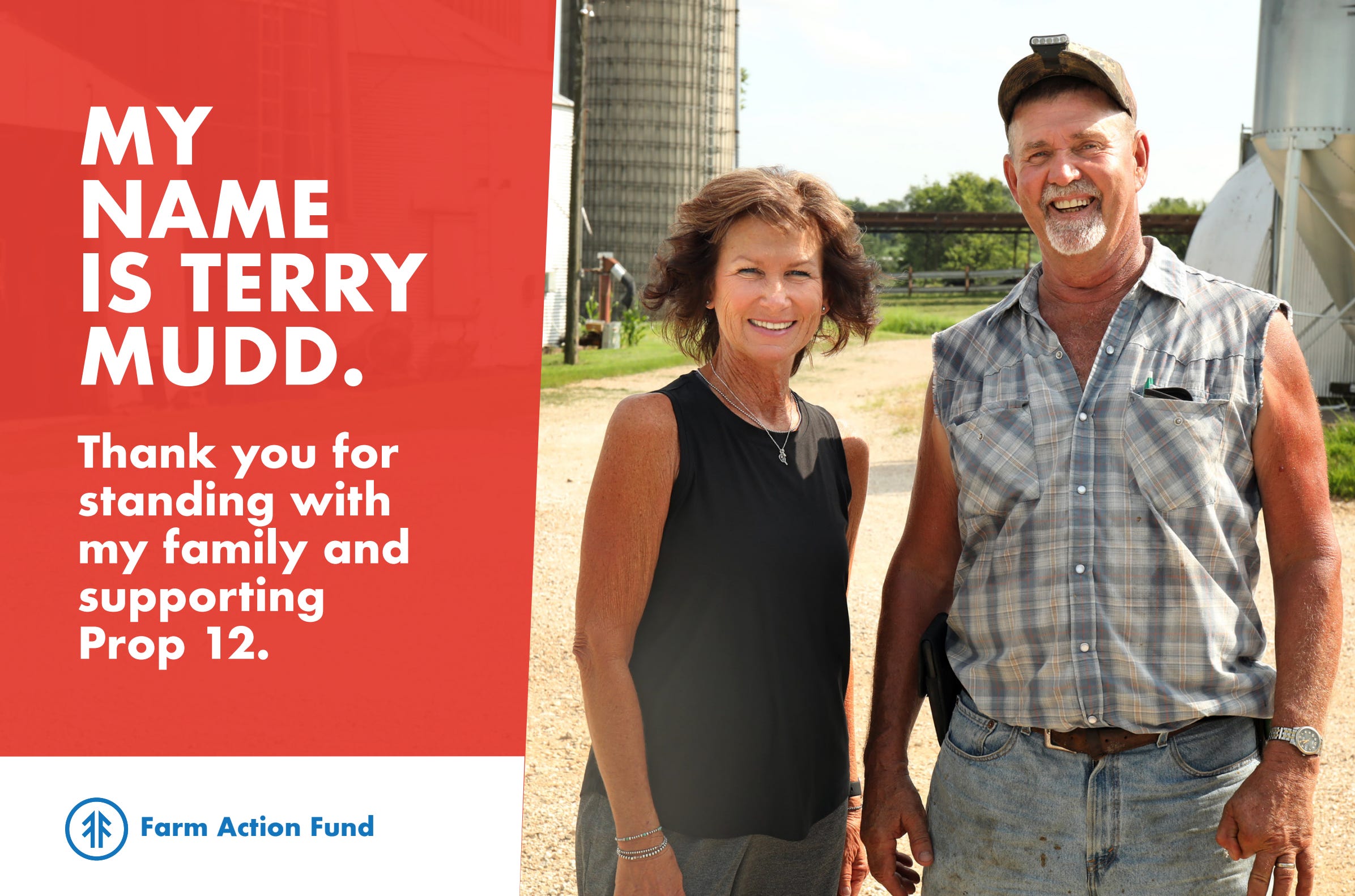
We’re taking our fight to Washington, D.C.—with billboards across Union Station and Reagan Airport, a mobile billboard circling the Capitol, postcards in every legislator’s mailbox, ads in major national outlets—and now online. Farmers have been excluded from the Prop 12 debate for too long, so we’re making sure our voices can’t be ignored. Here’s what they’re seeing.
TAKE ACTION
STAND WITH FAMILY FARMERS:
Every message, share, and donation helps family farmers fight against corporate special interests and protect Prop 12. Already, over 5,000 independent farmers nationwide have spoken out—add your voice today.
FARMER STORIES
Bob Street
“Thanks to Prop 12, my grandson just might have that chance.”
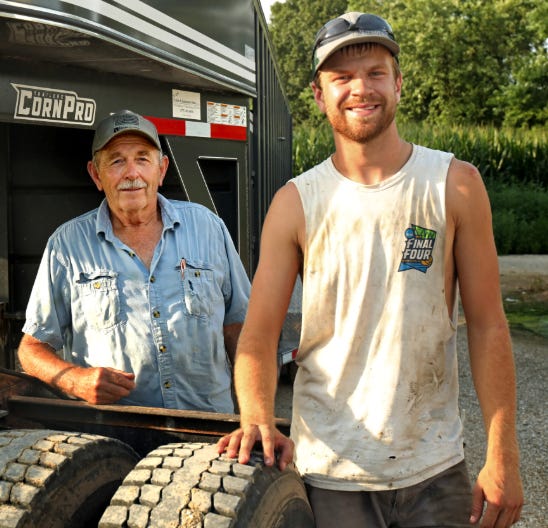
My name is Bob Street—you may have seen me featured on screens at Reagan National Airport thanking members of Congress for their support of California’s Prop 12. I’ve been farming since the mid-1960s. I’m 73 now, so I’ll have to slow down one day—but my grandson Mason, pictured here with me, hopes to carry on what I’ve built. Thanks to Prop 12, he just might have that chance.
Before Prop 12, smaller producers like me were being pushed out. The current system favors the big guys who control the market, leaving folks like us with nowhere to turn. This new market gave us the opportunity to earn a better price for our hogs, and it’s likely the reason we’re still in business today.
Terry Mudd
“Without Prop 12, we’d be in serious trouble.”
My name is Terry Mudd, and I farm with my brother on land that’s been in our family for over 200 years. After losing my dad in 1983, my mom, my brother, and I did everything we could to keep the farm going.
My wife, Sharon, who is pictured here with me, and I are proud to be part of a community of Midwest hog farmers working hard to raise crate-free pork. You may have seen my neighbors and me on signs around the Capitol.
Rising costs, disappearing markets, and big corporations nearly pushed us out. But then we found a lifeline in the crate-free market created by California’s Prop 12. It kept us in hog farming. Without it, we’d be in serious trouble. We’ve got kids and grandkids—we want this farm to be here for them.
Brian Sjostrand
“Prop 12 gave us a chance to keep farming.”
My name is Brian Sjostrand, and I raise hogs with my family—pictured here with me is my daughter Ashley, who’s heading to college soon. We’ve farmed most of our lives and got back into it full-time in 2011. You may recognize our faces from signs at Union Station.
This industry isn’t easy, and with our three daughters leaving home, we’ll soon have fewer hands on the farm. What’s keeping us going is the premium we get through California’s Prop 12. Without it, we couldn’t stay in hog farming—corporations are squeezing us out everywhere else.
Prop 12 gave us a chance to keep farming and raising quality meat. If that goes away, so does the future for families like ours.
Don Mudd
“Prop 12 makes it possible to keep our family farm thriving for the next generation.”
My name is Don Mudd, and together with my wife Debbie, our three sons—David, Daryl, and Daniel—and their families, we live and work on our 6th-generation family farm. Like those before us, we raise cattle and hogs, and grow corn, beans, wheat, hay, and straw to feed our animals. You may have seen our family’s faces on signs across Union Station.
We’ve always raised our pigs outdoors in a natural, antibiotic-free environment. California’s Prop 12 rewards the way we believe pigs should be raised—resulting in higher-quality pork and healthier, happier animals.
Farming this way takes hard work, long hours, and high costs, but Prop 12 created a market that makes it all worthwhile.
FARMER VOICES ARE TURNING THE TIDE
Corporate lobbyists may be pushing to overturn Prop 12, but House Republicans and Senate Democrats in Congress are listening to the farmers who depend on fair markets to survive. Their recent letters prove that bipartisan support for Prop 12 is growing stronger every day. This pushback shows that farmer voices are cutting through the noise in Washington, building powerful momentum to defend Prop 12 against corporate influence.
PROP 12: MYTHS VS. FACTS
Corporate lobbyists like the National Pork Producers Council (NPPC) are spreading misinformation to weaken Proposition 12. Voters approved this law to set basic animal welfare standards and create fairer markets for independent farmers. Here are the facts:
✅ FACT: Prop 12 kept pork prices stable.
Since Prop 12 took effect in January 2024, retail pork chop prices have moved only modestly—just 6.6% across the year—a normal short-term adjustment.
❌ MYTH: Prop 12 caused a 41% surge in pork prices.
✅ FACT: Prop 12 is helping farmers stay in business.
A loss of 5,000 hog farms happened between 2017 and 2022—years before Prop 12 took effect in 2024—as part of a decades-long consolidation trend driven by corporate control. By contrast, Prop 12 creates a fair market where independent farmers can compete.
❌ MYTH: Prop 12 caused the U.S. to lose 5,000 hog farms.
✅ FACT: Prop 12 keeps pork on shelves and supply chains strong.
At least 27% of U.S. pork producers are already compliant, and consumers in California continue to find pork in stores. USDA confirms supply chains remain intact.
❌ MYTH: Prop 12 disrupts supply chains and threatens food security.
✅ FACT: Prop 12 improves animal welfare.
By ending the use of gestation crates, Prop 12 ensures pregnant sows have room to turn around and move. It does not apply to piglet care, so claims about crushing are misleading.
❌ MYTH: Prop 12 endangers piglets without crates.