I’m taking a vacation for my emotional and physical health. I ramble about many things. Happy Thanksgiving everybody!
I’m taking a vacation for my emotional and physical health. I ramble about many things. Happy Thanksgiving everybody!
I don’t have any useful info on DMSO yet

This rambling post discusses the following topics:
-
My planned vacation
-
Why I need a vacation: political frustration
-
The city of Venice
-
DMSO (I have no final judgment)
-
Pinched spinal nerves
-
The Comments are filled with lots of good advice from many readers (MDs, veterinarians, therapists, homeopaths) on treating pain and pinched nerves
I am seeking spiritual, political and physical relief: I had such high hopes for this administration and they have almost all been dashed. How to accomplish what is so needed, so non-partisan, and yet so darn difficult? I guess the concept of partisan issues and political parties is so YESTERDAY. Let’s just refer to it as a Uniparty. Today the reality is the swamp/deep state/globalists against the rest of us, the other 99%. Right now it feels like the swamp is winning. In fact, it feels like they have a straight flush.
I can’t recall where I snagged this image, but it seems to encapsulate the frustration of the public, which feels betrayed by the enumerated policies, while our President and his bubble of courtiers keep telling us everything is just grand.

Emerald Robinson points out what struck me at the time, but had forgotten. How most of the Republican members who were going to challenge the election results quickly caved, once the Jan. 6 fake eruption happened, enabling the real coup that eviscerated the challenge to the election results by Republicans in Congress that day.
Trump’s own party, all of them, failed to support the challenge to the election, and several voted in favor of impeachment: voting that he had incited an insurrection. So, at least in January 2021, the R Congressmembers were not all playing for the same team. How many teams are there?
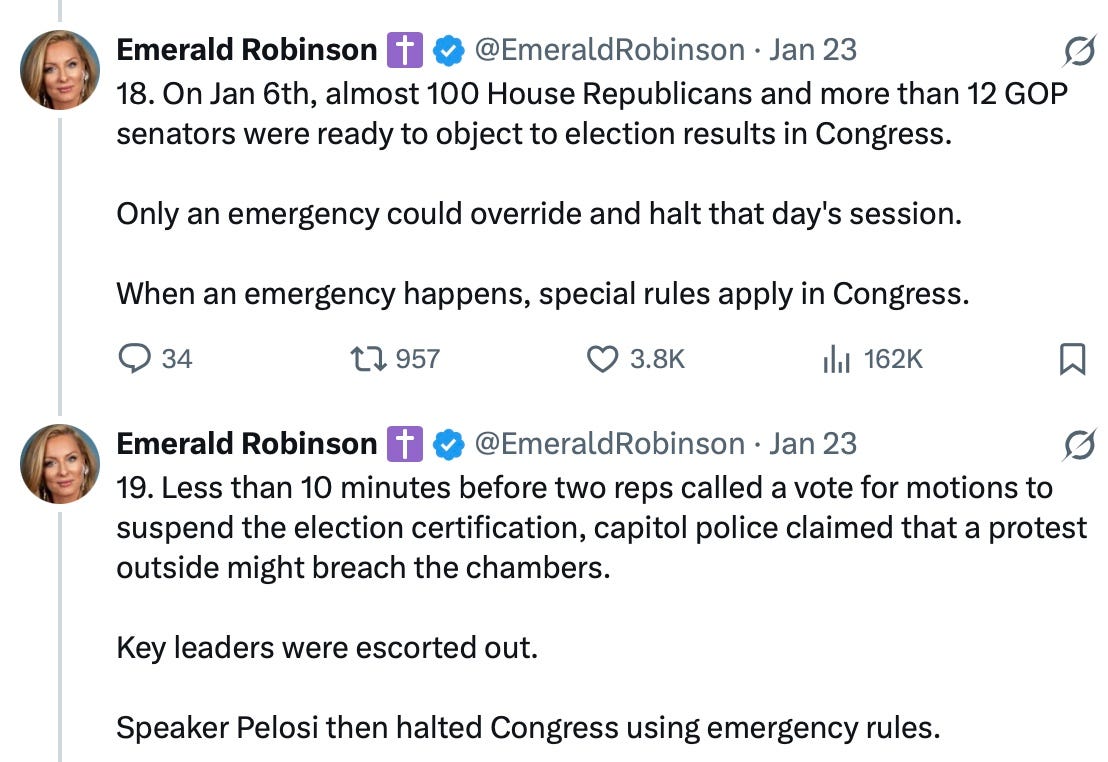

I have not been able to discern how to get through this morass. It seemed our President was betrayed, and he was on our team. But now practically every policy that rolls out favors the other team.
And that Sound of Music image didn’t even include the rollout of the surveillance state, digital IDs and money, and the Charley Kirk assassination, which is associated with yet another patsy and an obvious coverup. It’s a terrible look for this administration, which needs to be cleared up by a proper investigation.
Our farmer/food campaign rollout was halted. I think that was a good thing. We have developed plenty of good messages. (I have been glad to recently hear others repeating my refrain that since 2017, we have lost 63 farms A DAY, according to USDA figures.) But the forces opposed to changing agricultural policy are humongous. HHS has very limited power over this, and the HHS agency employees are, in the main, unaligned with the MAHA agenda. I’ve not been able to identify a path forward to victory.
The other side of that coin is that we are spending very little money now, just updating the website (Save Our Food And Farms or SOFAF.org). We are saving our funds to mount a campaign later, when we feel we can make a difference.
I need to regain my optimism and my ability to find chinks in the other side’s armor.
So I took a chunk of dough out of my IRA and I am heading to Europe for an intense detox, a visit to a mineral spring and this time I will give only one talk (in Venice) and spend the rest of the time enjoying myself. I love this wonderful city, truly an outdoor museum—the place that I consider to be Disneyland for grownups. All the building exteriors are about 500 years old, some older. The owners are not allowed to remodel the exteriors. So it is a feast for the eyes. Too bad it will be freezing cold. But then again, there will be few tourists, so I’ll take the trade-off. (And we Mainers know how to dress for winter outings.) Venice forces you to get plenty of exercise, since there are no cars, and you either walk or travel by boat. Consider bringing a backpack or daypack if you visit Venice, as it will travel better over the irregular paths, and up and down the 438 little bridges between the islands.
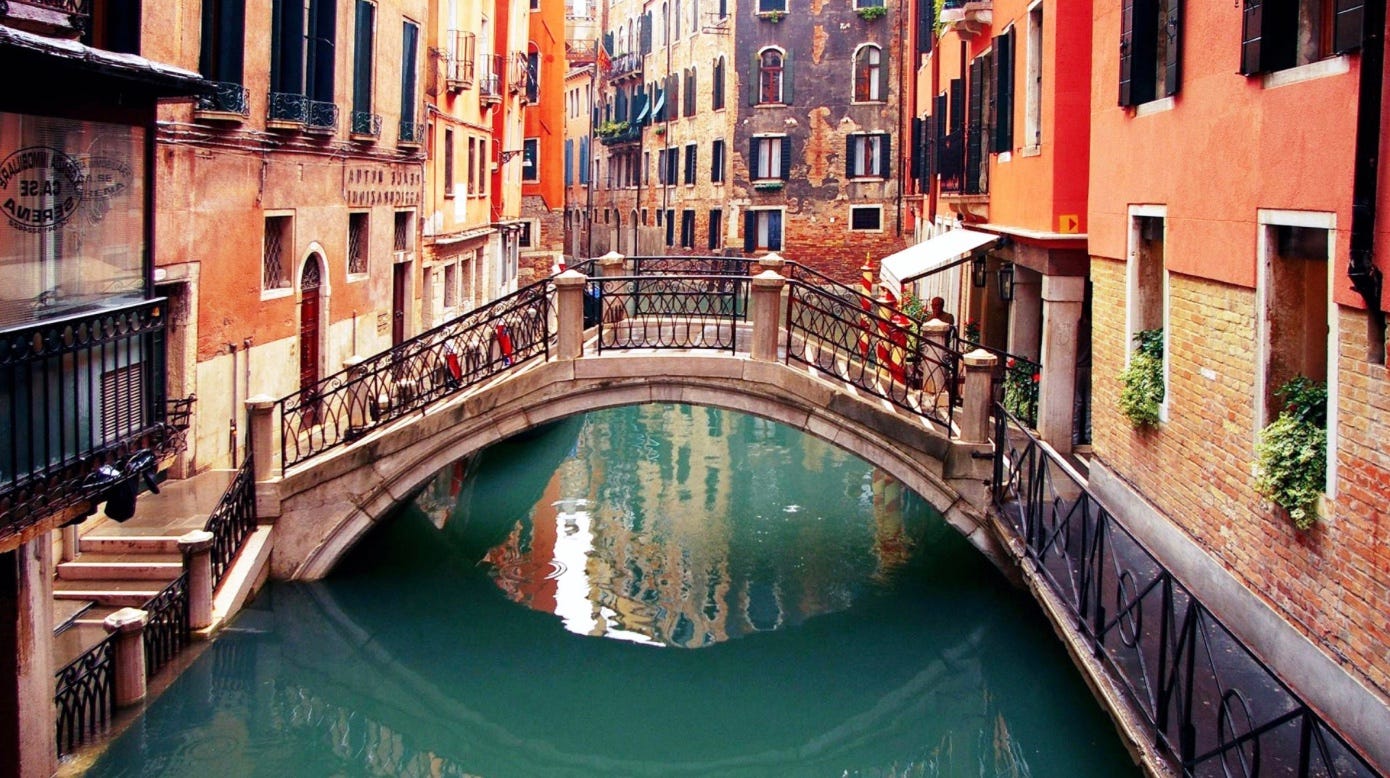
Those who can afford it take a boat to their hotel. Here is a map of the city.
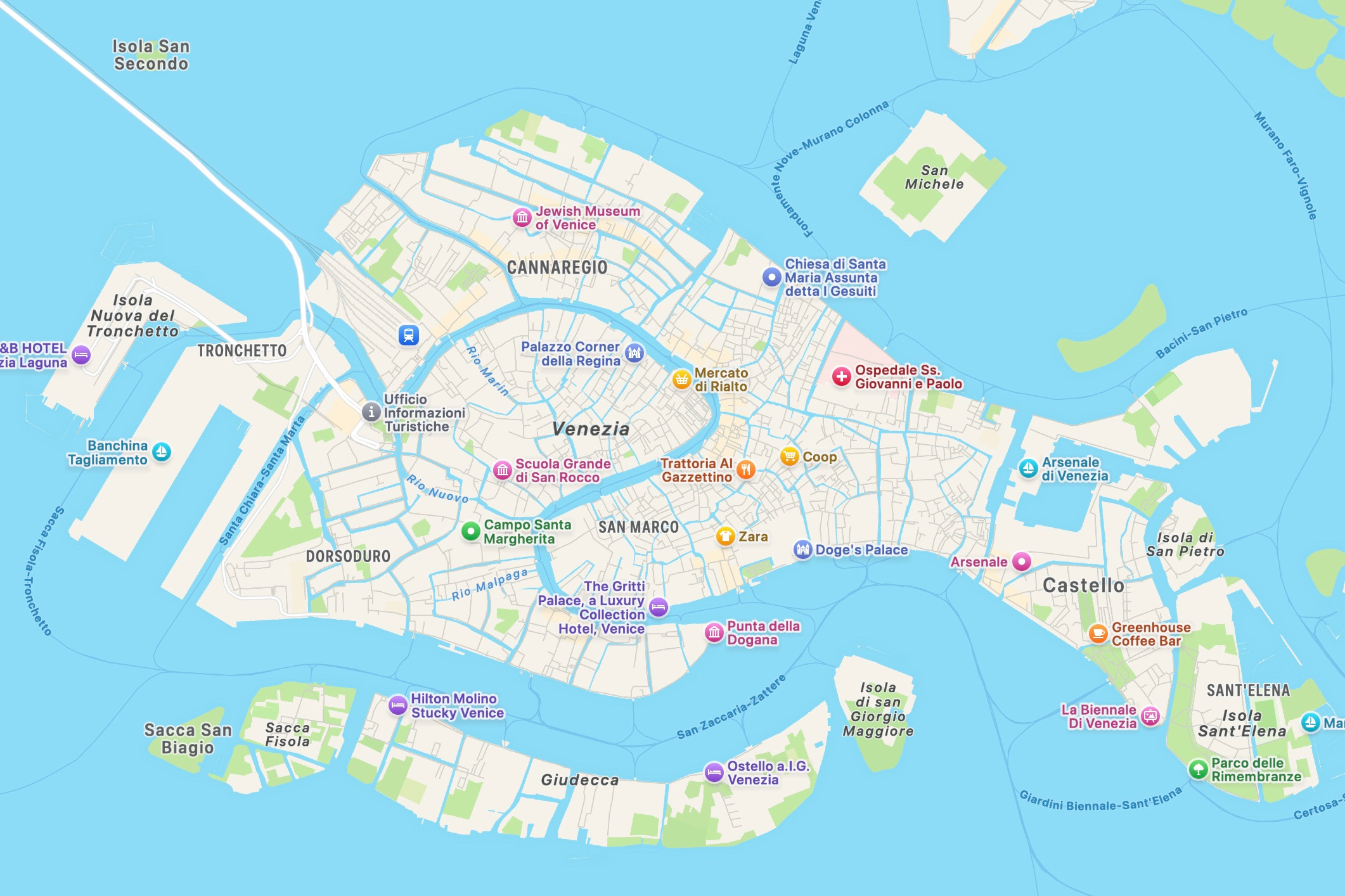
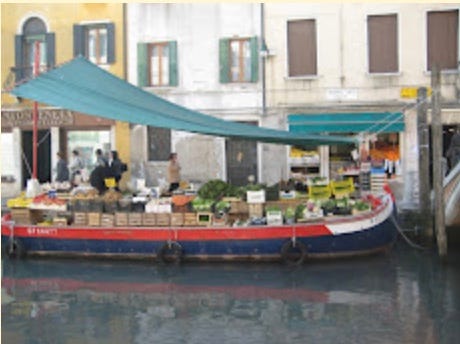
I have been there twice before, briefly. Here are photos I took 14 years ago of a typical canal and a greengrocer’s shop.
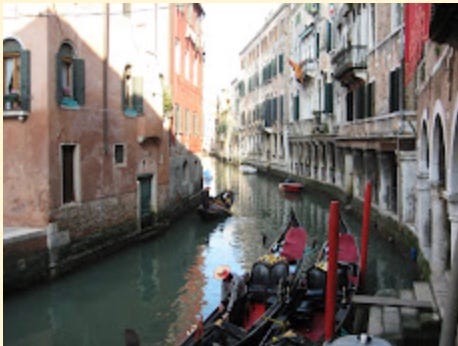
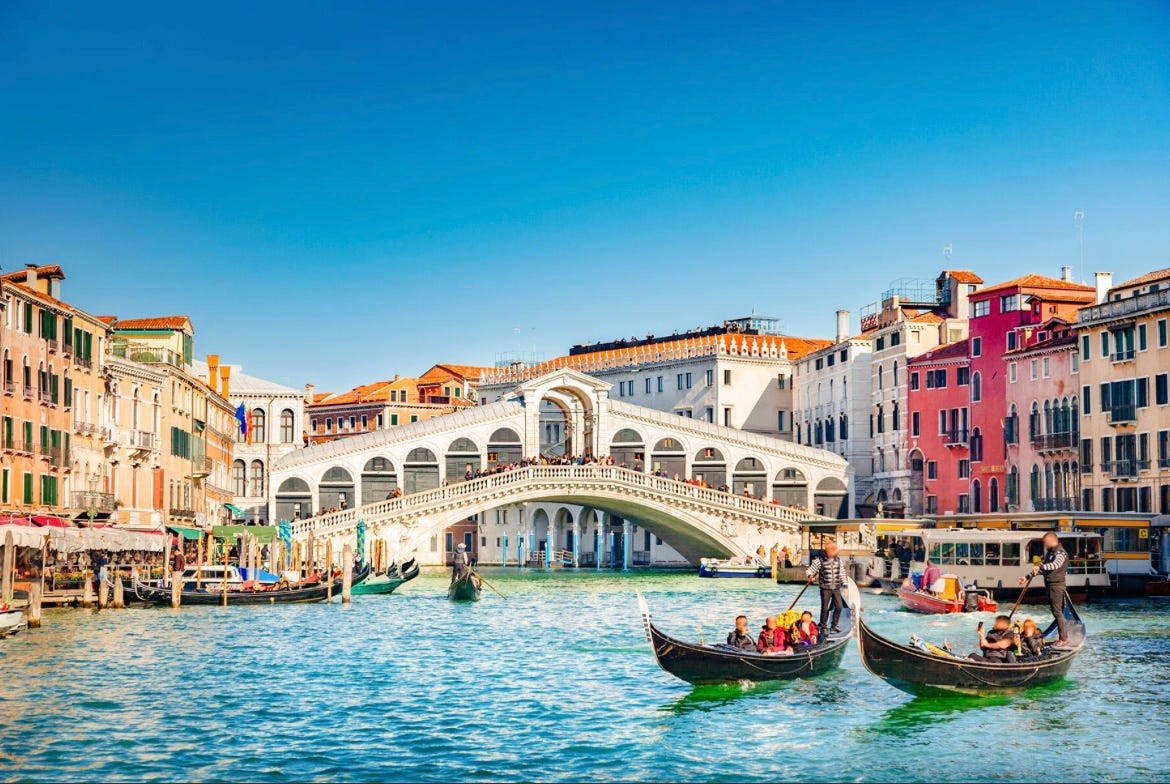
This is a bridge over the Grand Canal. There were tiny shops selling gold jewelry built into the bridge. The other canals are much narrower. In Venice, the canals are the roads.
Venice was formed by creating artificial islands in a shallow Adriatic Sea lagoon with logs—LOTS of logs—that later fossilized and formed the foundation of the homes and other buildings. Whatever happened to the wood, who really is certain, but after 1,000-1,600 years, it still holds up the city. The purpose of building a city on water was to escape the marauders (Vandals, then Goths, then Huns and who knows how many more) who arrived overland.
The locals began building the islands and their homes in the lagoon in the early 400s AD, as the Roman Empire was collapsing. They continued building for hundreds of years, until now there are 118 tiny islands, separated from the mainland by a couple of miles. Brilliant strategy. It enabled Venice to become possibly the richest and most prominent city in the world in the early centuries of the second millennium.
https://www.bbc.com/future/article/20250324-the-ancient-forest-that-supports-venice
The city, which turned 1604 years old on March 25, is built on the foundations of millions of short wooden piles, pounded in the ground with their tip facing downwards…
The piles were stuck as deep as possible, until they couldn’t be pounded down any further, starting at the outer edge of the structure and moving towards the centre of the foundations, usually driving nine piles per square metre in a spiral shape. The heads were then sawn to obtain a regular surface, which would lay below sea-level.
Transverse wooden structures – either zatteroni (boards) or madieri(beams) – were placed on top. In the case of the bell towers, these beams or boards were up to 50cm (20in) thick. For other buildings, the dimensions were 20cm (8in) or even less. Oak provided the most resilient wood, but it was also the most precious. (Later on, oak would only be used to build ships – it was too valuable to stick in the mud.) On top of this wooden foundation, workers would place the stone of the building.
The building of Venice happened in what we now call the Dark Ages—but building a large city of islands about 2 miles offshore required considerable engineering skills, manpower and wealth. It makes you wonder whether we have a very primitive understanding of what earlier cultures were really like.
This allowed Venice to prosper as a trading community relatively undisturbed, despite lack of natural resources, besides fish. It became the final stop on the Silk Road, managing trade between Europe and the vast East.
Marco Polo took off from Venice age 17 with his father and uncle in 1271, taking 3 years to arrive at the Mongol palace of Kublai Khan. His father and uncle had made the trip before. Marco spent 17 years total in China. We know all this because he wrote a book about his travels.
This site has a lot of interesting history about the city of Venice. At one time, its shipbuilders could turn out one warship a day! Tell that to General Dynamics.
DMSO: Mostly my leg pains are gone. I could only use the DMSO intermittently. It has a difficult odor. The Midwestern Doctor warned about chemicals from your clothes being carried into your body with the DMSO solvent, so I only used it after a shower, once daily. But the Midwestern Doctor also suggested use 4 times a day. So that didn’t work for me.
Once you apply it, you have to wait awhile (around 10-15 minutes) for it to dry completely before you can put clothes over the area. I found it irritated my skin a little, but only for about 5-10 minutes after application.
So I used it about 8 times, and my legs got much better. But also, “time heals all wounds” so it could be coincidence. I finally figured out that the odd sensations up and down my right leg must be due to an L4 pinched nerve. When you have a pinched nerve in your back, which is extremely common, you can feel pain in any of the areas that is served by that particular nerve, and you can potentially experience a wide range of sensations, yet it can all be coming from your back. Thus I had intermittent pains in my right knee, my thigh and my lower leg area, all on the right side, while at the same time my left knee swelled up, and it clearly had a local pathology. Looking back, it’s not surprising that I was confused.
This chart shows you all the areas that can bother you when the problem is simply a spinal nerve being pinched as it exits the spinal canal.
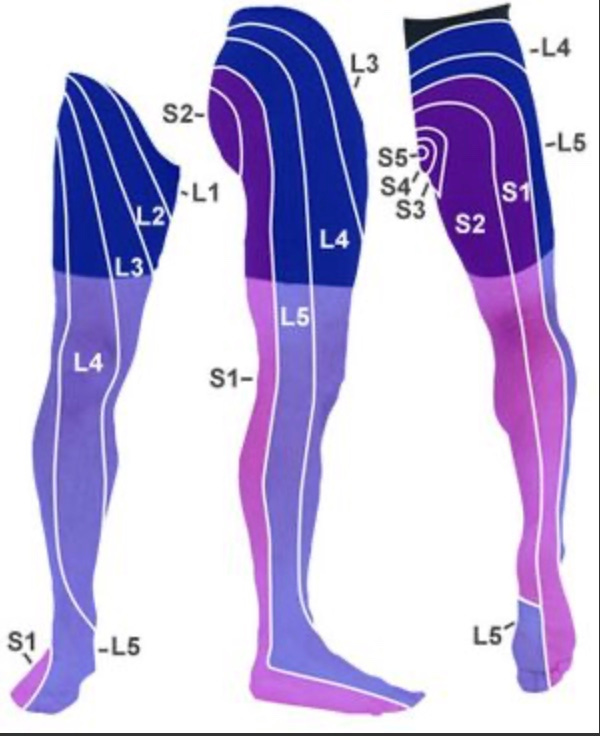
I hope this chart helps readers who may, from time to time, have odd leg pains. It describes where pain can appear to be located, when it really comes from one of the pinched lumbo-sacral nerves. L4, L5 and S1 are by far the most common nerves that get pinched.
Let me tell you, the pain from a pinched nerve can be very tricky, mimicking a variety of other pains. I was once convinced I had severe pain from an ingrown toenail. Only after I operated on my toenail, with no relief, did I realize the pain was originating in my back, from an L5 nerve.
In my recent and ongoing situation, the pains in different parts of my leg felt very different from one another, so I assumed they had different causes. Pinched nerves are also known as herniated discs, slipped discs or ruptured discs. The discs act as shock absorbers for the spine, are found between each vertebra, and under stress, may crack open a little and small amounts of material may be extruded from them, causing local inflammation and putting pressure on nearby spinal nerves.
I don’t think the DMSO that I rubbed on my leg helped reduce inflammation in my spine… but, you never know!