*High Dose* Flu Shots in Elderly Show No Benefit and Worse Harms, Compared to Standard Dose Shots/NEJM
*High Dose* Flu Shots in Elderly Show No Benefit and Worse Harms, Compared to Standard Dose Shots/NEJM
From a huge study in Denmark over 3 flu seasons, in which there was a reasonable match of vaccine to circulating strains. A friend just sent me these 3 months old articles

This is an example of what happens when FDA changes its policy without supportive data, only a “good idea” and skimpy info from big Pharma— more costs, more injuries, no benefits except to Big Pharma. FDA approved its first high dose flu shot 16 years ago. Why weren’t population studies demanded in those 16 years?
https://www.nejm.org/doi/full/10.1056/NEJMoa2509907
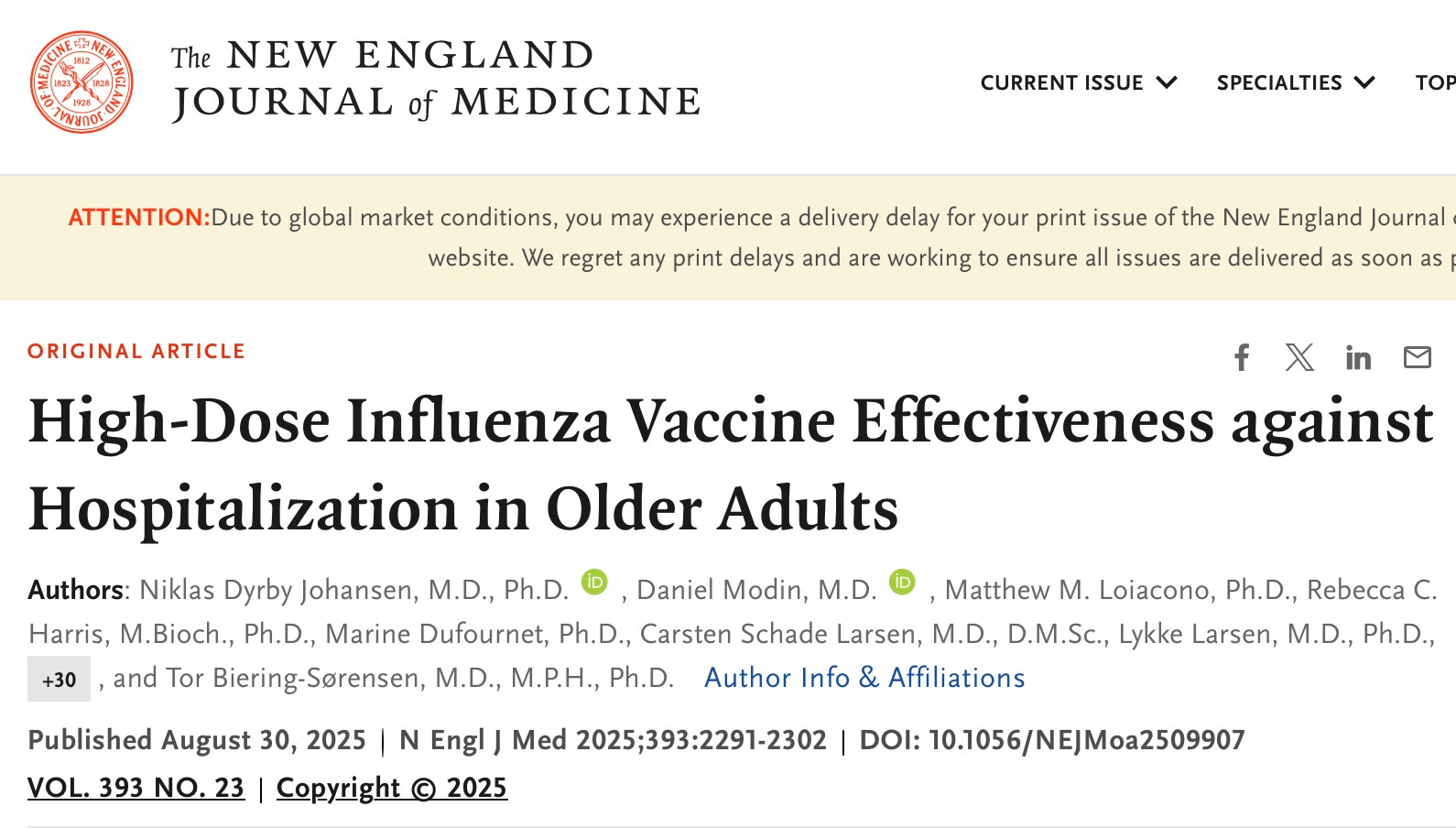
Abstract
BACKGROUND
High-dose inactivated influenza vaccine has been shown to provide protection against influenza that is superior to that with the standard dose. However, data from individually randomized trials on the effectiveness of the high-dose vaccine against severe outcomes are limited.
METHODS
In this pragmatic, open-label, randomized, controlled trial conducted in Denmark during the 2022–2023, 2023–2024, and 2024–2025 influenza seasons, we assigned older adults (≥65 years of age) to receive the high dose of the inactivated influenza vaccine or the standard dose. Data collection relied on nationwide administrative health registries. The primary end point was hospitalization for influenza or pneumonia that occurred from 14 days after vaccination through May 31 of the following year.
RESULTS
Of the 332,438 participants who underwent randomization, 166,218 were assigned to receive the high-dose vaccine and 166,220 to receive the standard-dose vaccine. The mean (±SD) age of the participants was 73.7±5.8 years, and 161,538 participants (48.6%) were women. A primary end-point event occurred in 1138 participants (0.68%) in the high-dose group and in 1210 (0.73%) in the standard-dose group (relative vaccine effectiveness, 5.9%; 95.2% confidence interval [CI], −2.1 to 13.4; P=0.14). Hospitalization for influenza occurred in 0.06% of the participants in the high-dose group and in 0.11% of those in the standard-dose group (relative vaccine effectiveness, 43.6%; 95.2% CI, 27.5 to 56.3); hospitalization for pneumonia occurred in 0.63% and 0.63%, respectively (relative effectiveness, 0.5%; 95.2% CI, −8.6 to 8.8); hospitalization for cardiorespiratory disease in 2.25% and 2.38% (relative effectiveness, 5.7%; 95.2% CI, 1.4 to 9.9); hospitalization for any cause in 9.38% and 9.58% (relative effectiveness, 2.1%; 95.2% CI, –0.1 to 4.3), and death from any cause in 0.67% and 0.66% (relative effectiveness, −2.5%; 95.2% CI, −11.6 to 5.9). The incidence of serious adverse events was similar in the two groups.
CONCLUSIONS
In this trial, a high-dose inactivated influenza vaccine did not result in a significantly lower incidence of hospitalization for influenza or pneumonia than a standard dose among older adults. (Funded by Sanofi; DANFLU-2 ClinicalTrials.gov number, NCT05517174; EU Clinical Trials Register number, 2022-500657-17-00.)
And this sentence from the Safety section:
After blinded review of each serious adverse event, a total of 132 events were deemed to be related to the trial treatment (75 in the high-dose group and 57 in the standard-dose group).
A second study, from Spain, was published back to back with the Danish study in the NEJM. This one had fewer enrolled subjects and was not as carefully done. Outcomes were lumped together. It produced a very weak conclusion: it seems the high dose shot was better, but we are not sure. I’d ignore this study.
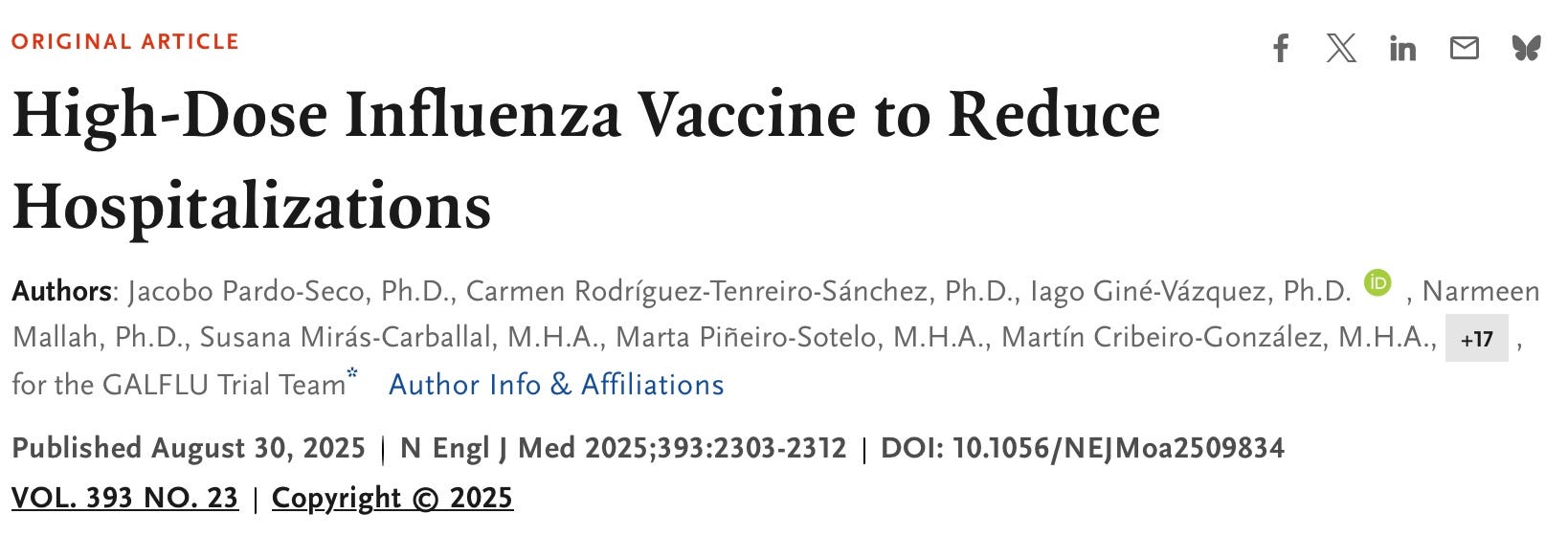
CONCLUSIONS
Among community-dwelling adults 65 to 79 years of age, there appeared to be fewer hospitalizations for influenza or pneumonia with high-dose inactivated influenza vaccine than with the standard dose. (Funded by Sanofi; GALFLU ClinicalTrials.gov number NCT06141655; EudraCT number, 2023-506977-36-00.)