Bayer’s $17 Billion War Chest to Pay For and END its Glyphosate Liability; a Supreme Court Coup; and identifying Bayer’s 6 pronged strategy to win at all costs
Bayer’s $17 Billion War Chest to Pay For and END its Glyphosate Liability; a Supreme Court Coup; and identifying Bayer’s 6 pronged strategy to win at all costs

Bayer bought Monsanto in 2018 for $63 billion dollars—a few months before Monsanto lost its first liability case for causing non-Hodgkins lymphoma. I was not a close observer of the case, but the win seemed to hinge on documents obtained during discovery that revealed Monsanto knew a great deal about the injuries its product caused but deliberately hid those findings.
Once there was a win—and the jury awarded the plaintiff with non-Hodgkin’s lymphoma $hundreds of millions, later reduced—the bandwagon effect began, with other lawyers seeking plaintiffs to sue Monsanto. Eventually over 100,000 plaintiffs were suing Monsanto/Bayer for cancers related to glyphosate, the so-called active ingredient in Roundup. There are other ingredients that are probably toxic too, but they were not at issue. Most plaintiffs were homeowners. Bayer then removed glyphosate from Roundup, producing a new formulation for homeowners.
Still, there were more and more cases and more and more wins in state courts due to Monsanto/Bayer’s failure to warn of a cancer risk. Then Monsanto settled about 50,000 of the cases.
12/15 addendum: I just found this update on the number of cases and cases settled:
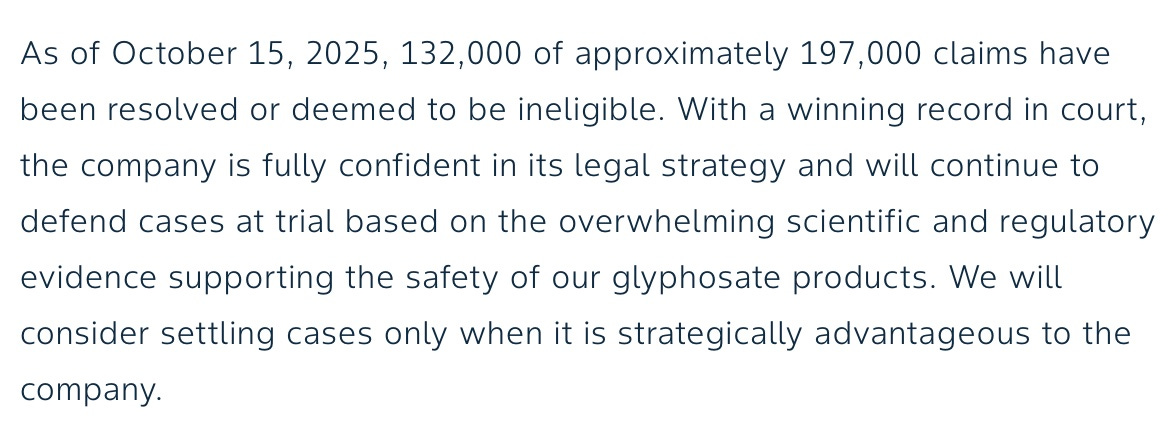
The settlements and the big losses have cost Bayer $10 billion so far.
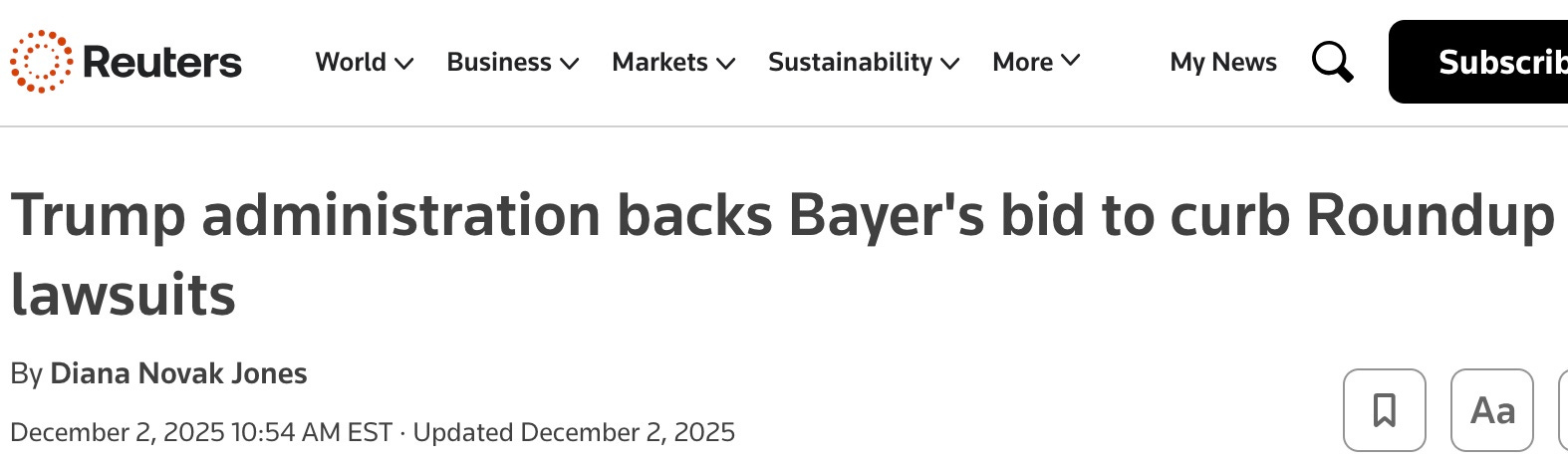
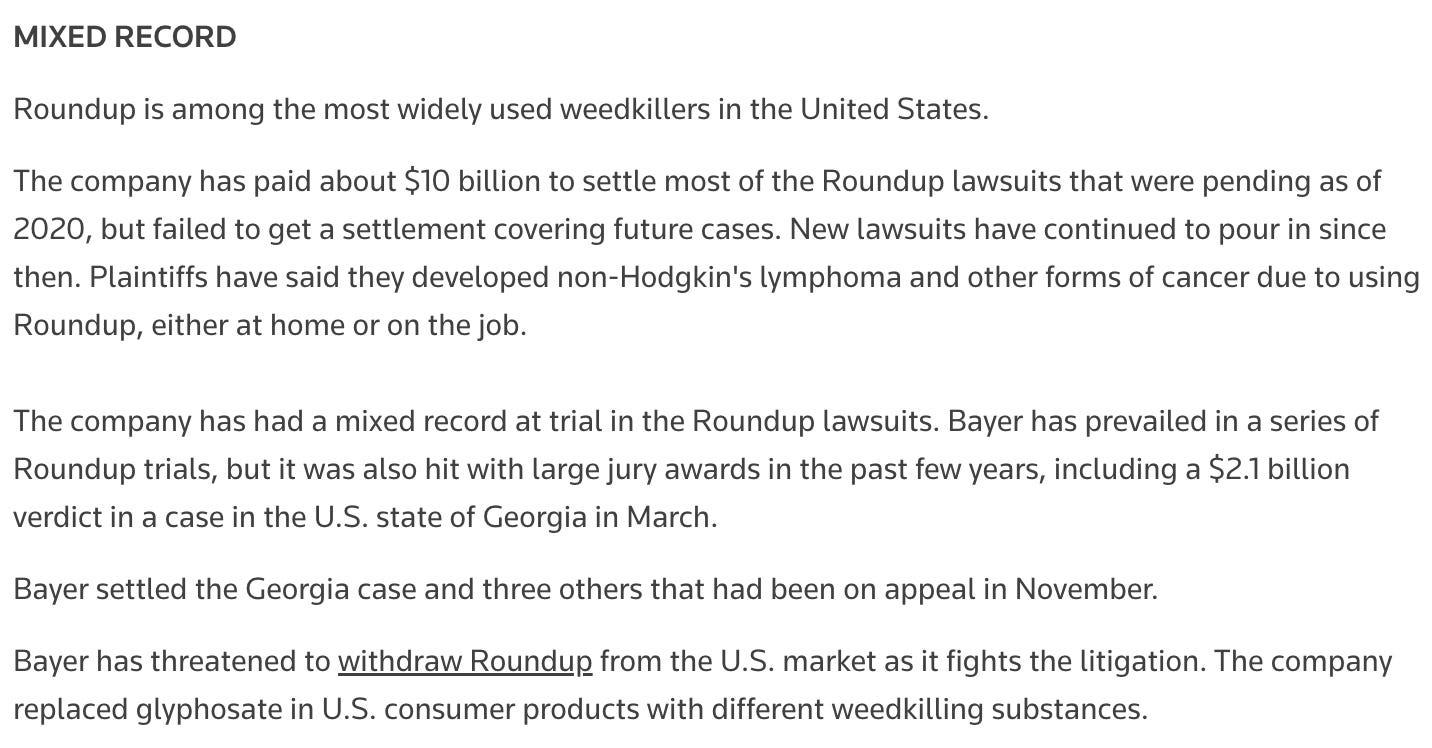
Not only did Bayer pay out a King’s ransom, but its stock price tanked. Desperate times call for desperate measures. Bayer, a German company, hired a Texan, Bill Anderson, as CEO to come to its aid. CEO Anderson’s career hinged on stanching Bayer’s bleed. He initiated a very expensive series of legal and political strategies in the hopes that one would be successful. He also formed a new agricultural industry lobby group with a huge advertising budget.
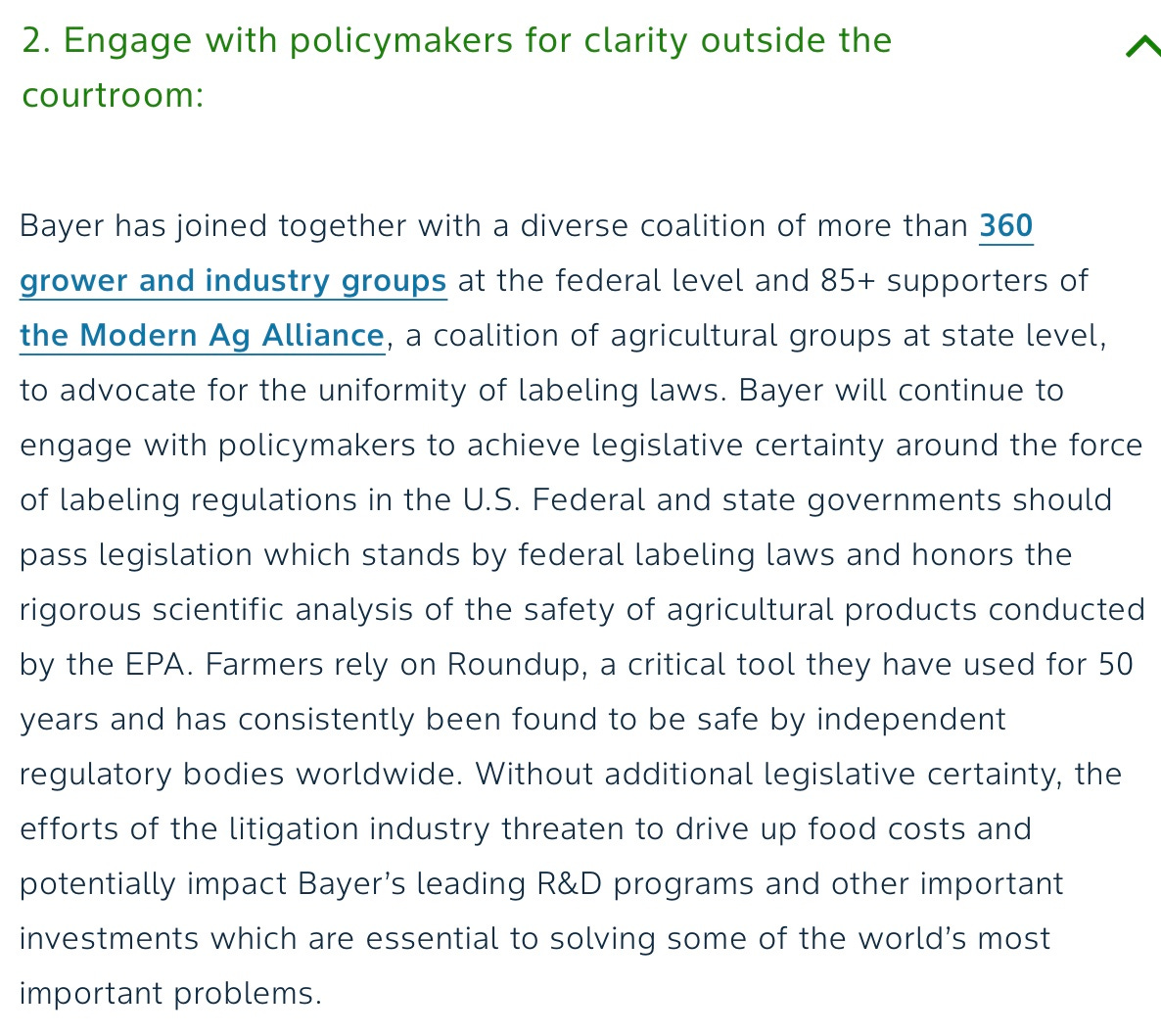
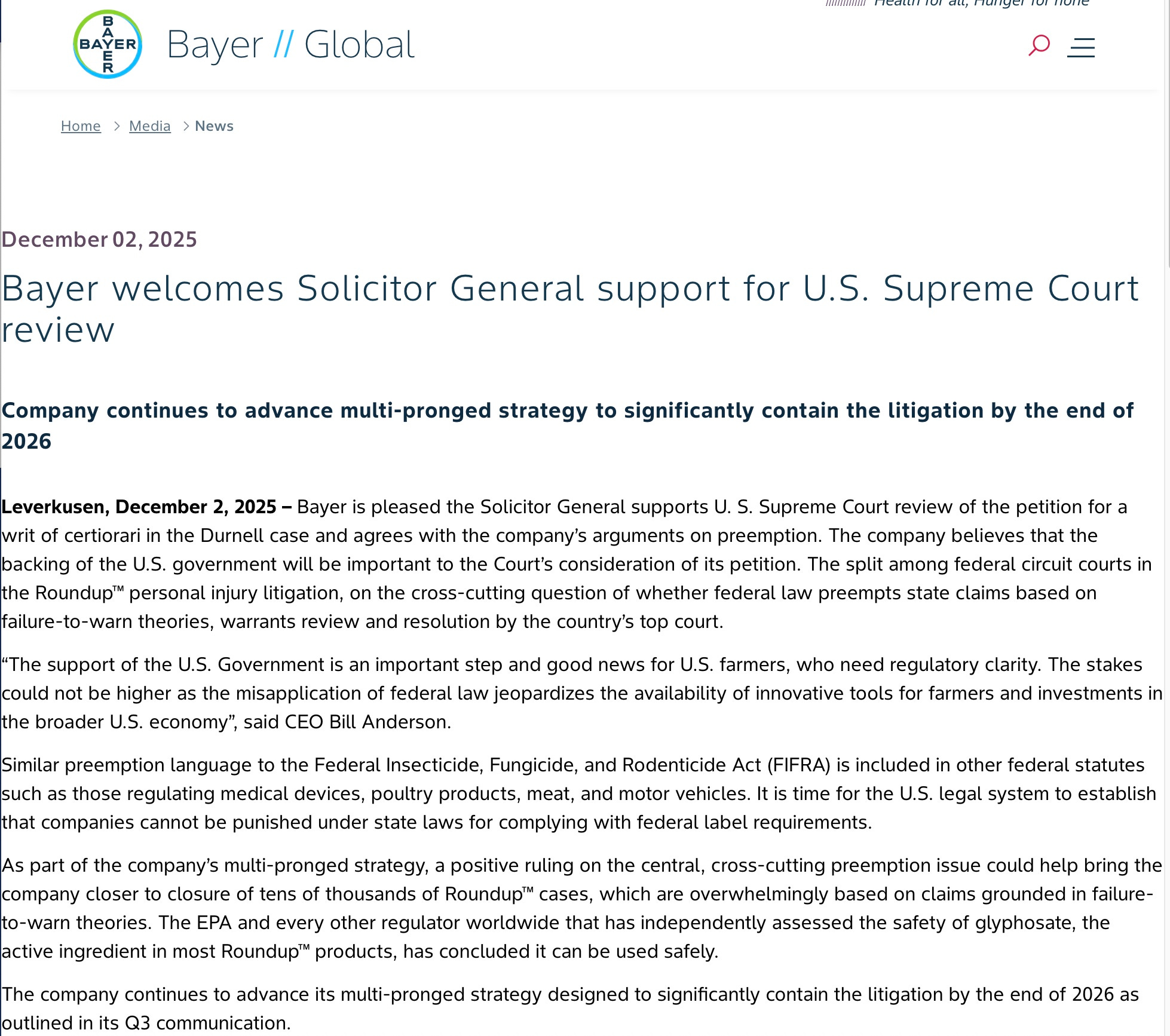
12/15 Addendum from Bayer’s website:
CEO Anderson got the Bayer board to agree to setting aside around $17 Billion for this problem. With $10 Billion already spent (the same figure reported 5 months ago) that left him with about $7.6 Billion to deal with the 67,000 pending cases and to end the litigation for good.
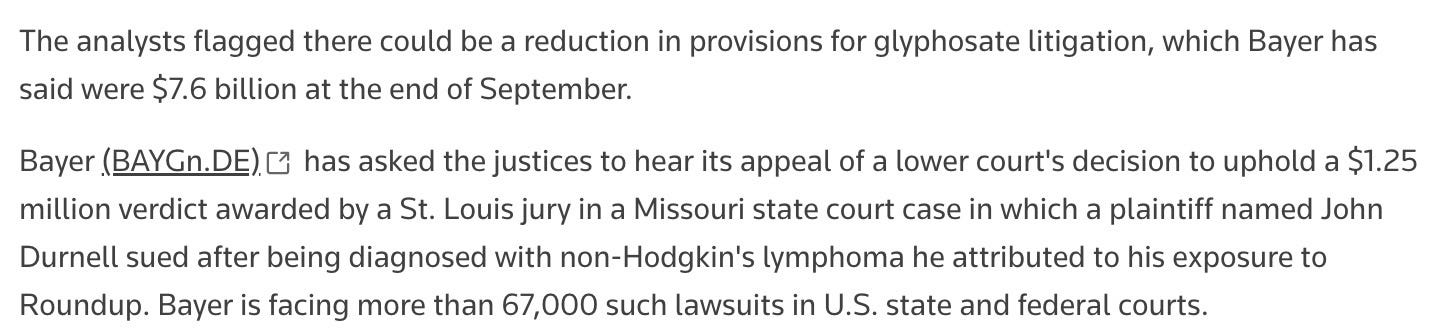
I discussed the six different tracks Anderson pursued to make this problem go away in this piece. One of those tracks was getting Congress to pass a bill rider that would provide a liability shield by forbidding the EPA from making label changes unless a tedious, years-long process had been undertaken.
The bill rider got a lot of pushback from my readers and many other constitutents during July-September 2025, when it passed the EPA’s Appropriations committee on a voice vote, thereby shielding individual members from having to own up to their vote. Apparently it was not going to go through the whole House easily (lots of political capital would have been expended by every member voting for it) and so far, the bill that included the pesticide rider has not been brought to a House vote. There was no companion bill in the Senate, another clue that Congressmembers did not want their fingerprints on this obvious giveaway to Big Pesticide and Bayer at the expense of citizens.
The five other tracks included:
-
This request to the Supreme Court to rule on the issue, which failed to gain a Supreme Court hearing in 2022, was filed again early last April
-
Bills in about 20 state legislatures that would end state causes of action for pesticide injuries, which passed in GA and ND, failed in TN and many other states, and have not been decided in other states
-
Threats by Bayer to take glyphosate off the market, which would allegedly harm the agriculture industry, even though there are generic versions of glyphosate available, and allegedly raise food prices drastically. This track was accompanied by a big publicity campaign.
-
Assertions by Bayer that it was developing 5 newer pesticides and would simply replace glyphosate with something better (and potentially more dangerous). If it kept swapping out pesticides as their harms became known, it could avoid having label warnings placed on them.
-
Bayer hinted it could spin off part of the company, leaving all the liability in an underfunded spin-off that would not be able to pay claims.
Remember, Bayer has a very fat bank account. Both Bayer and Monsanto are famous for sleazy corporate dealings and extremely serious product safety concerns. Bayer’s parent IG Farben even manufactured the Zyklon B gas used in concentration camps during World War 2 to kill millions, and used about 150,000 slave laborers. That’s how you make a real profit!
Bayer/Monsanto filed its request for a writ of certiorari (a request to take the case) with the Supreme Court on April 4, 2025.
The Supreme Court invited the US Solicitor General to file a brief “expressing the views” of the US government on June 30, 2025. Only 1-2% of requests that it receives are actually taken up by the Court for a ruling. But by asking for a comment from the Administration, the chance that the Court will take the case is considerably higher.
Five months went by before there was a response. Then, on December 1, the Trump Solicitor General filed an amicus in response, asking the Supreme Court to take up the case on glyphosate injury, and furthermore, to rule in favor of Bayer. It is relevant, I think, that Bayer has garnered 5 amicus briefs in its favor, while the injured party, Durnell, has only his own brief.
If the Supreme Court judges do what was asked of them by the U.S. Solicitor General, all pesticides will receive a de facto liability shield–because the “failure to warn” of potential injuries on pesticide labels will no longer be an argument that can win a case. Labels (EPA-approved) will be assumed to be the final word on the subject of risk. This is the argument Bayer is making.
However, if the Court made a decision on this basis, it would seem to conform to the Chevron Doctrine, which the Supreme Court overturned 18 months ago. Chevron was a 40 year old Supreme Court instruction to lower courts to not litigate questions that federal agencies had answered—instead, they should always give deference to the agency interpretation. Hopefully, the Court will recognize that it should NOT give agencies deference and instead allow controversies of science, medicine or fact to be litigated in our courts.
So it is not clear what will happen, but there is a considerable chance the court will take the case, and if so, rule in Bayer’s favor.
Bayer’s share price rose 16% in the 10 days immediately after the Solicitor General’s amicus brief was filed.
If you would like to see Bayer gloating about the Solicitor General’s brief, read on. I just wonder what it cost them.
What can we do about it?
-
We need more amici briefs on the side of the plaintiff, Durnell, and against Bayer.
-
We need to put the Trump administration’s feet to the fire on this, get publicity, and make their choice very costly to them in terms of political capital, especially since Trump’s approval rating is around 42% now and the administration is trying to regain popularity.
-
The Court needs to learn how the Solicitor General’s brief “misspoke” about the IARC’s conclusion regarding possible vs probable danger of the carcinogenicity of glyphosate. I have asked associates to weigh in on this. It’s not exactly a fraud on the court, but it has a strong whiff of deceit, which the justices won’t like. Note that the press release on Bayer’s website that I provided above also carefully misrepresents or omits the conclusion of the WHO’s IARC that glyphosate is a probable carcinogen, by limiting its claim to regulators, while IARC is solely an advisory body—THE advisory body for the WHO/UN system. Do you think Bayer’s lawyers had anything to do with those two aligned examples of disinformation?
-
Please provide any other ideas that you have that can stop this travesty — we don’t need to add liability shields to other consumer products, now that we have seen what it did for vaccines.