The Supreme Court has not yet announced whether they will take Monsanto’s case. It’s a huge deal.
The Supreme Court has not yet announced whether they will take Monsanto’s case. It’s a huge deal.
Let me summarize the main points and then give you a very good NYT article on this subject, written by the same author as the article I posted a few days ago.

POINT 1
While removing the Monsanto rider from the Appropriations bill on Monday was certainly good, it will be of no value if any one of the following happens:
-
a similar rider in the Farm Bill gets passed, or
-
the Supreme Court takes up and rules in favor of Monsanto-Bayer’s preemption case, or
-
the states rule in favor of federal preemption (as GA and ND already have)
“Preemption” in this case means that states will lose the right to challenge EPA assessments and label requirements. Right now, states have the right (unless they vote it away, as GA and ND did) to require stricter safety standards than the federal standards for products, and citizens can sue in state courts using the “failure to warn” legal doctrine. This gives citizens the opportunity to present scientific data, and to obtain discovery—which in the past has shown that Monsanto knew of glyphosate’s dangers and chose not to notify EPA or request a change in the warning label. If preemption wins, their cases will become unwinnable.
POINT 2
By having the Solicitor General, who argues cases for the US govt at the Supreme Court, ask the Court to take the case and rule for Bayer, the Trump administration has sided with Monsanto-Bayer and Big Chemical over citizens who are harmed by the 20,000 pesticide formulations used in the US. This stand is anti-MAHA, anti-safety, and anti-citizen. The Administration is surrendering a great deal of political capital in a year with midterms looming. Why? (Author Hiroko Tabuchi mentions the issue of “Why?” twice in her article below.)
POINT 3
Bayer’s president, Bill Anderson, continues spreading the false claim that if Bayer loses, farmers will lose “innovative tools.” Yet he has also claimed that the company is developing 5 pesticides to replace glyphosate. Losing the lawsuit will speed up development of (hopefully) safer, innovative replacements.
Furthermore, Bayer is not the only glyphosate manufacturer—the product is now generic and there are other manufacturers, so even if Bayer removed it from the market (and they have removed it from products designed for homeowners) it will likely remain available. Or perhaps it should come off the market if it is that dangerous. But this would upset Bayer’s business model of making farmers buy the GMO seed and the glyphosate pesticide together, using contracts that bind farmers to the company.
POINT 4
The WHO’s cancer agency found glyphosate to be a probable carcinogen. However, other regulatory agencies found otherwise. The huge problem here is that Monsanto fakes the science. This landmark study claiming safety, highly influential in regulatory decisions, was just retracted because it was ghostwritten by Monsanto:
Williams, G., Kroes, R. and Munro, I. (2000) RETRACTED: Safety Evaluation and Risk Assessment of the Herbicide Roundup and Its Active Ingredient, Glyphosate, for Humans, Regulatory Toxicology and Pharmacology. Available at: https://www.sciencedirect.com/science/article/pii/S0273230099913715.
Monsanto used fake science as a business model. See this 2017 discussion of Monsanto’s attempt to hide the cancer risk of glyphosate. A huge collection of documents on Monsanto can be found here. Monsanto employees have rotated to work at EPA, along with industry lobbyists, which is thought to have controlled what EPA decides wrt cancer and other risks. Carey Gillam published The Monsanto Papers about Monsanto and glyphosate, reporting:
we are once again reminded of the EPA’s history of lax regulatory enforcement and outrageous collusion with industry. In just one example, Gillam documents how in 1985, eight members of the EPA’s toxicology branch were pressured to reverse their classification of glyphosate as a Category C carcinogen and amend the classification to “not likely to be carcinogenic.”
“The EPA has a long history of rubbing elbows with the companies that they regulate,” Gillam says. “The result is, profits get protected, and public health does not.”
POINT 5
The overturning of the legal doctrine “Chevron Deference” in 2024 meant that federal agencies should not go beyond what Congress authorized when interpreting the law—or they could be sued. I’m no lawyer, but doesn’t that open up a challenge to the EPA’s decisionmaking, especially when the documents obtained in discovery have revealed that Monsanto cooked the data EPA used to regulate glyphosate?
POINT 6
If pesticides do receive a de facto liability shield one way or another, what will that mean for the US tort system, in general?
The War Over a Weedkiller Might Be Headed to the Supreme Court/ NYT
https://www.nytimes.com/2026/01/09/climate/supreme-court-weedkiller-roundup.html
Bayer has asked the justices to decide whether federal law shields the company from lawsuits over its Roundup herbicide and cancer. Democrats and MAHA activists aren’t happy.
Jan. 9, 2026
The Supreme Court is poised to decide whether to take up a case involving weedkillers and cancer that could effectively curtail one of the largest waves of tort litigation in American history.
The case involves Bayer, the German conglomerate that acquired the pesticide manufacturer Monsanto in 2018. Bayer is petitioning the court for a definitive ruling on whether federal law shields the company from thousands of lawsuits claiming that its widely-used weedkiller Roundup causes cancer.
The Trump administration has thrown its support behind Bayer, reversing a position taken by President Biden. But the issue has raised the ire of an extraordinary coalition of lawmakers on both sides of the aisle, environmental groups, and Republican-aligned Make America Healthy Again activists who say that Bayer is seeking corporate immunity at the expense of public health.
“This transcends politics,” said Chellie Pingree, a Democratic congresswoman from Maine who helped to defeat a separate measure, a provision in a House spending bill, that could have shielded Bayer from lawsuits. “It’s all about people worrying about their own health, their children’s health,” she said, “and there’s a deep suspicion that corporations care more about profits.”
Now, the broad coalition is asking why the Trump administration is siding with a pesticides maker over American plaintiffs. The justices are scheduled to consider the matter in their closed-door conference on Friday. They could announce their decision as early as Monday, though they could also weigh the issue several times before a public announcement.
“It would be the most unpopular decision made by any Supreme Court if they ruled in favor of Bayer,” said Vani Hari, an activist and author known to her millions of social media followers as the Food Babe. Ms. Hari is also a key figure in Health Secretary Robert F. Kennedy Jr.’s Make America Healthy Again movement. “Nobody wants to be poisoned,” she said.
In a statement, Bayer’s chief executive, Bill Anderson, expressed thanks for the support of the U.S. government, calling it “an important step.” He added, “The stakes could not be higher as the misapplication of federal law jeopardizes the availability of innovative tools for farmers and investments in the broader U.S. economy.”
Bayer’s Supreme Court petition is the latest chapter in a yearslong controversy over Roundup, developed by Monsanto in the 1970s as a revolutionary weedkiller.
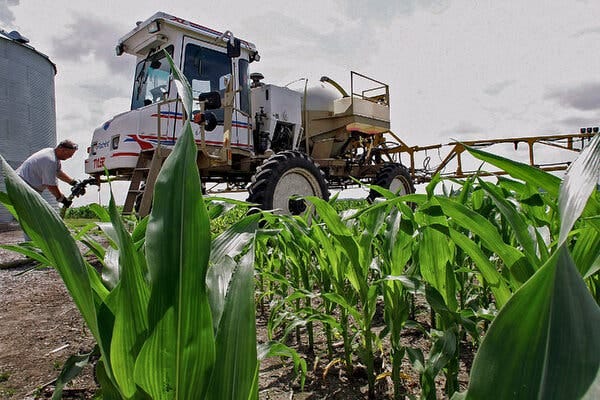
Formulated to be paired with genetically modified seeds, the pesticide allows GMO crops to grow unimpeded while killing most weeds. It has become the best-selling weedkiller in the world and a cornerstone of American food production.
The American Farm Bureau Federation said in a filing with the Supreme Court that glyphosate, Roundup’s active ingredient, was used on roughly 300 million acres of farmland growing cotton, soybeans, sugar beets and more. It warned that without glyphosate, food yields would “drop precipitously.”
But a growing body of evidence in lab animals, and more limited evidence in humans, has indicated a link to cancer, including non-Hodgkin lymphoma, as well as harm to biodiversity. In 2015, the World Health Organization’s International Agency for Research on Cancer found that the herbicide was “probably carcinogenic.”
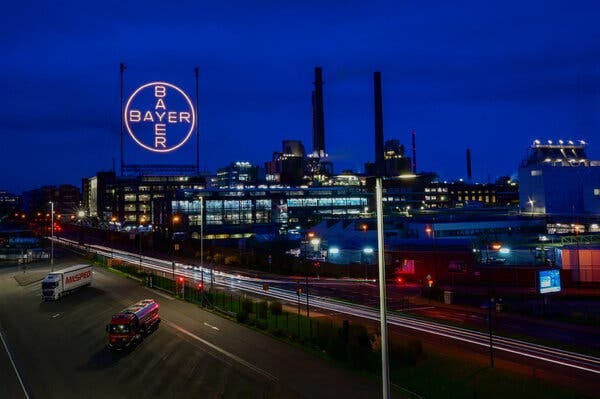
The Bayer headquarters in Leverkusen, Germany. The conglomerate acquired Monsanto in 2018.Credit…Ina Fassbender/Agence France-Presse — Getty Images
Still, the Environmental Protection Agency does not classify glyphosate as a carcinogen and has repeatedly approved Roundup’s product labeling, which doesn’t carry a cancer warning. A handful of states, however, set stricter rules on how and where Roundup is used, and California has challenged federal labeling standards.
Against that backdrop, thousands of lawsuits, farm workers, landscapers, home gardeners and others have argued that, under state laws, Bayer should have notified consumers of potential cancer risks by affixing warning labels to Roundup bottles and drums. Bayer has paid out more than $10 billion to settle approximately 100,000 Roundup claims, and faces thousands more.
Bayer has countered that because the E.P.A. does not classify glyphosate as a carcinogen, and has repeatedly approved Roundup’s label without a cancer warning, it would not be feasible for the company to add one. Federal pesticide policies pre-empt any state-imposed obligations to warn consumers of cancer risks, Bayer has argued.
For years, courts ruled against Monsanto, asserting that the E.P.A.’s approval is just a “minimum standard” and does not stop states from requiring additional protections.
But in 2024, a federal court in Pennsylvania ruled differently, saying that for Bayer to satisfy the state law, it would have to do something that federal law literally does not allow it to do. The company now argues that there is a split among courts that only the nation’s highest court can resolve.
The case that Bayer has petitioned the Supreme Court take on to resolve the situation is Monsanto Co. v. Durnell, No. 24-1068, brought by John Durnell, a resident of St. Louis and an avid gardener who used Roundup for decades. Mr. Durnell eventually received a diagnosis of non-Hodgkin lymphoma and sued Monsanto in 2019, alleging that his illness was a direct result of chronic exposure to Roundup and that Monsanto had failed to warn of the cancer risks.
Monsanto had said that it should not be sued for failing to warn because federal law does not allow it to.
Lawrence S. Ebner, a prominent lawyer with the Atlantic Legal Foundation, a public interest law firm backed by conservative funders and a leading advocate for Bayer, has called the current wave of Roundup lawsuits a “product liability bonanza” driven by trial lawyers. In the foundation’s amicus brief to the court, it argues that “lay jurors” should not decide scientific safety over E.P.A. experts.
“The most important fact is that the E.P.A. does not require a cancer warning,” he said. “Only the E.P.A. can regulate the content of pesticide labeling, and states cannot impose their own different or additional requirements for labeling,” Mr. Ebner said. “This not only affects thousands of pending Roundup cases, but other cases involving pesticides.”
The case could pit some major players in the Trump orbit against each other.
As a young lawyer, Associate Justice Clarence Thomas spent nearly three years working for Monsanto, his only experience in the private sector. Later, as a Senate aide, Mr. Thomas lobbied his boss on behalf of corporate interests, including those of Monsanto, the legal scholar Scott W. Stern wrote in a 2022 paper.
At the same time, Associate Justice Thomas has expressed skepticism of the pre-emption defenses that Monsanto had asserted.
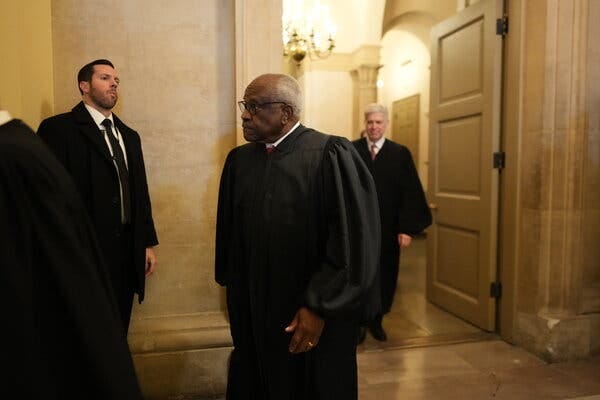
As a young lawyer, Associate Justice Clarence Thomas spent nearly three years working for Monsanto, his only experience in the private sector.Credit…Doug Mills/The New York Times
Then there is Mr. Kennedy, who for decades assailed glyphosate as a threat to the soil and water, and who worked closely with the lead law firm handling lawsuits on behalf of people who became ill after glyphosate exposure.
Representative Thomas Massie, a libertarian-leaning lawmaker from Kentucky, asked Thursday, on social media: Why has the Department of Justice, under Attorney General Pam Bondi, “sided” with the German company Bayer?
The timing of the case is particularly significant. Last month, a scientific journal retracted a widely cited paper that had reviewed available evidence and declared glyphosate safe. The journal pointed to email messages, made public in connection with litigation, that appeared to show that Monsanto scientists had guided the research.
George Kimbrell, an executive director at the Center for Food Safety, a health advocacy group, said the retraction had added to concerns that the E.P.A.’s conclusions were based on manipulated science and should not be used as a legal shield. The Environmental Protection Agency still considers the herbicide to be safe. But the federal government faces a deadline in 2026 to re-examine the safety of glyphosate.
“It’s important that there be other ways to regulate these products, other than all of us risking irreparable harm to our health and to the environment on E.P.A. determinations,” Mr. Kimbrell said.
R. Brent Wisner, a plaintiff lawyer who played a key role in bringing the emails to light, said litigation was also important because it helped expose vital internal evidence and corporate influence on science that might otherwise remain hidden.
But if the Supreme Court were to take up the current case, and rule in favor of Bayer, it could lead to the dismissal of many of the tens of thousands of active Roundup cases.
It would make pesticide manufacturers “a special class of corporations in our society that receive special treatment,” Mr. Wisner said.
Republicans in Congress, meanwhile, have vowed to bring back a measure to shield Bayer in the 2026 Farm Bill, and industry groups have successfully lobbied for immunity laws in states such as North Dakota and Georgia.
Leslie A. Brueckner, an appellate attorney and expert on federal pre-emption, said the Supreme Court’s decision loomed large for the tort system overall; whether it could continue to play an overarching role in protecting the public from hazardous products, because regulatory approval could sometimes be based on limited science.
“It’s just incredibly important,” Ms. Brueckner said. “The stakes are very high.”