Waterkeeper Alliance points out yet more issues with the Farm Bill and Trump’s Executive Order on glyphosate.
Waterkeeper Alliance points out yet more issues with the Farm Bill and Trump’s Executive Order on glyphosate.
The new issues are in italics below. Thankful that more lawyers are opining as the markup (horse-trading) for the Farm Bill provisions begins on Monday at 1 pm.

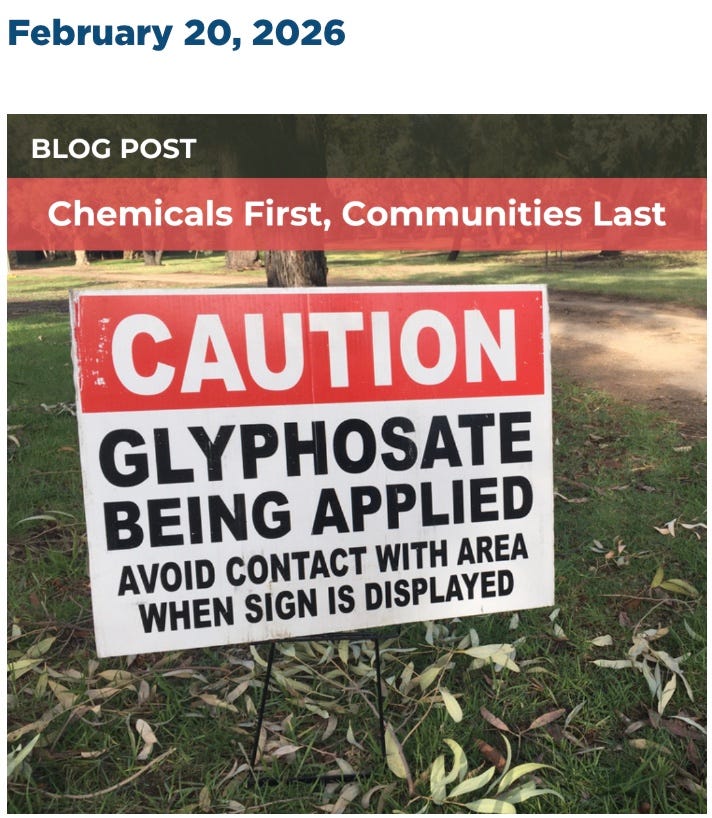
On Wednesday, President Trump signed an executive order titled Promoting the National Defense by Ensuring an Adequate Supply of Elemental Phosphorus and Glyphosate-Based Herbicides. Using the Defense Production Act, the order declares glyphosate and elemental phosphorus “critical” to national security and U.S. agriculture.
At first glance, this may sound like a supply chain measure. But in reality, it puts chemical industry profits above public health and clean water.
Why President Trump’s Executive Order on Glyphosate is Dangerous
Instead of addressing decades of independent research by experts linking glyphosate — a widely used herbicide — to cancer, liver damage, endocrine disruption, and other serious health effects, the executive order pushes for more production.
Glyphosate and other pesticides already pollute our water. Studies have shown these toxic chemicals are widespread in streams and rivers. Despite this, the executive order doubles down, prioritizing the chemical industry’s interests over community safety.
Even more alarming, the order grants legal immunity to chemical producers following federal directives. Communities harmed by contamination could find it even harder to hold chemical companies accountable. And, the U.S. Department of Agriculture (USDA) is now directed to prioritize chemical production even if it increases exposure risks.
The 2026 Farm Bill Further Compounds the Threat to Clean Water and Public Health
The Farm Bill is supposed to protect farmers, land, and water — but the U.S. House Agriculture Committee’s February 2026 draft (H.R. 7567) includes provisions that roll back critical protections, including:
-
Permanently removing dozens of hazardous pesticides used in industrial agriculture from important health and environmental safety reviews required under federal law.
-
Weakening protections for children, farmworkers, and the public by giving USDA new power to second-guess or block EPA health and environmental safeguards.
-
Delaying or weakening protections for endangered species by allowing an internal government workgroup to slow down efforts to address pesticide harm to wildlife.
-
Delaying safety reviews of hundreds of pesticides until 2031, meaning potentially harmful chemicals could stay on the market for years without updated protections.
-
Removing long-standing Clean Water Act protections that limit pesticide pollution in rivers, lakes, and streams. Its broad language could also weaken other major environmental laws.
-
Weakening Clean Water Act protections against toxic fire retardant chemicals being sprayed into waterways, putting water quality, fish and wildlife, and public health at risk.
Combined these measures protect chemical industry profits while leaving communities exposed. Chemical companies could avoid legal accountability even when pesticides poison water or damage crops, and local governments could lose the power to impose stronger restrictions.
These policies don’t just fail to protect water and public health—they actively put millions at risk from harmful pesticides and other toxins, making us all less safe.
We call on Congress and the public to:
-
Oppose liability protections that shield chemical companies.
-
Strengthen, not weaken, Clean Water Act protections.
-
Support federal action that reduces harmful toxic contamination rather than increasing its production, including safer alternatives and rigorous scientific review.
Everyone deserves reliable access to clean water and air. Families, children, farmers, and communities should not pay the price for policies that prioritize the interests of chemical companies over our health.
Call your member of Congress today and demand they oppose these harmful provisions in the Farm Bill and President Trump’s Glyphosate EO.