The ugly story of the multi-pronged Pesticide Liability Shield.
The ugly story of the multi-pronged Pesticide Liability Shield.
I’ve updated a post I wrote in the fall, and appended the contact information for all the members of the House Agriculture Committee.

Bayer bought Monsanto in 2018 for $63 billion dollars—a few months before Monsanto lost its first liability case for causing non-Hodgkins lymphoma. I was not a close observer of the case, but the win seemed to hinge on documents obtained during discovery that revealed Monsanto knew a great deal about the injuries its product caused but deliberately hid those findings. Not only that, but Monsanto had secretly ghostwritten academic papers that supposedly proved the product was safe. And the EPA had approved the label for glyphosate-containing products by relying on Monsanto’s phony science. This too had come out during the trial—but EPA has never since budged on asking Monsanto for a new, more accurate label.
Once there was a win—and the jury awarded the initial winning plaintiff with non-Hodgkin’s lymphoma $hundreds of millions, later reduced to about $21 million—the bandwagon effect began, with other lawyers seeking plaintiffs to sue Monsanto. Eventually about 200,000 plaintiffs were suing Monsanto/Bayer for cancers related to glyphosate, the so-called active ingredient in Roundup. There are other ingredients in various Roundup products that are probably toxic too, but they were not at issue. Most plaintiffs were homeowners. Bayer then removed glyphosate from Roundup, producing new formulations for homeowners. Farmers could still access glyphosate-containing products, for use with GMO seeds that were glyphosate-resistant.
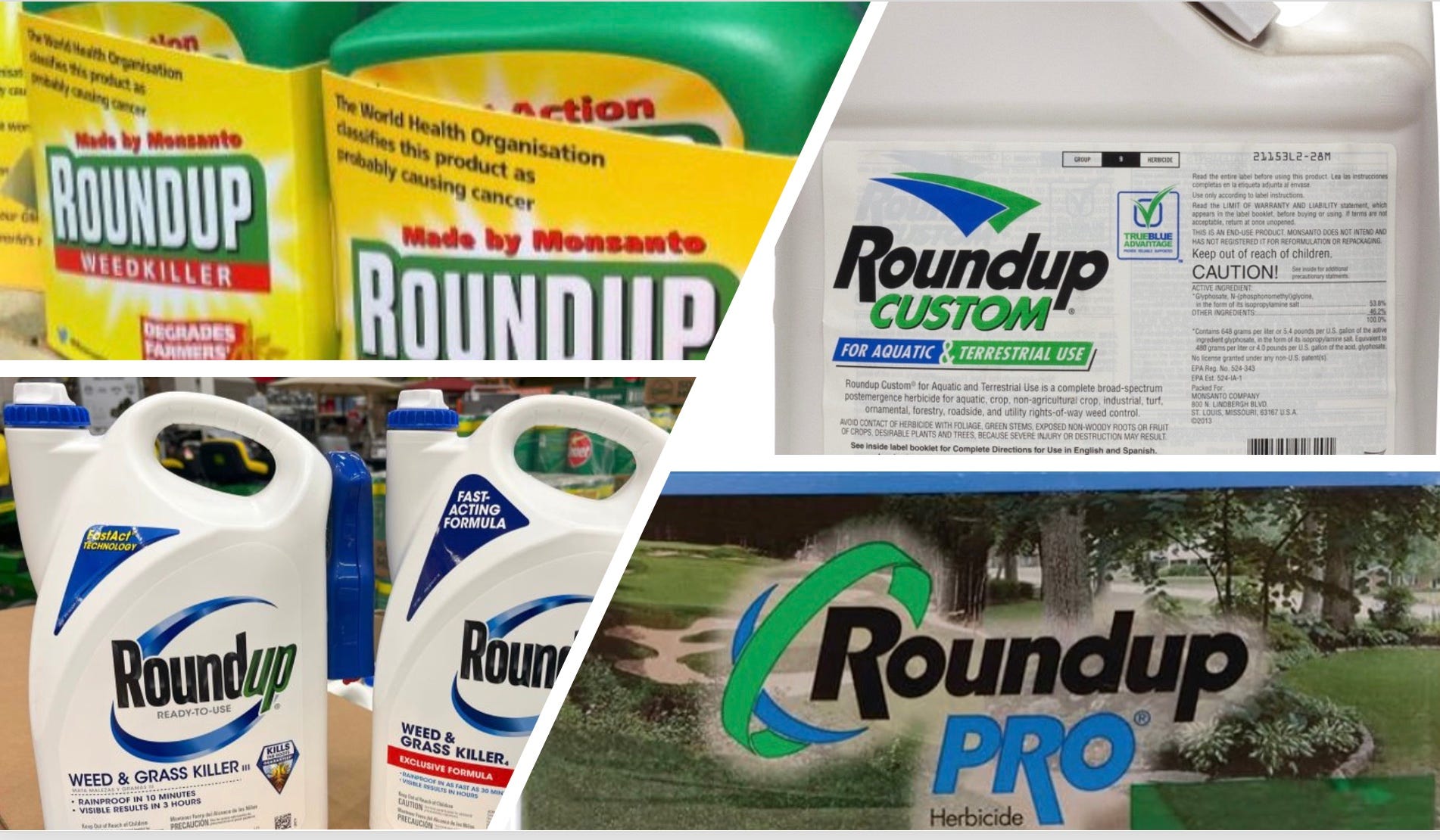
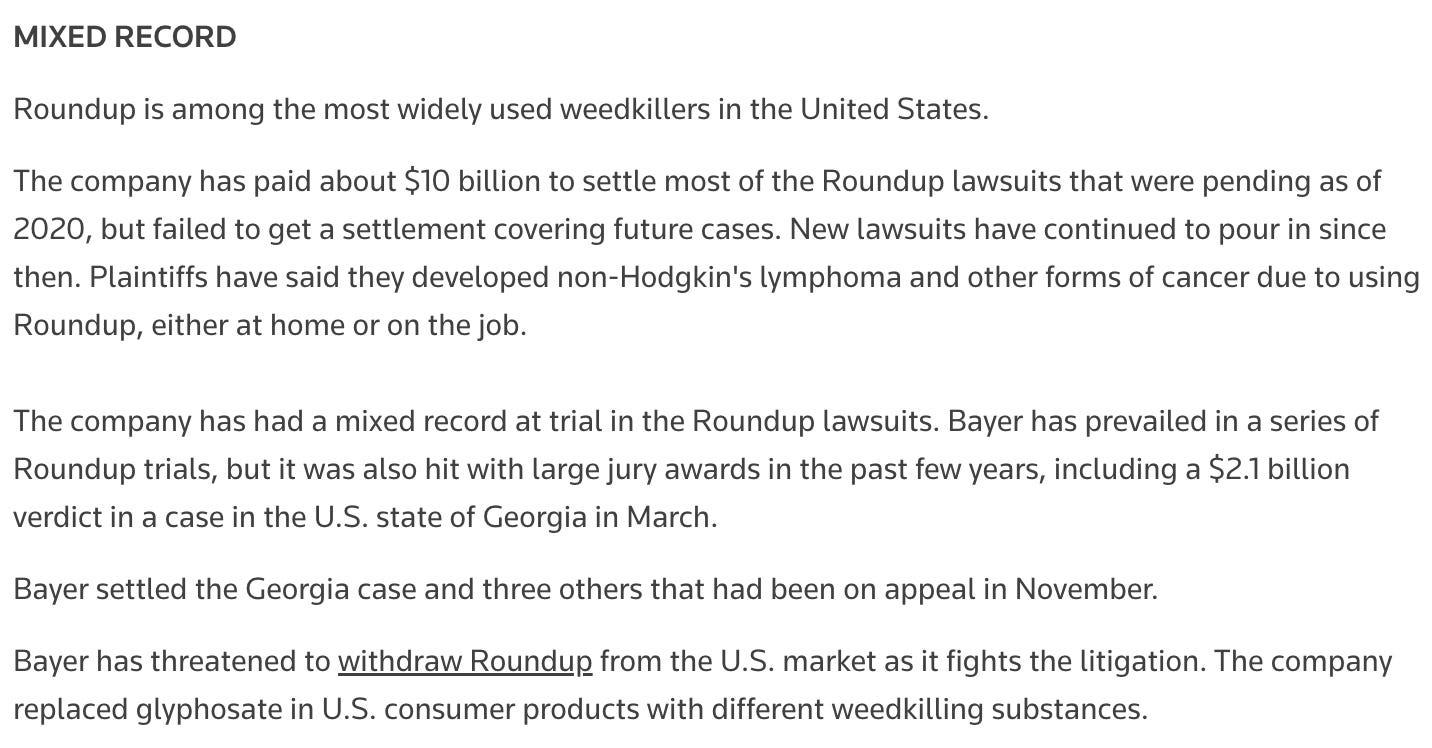
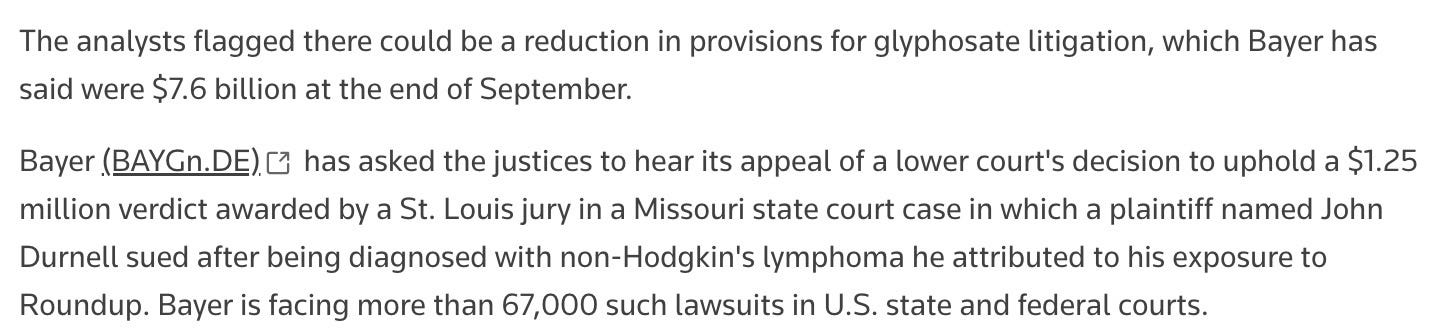
Still, there were more and more cases and more and more wins in state courts due to Monsanto/Bayer’s failure to warn of a cancer risk. The plaintiffs won about a dozen cases, and Monsanto/Bayer won about the same amount. Then Monsanto settled about 100,000 of the cases. And in late February it offered $7 Billion to settle the rest, about 67,000.
The settlements and the big losses had cost Bayer about $11 billion by December 1. Then this happened:
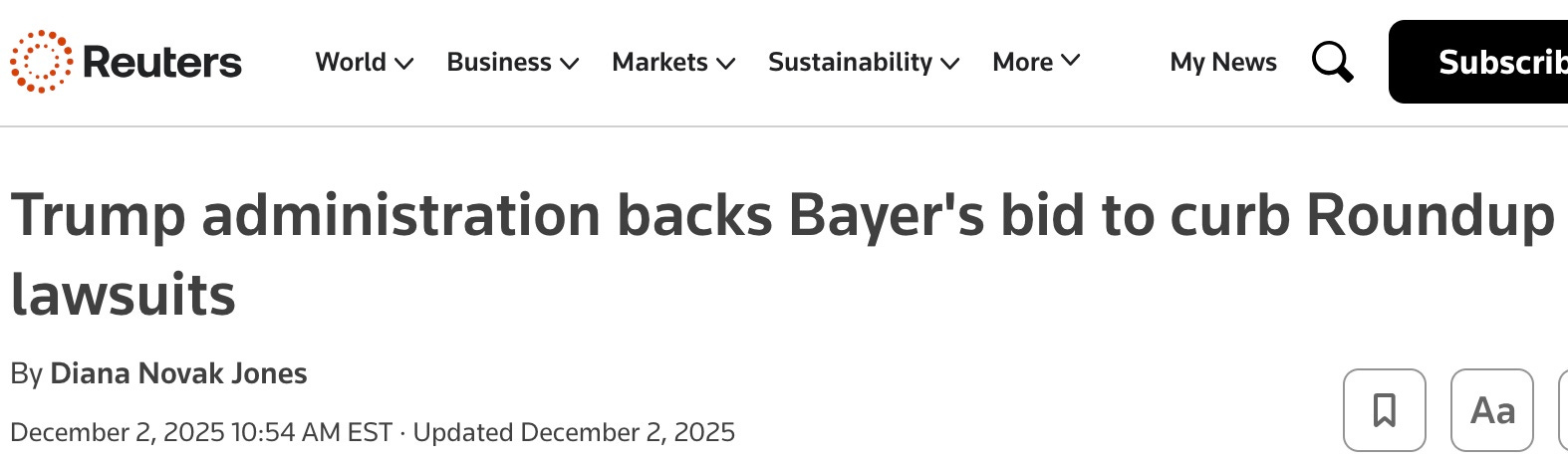
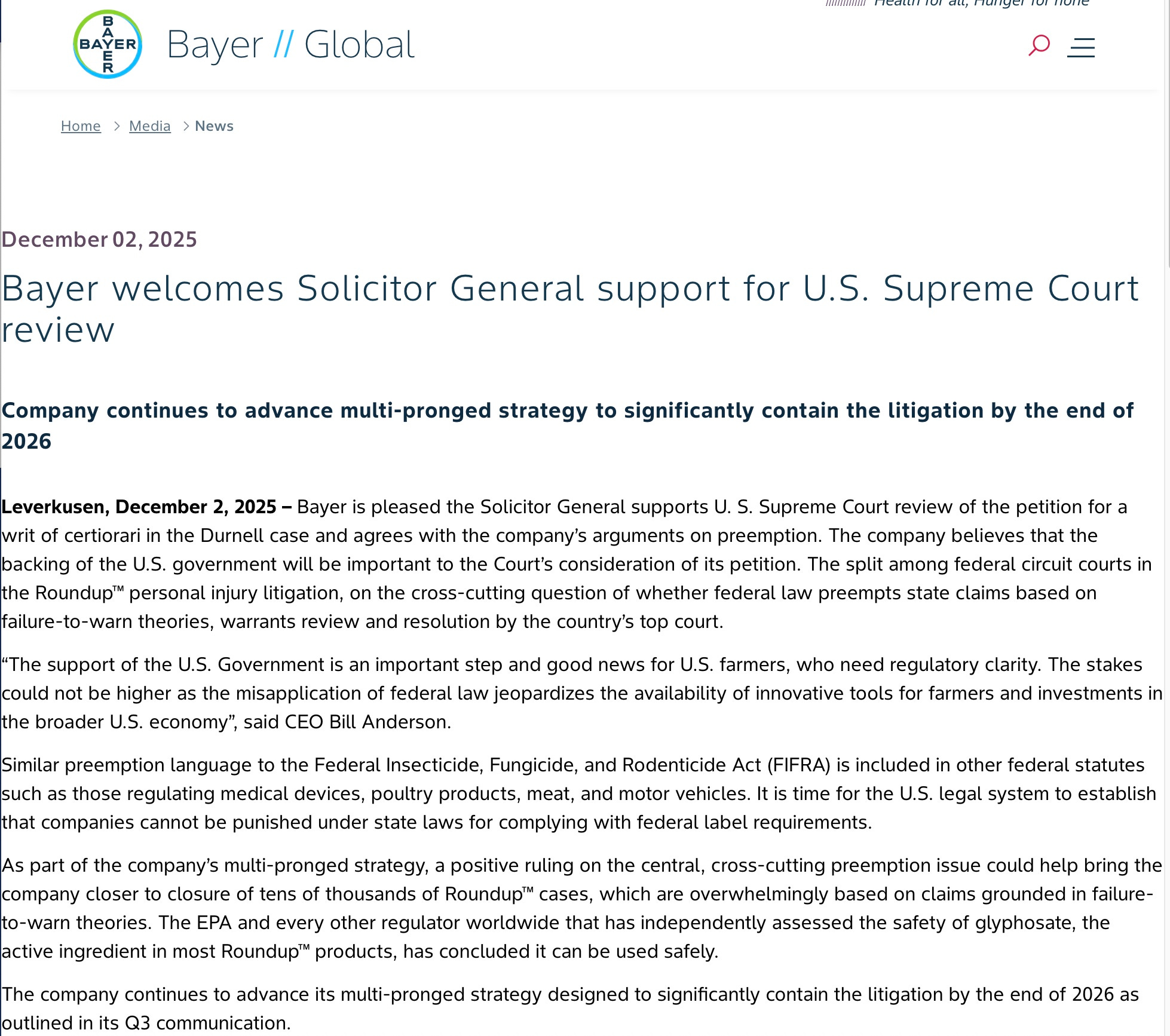
The Trump DOJ filed an amicus with the Supreme Court, asking it to take a case that Monsanto had lost in 2 lower courts, titled Monsanto v. Durnell. The amicus also asked the Supreme Court to rule in Monsanto’s favor.
Not only did Bayer pay out a King’s ransom, but its stock price tanked. Desperate times call for desperate measures. Bayer, a German company, hired a Texan, Bill Anderson, as CEO to come to its aid. CEO Anderson’s career hinged on stanching Bayer’s bleed. He initiated a very expensive series of legal and political strategies in the hopes that one would be successful. He also formed a new agricultural industry lobby group with a huge advertising budget.
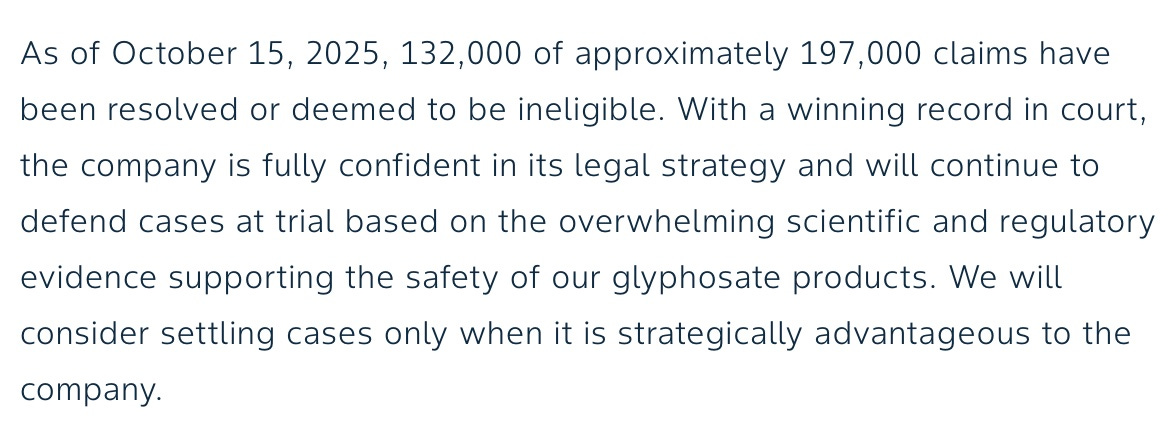
12/15 Addendum from Bayer’s website:
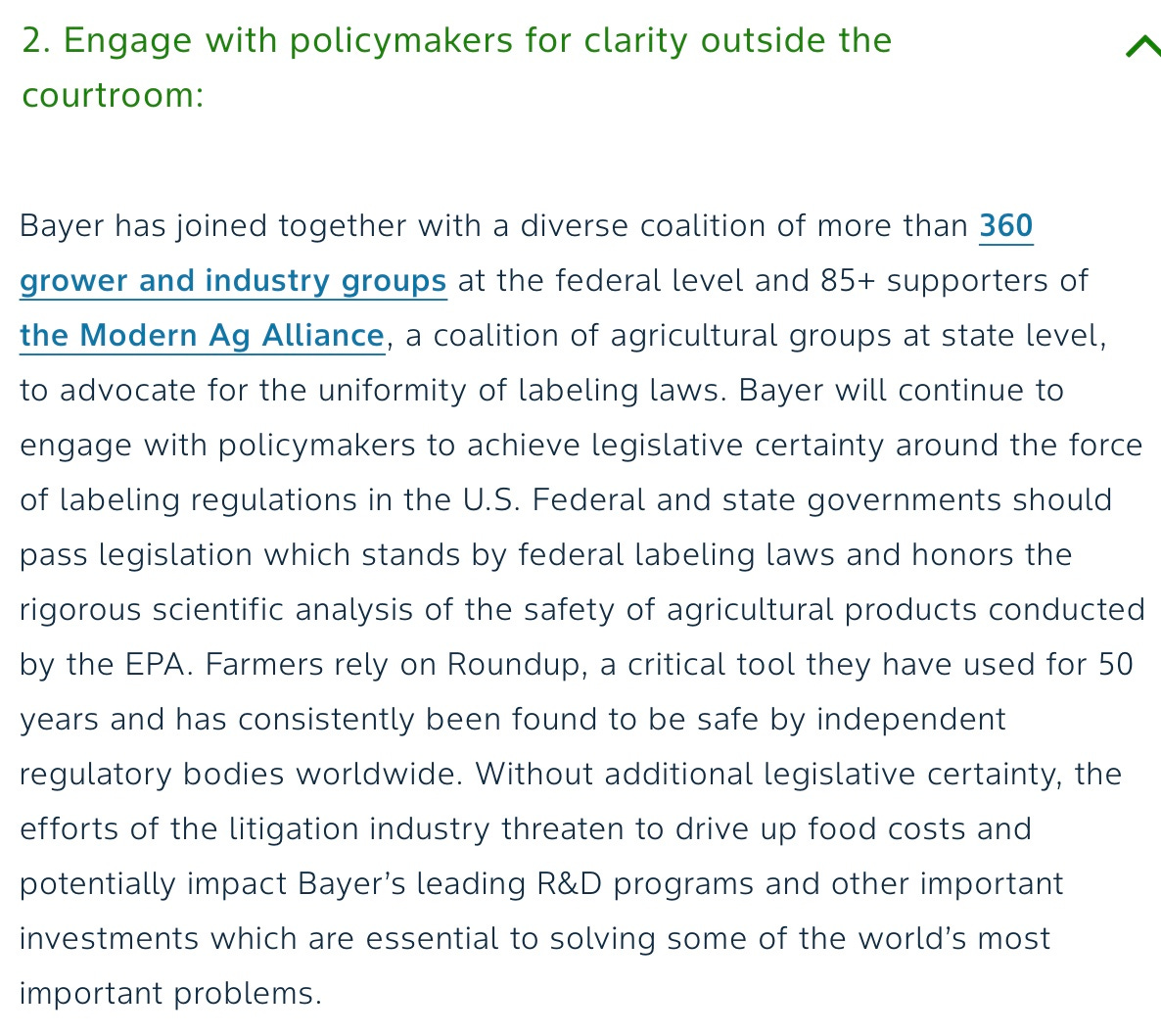
CEO Anderson got the Bayer board to agree to setting aside around $17 Billion for this problem. With $11 Billion already spent on settlements and legal losses, plus lobbying, plus creating the Modern Ag Alliance to fight for liability protection for all pesticides, it did not leave Bayer enough to deal with the 67,000 pending cases and to end the litigation for good. Anderson asked for another $billion plus from the company, and received it.
I discussed the six different tracks Anderson pursued to make this problem go away in this piece. One of those tracks was getting Congress to pass a bill rider that would provide a liability shield by forbidding the EPA from making label changes unless a tedious, years-long process had been undertaken.
The bill rider got a lot of pushback from my readers and many other constitutents during July-September 2025, when it passed the EPA’s Appropriations committee on a voice vote, thereby shielding individual members from having to own up to their vote. Apparently it was not going to go through the whole House easily (lots of political capital would have been expended by every member voting for it) and so it was quietly removed from the Appropriations bill in January. There was no companion bill in the Senate, another clue that Congressmembers did not want their fingerprints on this obvious giveaway to Big Pesticide and Bayer at the expense of citizens.
But we knew it would come around again in another piece of legislation, the Farm Bill, and sure enough it did, 2 weeks ago. In this new iteration, the protection for pesticides was even more expansive and the language more clear than in the Appropriations bill. As drafted (probably by Bayer’s lawyers) it explicitly prohibited courts from considering any information besides what was on the pesticide label, and it explicitly prohibited states, counties and towns from imposing restrictions on pesticide uses! So no entity would be allowed to, for example, restrict spraying any pesticides near a school or daycare center—no matter how dangerous the product was, even when acknowledged on the label!
The five other tracks included:
-
This request to the Supreme Court to rule on the issue, which failed to gain a Supreme Court hearing in 2022, was filed again early last April, accepted by the Court in January 2026, and oral arguments will be heard on April 27, 2026. The docket for the case can be accessed here.
-
Bills in about 20 state legislatures that would end state causes of action for pesticide injuries, which passed in GA and ND, failed in TN and many other states, and have not been decided in other states
-
Threats by Bayer to take glyphosate off the market, which would allegedly harm the agriculture industry, even though there are generic versions of glyphosate available, and woould allegedly raise food prices drastically. This track was accompanied by a big publicity campaign by the Modern Ag Alliance.
-
Assertions by Bayer that it was developing 5 newer pesticides and would simply replace glyphosate with something better (and potentially more dangerous). If it kept swapping out pesticides as their harms became known, it could avoid having new label warnings placed on them as the harms became known, which often takes many years.
-
Bayer hinted it could spin off part of the company, leaving all the liability in an underfunded spin-off that would not be able to pay claims.
Remember, Bayer has a very fat bank account. Both Bayer and Monsanto are famous for sleazy corporate dealings and extremely serious product safety concerns. Bayer’s parent, IG Farben, even manufactured the Zyklon B gas used in concentration camps during World War 2 to kill millions, and used about 150,000 slave laborers. That’s how you make a real profit!
If the Supreme Court judges do what was asked of them by the U.S. Solicitor General, all pesticides will receive a de facto liability shield–because the “failure to warn” of potential injuries on pesticide labels will no longer be an argument that can win a case. The same will be true if the Farm Bill’s pesticide section is approved by Congress. Labels (EPA-approved) will be assumed to be the final word on the subject of risk. This is the argument Bayer is making.
EPA has failed to update its safety reviews for pesticides every 15 years as required by law, and the proposed Farm Bill will do away with that requirement.
However, if the Supreme Court made a decision in favor of Bayer, it would seem to conform to the Chevron Doctrine, which the Supreme Court overturned 18 months ago. Chevron was a 40 year old Supreme Court instruction to lower courts to not litigate questions that federal agencies had answered—instead, they should always give deference to the agency interpretation. Hopefully, with the overturning of Chevron in 2024, the Court will recognize that it should NOT give agencies deference and instead allow controversies of science, medicine or fact to be litigated in our courts.
So it is not clear what will happen, but there is a reasonable chance the court will take the case, and if so, rule in Bayer’s favor.
Bayer’s share price rose 16% in the 10 days immediately after the Solicitor General’s amicus brief was filed.
If you would like to see Bayer gloating about the Solicitor General’s brief, read on. I just wonder what it cost them.
But that wasn’t bad enough. Twelve days ago President Trump issued an Executive Order (E.O.), which has the force of law unless and until it is overturned by a future President. The E.O. singled out glyphosate as necessary for the national defense. And it provided unspecified, but potentially very broad immunity to glyphosate (but not other pesticides).
The E.O. furthermore signals to the Congress and the Supreme Court what the President wants them to do with respect to glyphosate.
What can we do about all this?
-
We need to put the Trump administration’s feet to the fire on this, get publicity, and make their choice very costly to them in terms of political capital
-
The Court needs to learn how the Solicitor General’s brief “misspoke” about the IARC’s conclusion regarding possible vs probable danger of the carcinogenicity of glyphosate. I have asked associates to weigh in on this. It’s not exactly a fraud on the court, but it has a strong whiff of deceit, which the justices won’t like. Note that the press release on Bayer’s website that I provided above also carefully misrepresents or omits the conclusion of the WHO’s IARC that glyphosate is a probable carcinogen, by limiting its claim to regulators, while IARC is solely an advisory body—THE advisory body for the WHO/UN and the nations who don’t have their own regulatory bodies.
-
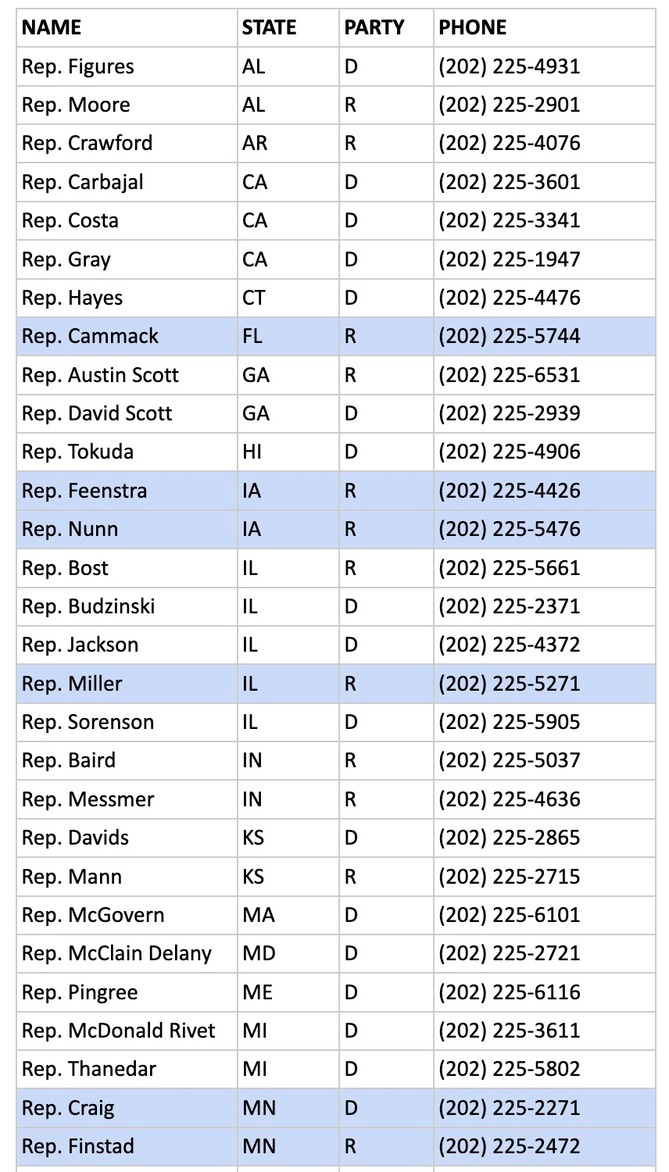
Please consider making another call, or many, to the members of the Agriculture Committee. Consider telling them you feel betrayed by Trump’s pledge to Make American Healthy again—and now this. Calling right before they vote, which will almost certainly be later this week, since they won’t have time to go over the entire bill tomorrow night, is the most effective time to make a difference.
We have identified the most critical members (those most likely to vote against their party line and vote against the liability shield) if there is enough pressure on them. The Democrats also need to be called, because if there is no recorded vote, they may hop over and support the liability shield.
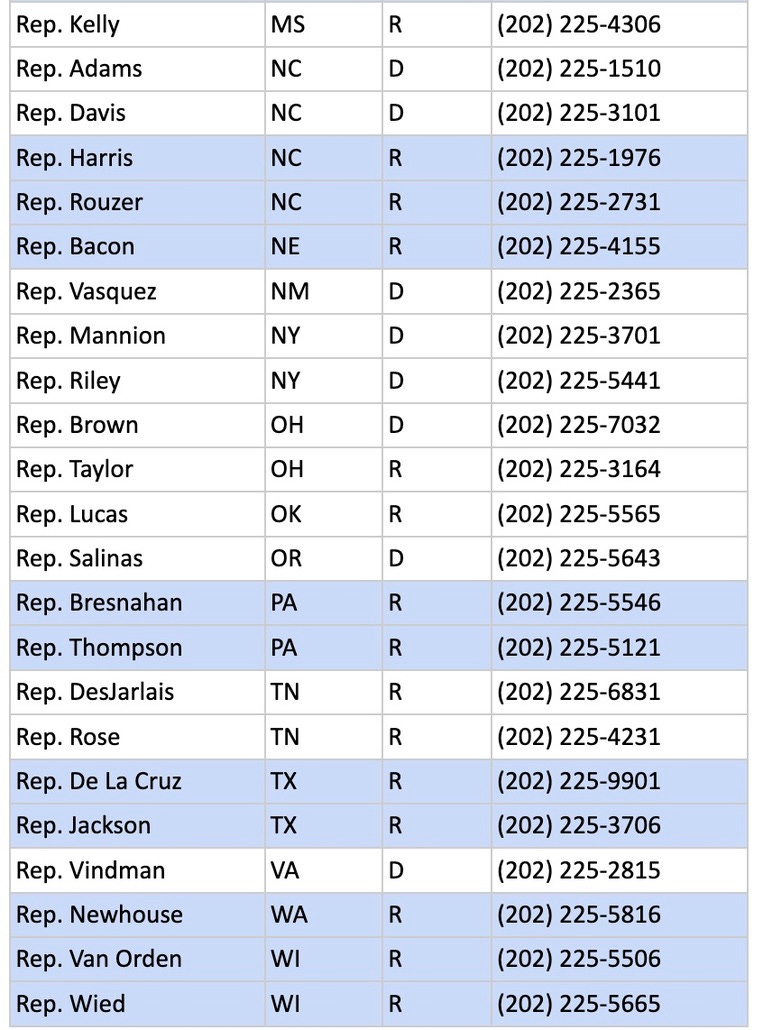
-
Tell them no immunity for pesticides.
-
No federal preemption of the right of states and towns to make stricter pesticide rules.
-
And to hold a recorded vote.
Thank you again to everyone. Chin up! Don’t let bad people and bad events make you miserable. Fight back! It makes you feel better, at least it does for me.
You can watch the markup here at 5 pm ET March 3, Tuesday.