Have not been posting while I tried to make sense of the trajectory of the war on Iran
Have not been posting while I tried to make sense of the trajectory of the war on Iran
And the Ukraine war, since they are both part of the same effort to weaken Russia, grab its resources, and thereby weaken China as well–2 proxy wars that instead have weakened us

Although Trump threatened Iran over the last couple of days with fire and brimstone and an attack on Pickaxe Mountain, after the Israelis “leaked” the fact that Iran keeps its uranium centrifuges buried under it, the US press has published very little info on what we actually struck. And the Israeli leak is likely incorrect. From today’s NYT:
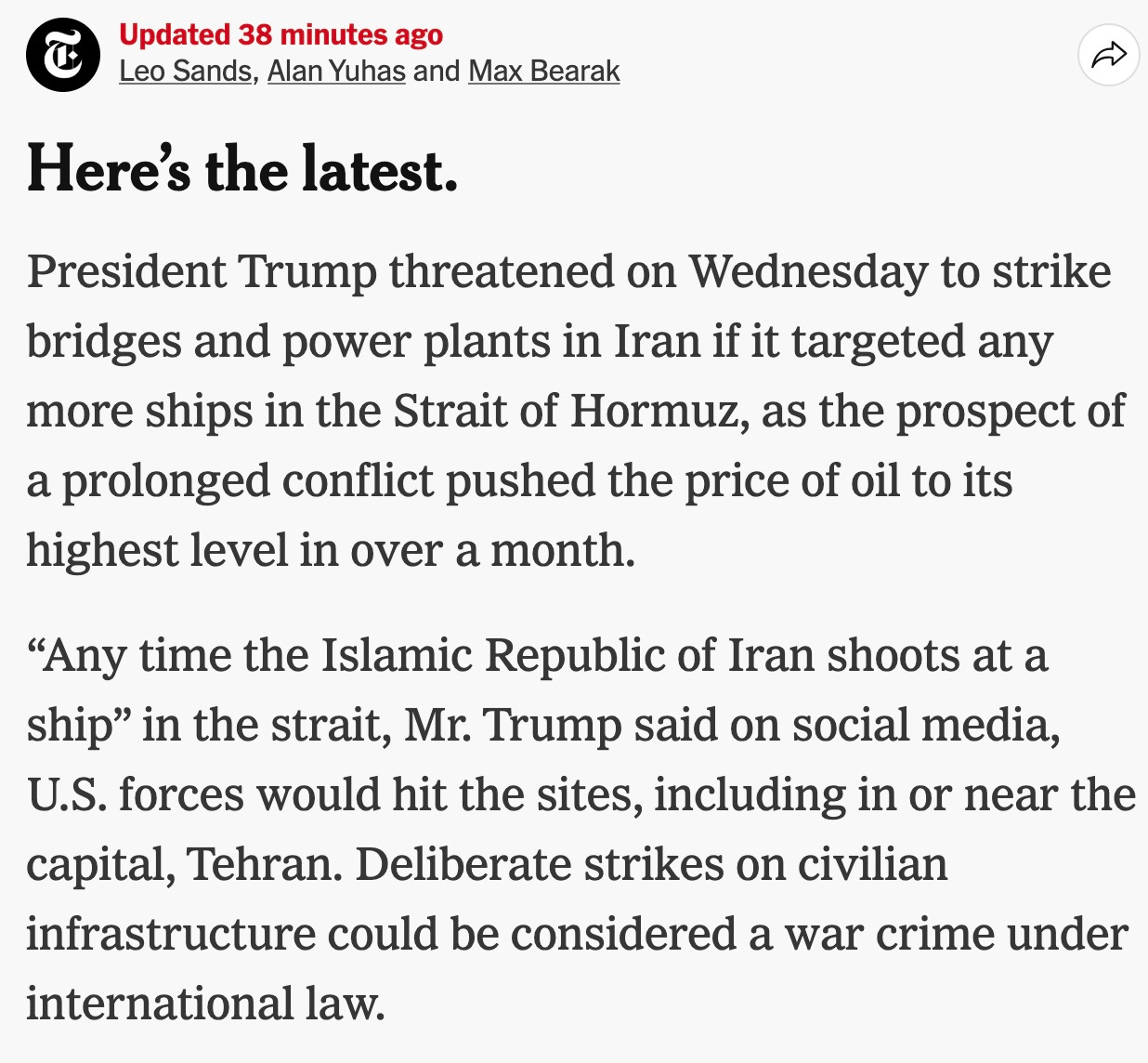
Glad the Times has finally begun acknowledging that our attacks on Iran’s civilian infrastructure, schools and hospitals are war crimes. Funny that Trump is threatening to hit a bridge, when we hit six on the night of July 16th. It appears the Iranians are rebuilding their bridges and railways very fast, and also rebuilt their capacity to manufacture drones very rapidly. (It looked like our bombing of a railway bridge far from the Gulf, in Golestan, Iran’s northeast, was at least in part an effort to obliterate a land corridor between Iran and Russia and China, and reduce the flow of oil out of Iran by rail.)
As you know, Iran has been doing a “tit for tat” response on US bases in the region, and occasionally on civilian infrastructure like desalination plants in Gulf countries. The military barracks were struck on a US base in Jordan, killing and wounding dozens of US soldiers, only after the US struck a barracks in Bampur, Iran on July 15. Which ought to give our President some trepidation.
Iran also issued threats, one of which was that if its civilian energy infrastructure was hit, it would hit Israel. It has further warned that it would strike private US companies in the Gulf region, and did strike an Amazon facility this week. There are critical cables traversing the Strait of Hormuz that could also be a ripe target.
There has been a great deal of feigned surprise that Iran’s missiles just keep getting better: faster (Iran has moved to using supersonic and hypersonic missiles) and they are targetable as they descend, some even releasing multiple independently targeted vehicles—making some difficult and others completely impossible to conterract. Not only that, but the targeting and identification of targets is said to be very impressive—missiles are landing exactly where they can do the most damage, not somewhere close by.
But this should be no surprise: it has been known for some time that Iran used its cheapest, oldest and slowest missiles early in the war in order to use up our anti-missile missiles. Iran also used decoys, such as pictures of missile launchers, to provide worthless targets for US missiles, in order to further deplete our supplies of expensive armaments.
US supplies of missile interceptors are dwindling, and have been scavenged from other spots around the world. This affects US readiness in all other potential theaters. And it takes many years to replenish our stocks. The US defense industry was not built for speed but for profit.
The other big issue is that now Iran has every reason to develop its own nuclear weapons, and it has threatened to pull out of the nuclear non-proliferation treaty (NPT).
Article X of the NPT allows a state-party to withdraw “if it decides that extraordinary events, related to the subject matter of this Treaty, have jeopardized the supreme interests of its country.”
Therefore, even ignoring the public revulsion toward the war and the Congress’ queasiness about funding it, the US should have every reason to want to cut and run—that is, apart from what Israel or the Anglo-Zionists or the Great Resetters may want. These elites’ goal could be to weaken the US while weakening Russia, create a Depression that will weaken and reduce populations worldwide, and set the stage for their own global takeover attempt.
Get us hungry, then throw a pandemic or two at us, maybe send in a plague of locusts, make fertilizer too expensive for most farmers, and there you have it—a debt crisis like no other, requiring, of course, us to own nothing and be happy.
The Gulf states don’t want us endangering them even more. Saudi Arabia, Kuwait, Qatar, United Arab Emirates (UAE), and Bahrain have all refused to allow the US to use their airbases or airspace to launch military strikes against Iran. Nonetheless, they (but mostly our bases, located on their land) are still targets, until Iran finds better targets. Remember that Iran’s goal is to remove the US military entirely from the Middle East.
The new UK Prime Minister (same as the old boss) immediately allowed the US to launch bombers and tankers from the UK proper, in addition to using bases on Diego Garcia. We are also using bases in Romania, Bulgaria, and huge numbers of US planes have been relocated to Israel. The feud between Trump and Meloni, Italy’s PM, is primarily about her refusal to allow the US (which has a military base inside Italy’s Sigonella military base in Sicily, which is legally under Italy’s jurisdiction) to use it to stage attacks on Iran.
Then add the recent closure of the Bab el-Mandab strait in the Red Sea and you have real potential for chaos, if it lasts for long. As I said earlier this week, having to travel around Africa’s Cape of Good Hope instead of transiting the Suez Canal to reach Europe makes shipping between China and Europe tremendously more expensive. Google’s AI says it adds 10-14 days to a trip between China and the UK, and adds $1,500-2,000 to the shipping cost for each container.
So Saudi Arabia can still sell oil from its pipeline on the Red Sea to Asia, if the oil travels north through the Suez Canal into the Mediterranean and then all the way around Africa; but there will presumably be reduced demand due to the much higher transportation cost.
US oil companies will benefit from the blockaded straits, especially since US targeting data and possibly missiles allowed Ukraine to lob weapons into Russia’s interior, recently damaging all its major oil refineries and other energy infrastructure. The next 2 paragraphs and 4 lists of bullet points come from Google Gemini AI:
Ukraine’s deep-strike campaign against Russian hydrocarbon assets has focused heavily on refineries, export terminals, storage depots, and pipeline infrastructure across western Russia and into Siberia.
By targeting primary processing units—particularly Crude Distillation Units (CDUs)—and major storage networks, the strategy aims to restrict military fuel supply, force domestic fuel rationing, and reduce Moscow’s energy revenues.
Primary Target Categories
1. Major Oil Refineries
Ukraine has hit all 11 of Russia’s largest oil refineries using long-range strike drones:
-
Omsk Oil Refinery (Siberia): Russia’s largest refinery (~22 million metric tons/year capacity). Struck in deep-range attacks over 2,500 km from the Ukrainian border.
-
Kirishi (KINEF – Leningrad Region): Second largest refinery (~20 million tons/year).
-
Ryazan Oil Refinery: Crucial supplier for central Russia (~17.1 million tons/year); targeted repeatedly.
-
Kstovo (Lukoil – Nizhny Novgorod): Major hub for high-octane gasoline (~17 million tons/year).
-
Yaroslavl & Volgograd Refineries: Major regional processors; hit multiple times, damaging fractionating columns and distillation capacity.
-
Moscow Oil Refinery (Kapotnya): Processing suspended after extensive damage to key units.
-
Samara Region Cluster (Novokuibyshevsk, Syzran, Kuibyshev): Operations repeatedly halted or limited due to damage to AVT (crude distillation) units.
-
Southern Refineries (Tuapse, Slavyansk-na-Kubani, Krasnodar, Afipsky): Frequently targeted due to their proximity to Black Sea export channels and frontline logistics.
2. Export Terminals & Ports
-
Ust-Luga (Baltic Sea): Struck repeatedly, targeting gas/condensate processing facilities and fuel-loading terminals.
-
Novorossiysk & Port Kavkaz (Black Sea): Fuel loading terminals, transshipment points, and offshore bunkering vessels supplying military assets.
3. Storage Depots & Pumping Stations
-
Transneft Pumping Stations: Infrastructure along pipeline routes (including branches of the Druzhba pipeline) and regional distribution nodes (e.g., Perm).
-
Rosrezerv (State Reserve) Storage Facilities: Large tank farms storing diesel and aviation fuel directly designated for the military, including depots in Rostov, Voronezh, Belgorod, and the Moscow region.
Economic & Logistics Impact
-
Refining Bottlenecks: Rather than hitting easily replaceable storage tanks alone, strikes have increasingly targeted complex fractionating towers. Western sanctions on specialized refining equipment make these components difficult to replace.
-
Domestic Shortages: The loss of capacity has led to local motor fuel shortages and price spikes, particularly in occupied Crimea and southern Russian border regions.
-
Export Shifts: Russia has repeatedly been forced to restrict or ban refined fuel (gasoline/diesel) exports to prioritize internal military and civilian supply.
Back to Nass.
Do we think Russia is going to sit still for this? This is why it has been lobbing missiles into Kiev, although earlier in the “Special Military Operation” Russia carefully spared civilian infrastructure and cities outside its direct on-the-ground efforts. The Russian public have said enough is enough, throw everything we have at this war and win it—and Putin is now complying.
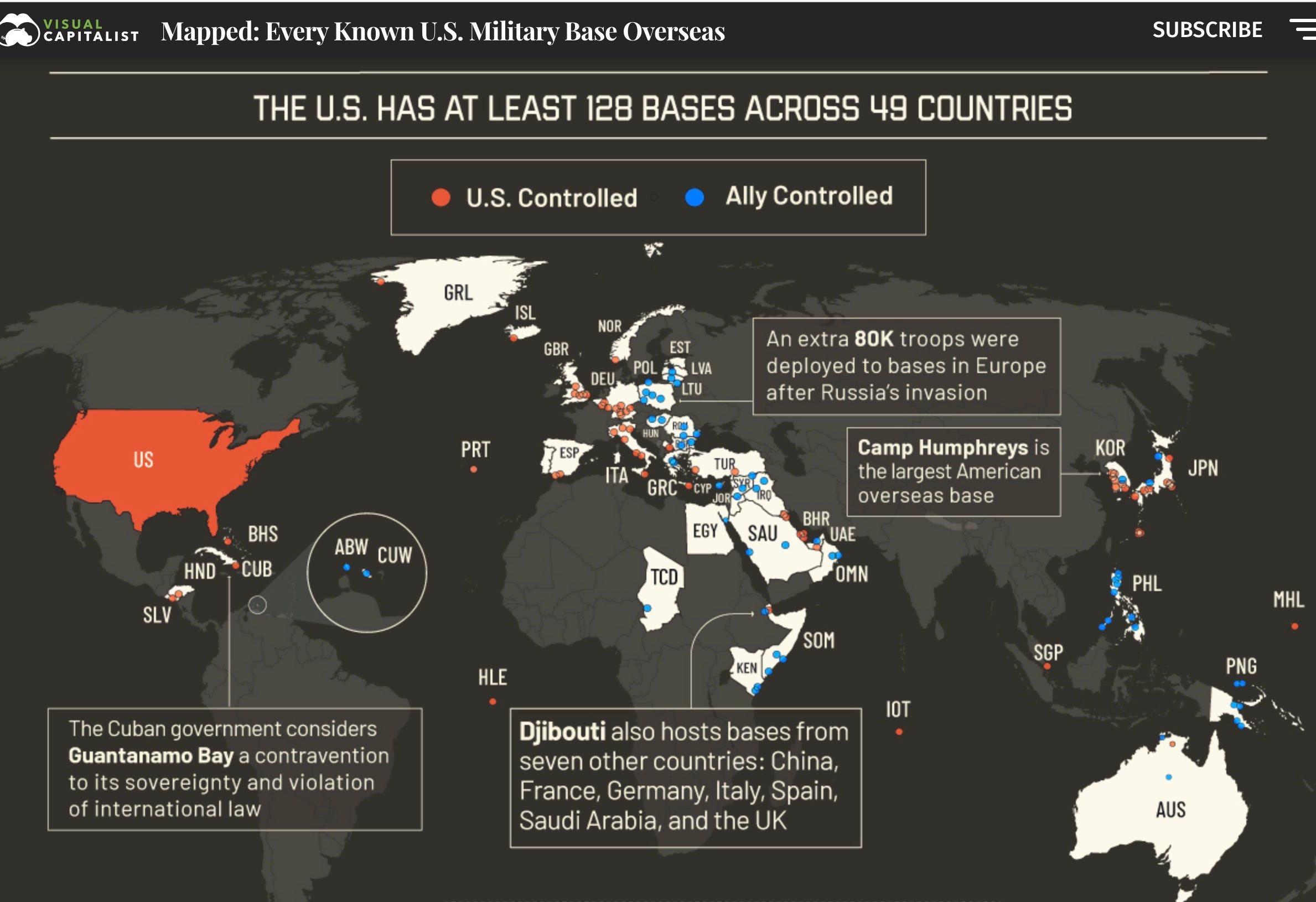
As our munitions could sink to dangerously low levels if the Iran war continues interminably, will Putin target the US proper? Or our bases around Russia’s perimeter? There are about 800 US bases on foreign territory that could be targeted.
https://www.visualcapitalist.com/mapped-every-known-u-s-military-base-overseas/
It seems obvious that if the goal is to make Americans safe and to not waste billions or trillions of taxpayer funds on unwinnable wars, we need to get out of the Iran war and stop attacking Russia proper through Ukraine.
But if the goal is to creat chaos, instability and a new world order, then we should keep these wars going, by all means necessary.
A few hours ago the House passed the 2027 National Defense Authorization Act. It included Section 219, which will merge the US and Israel’s military and intelligence operations. The vote was 219-206.
It has yet to get a Senate vote. It is an unconstitutional giveaway of sovereignty that tops anything that came before. It is hard to believe that “our” representatives, especially Republicans, who were once for small government, have done this to us.
Our Congress is bought. Our Executive Branch is obviously not working for the people. And the Supreme Court makes capricious decisions that are sometimes contradictory and very difficult to understand.
Our food, water and air are being poisoned. Our minds are being poisoned with incessant propaganda.
If we are to be saved, we will have to do it ourselves. Speaking up is the first step.