More on the Farming Crisis
More on the Farming Crisis

Another article on the dire crisis in farming.
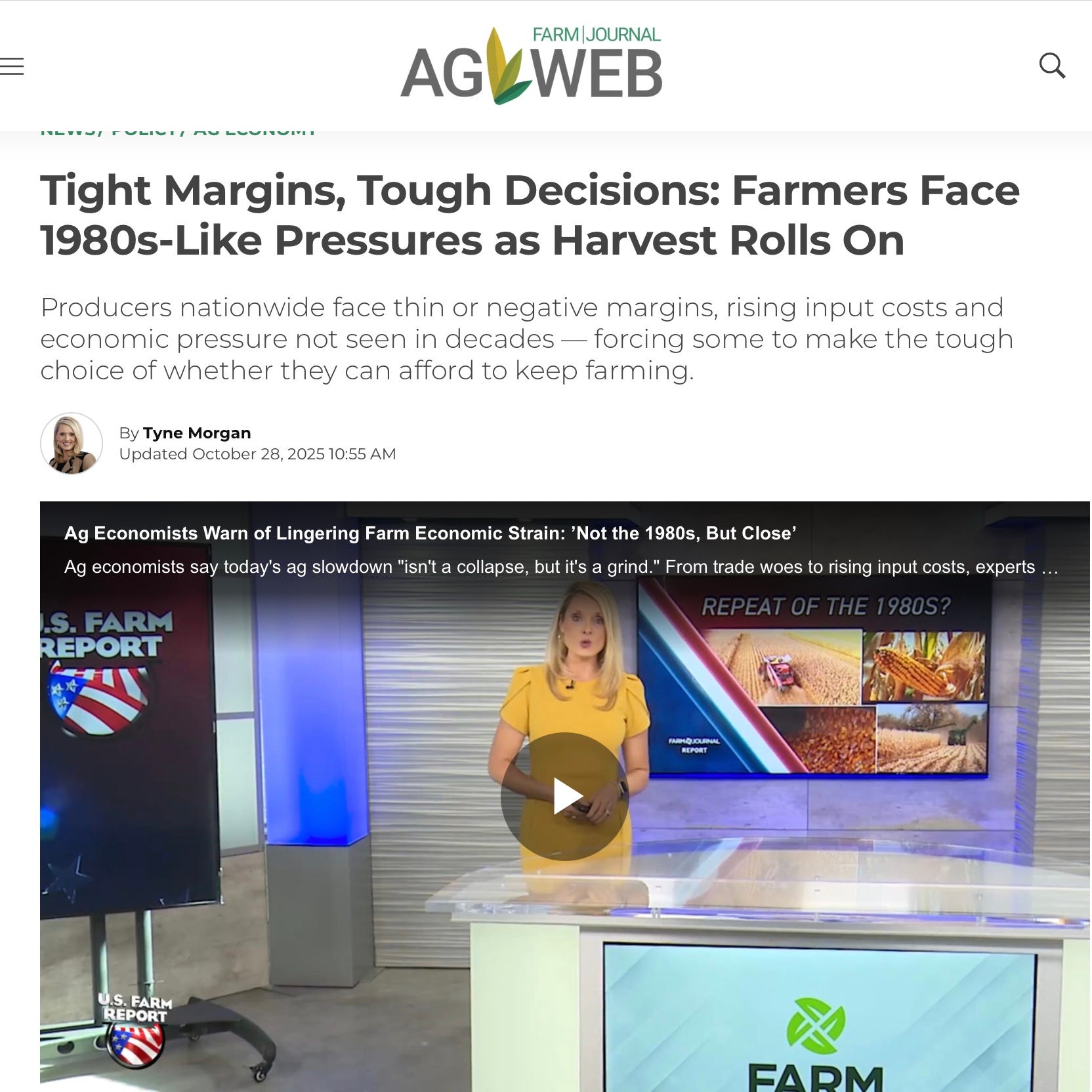
Peanut harvest is in full swing across the southeastern corner of Alabama. But as combines hum and dust fills the air, Jonathan Sanders says the mood in the field is far from upbeat.
“Commodity prices are always a challenge, but weather’s the biggest concern right now,” Sanders says. “We’ve been dry for a month, and it’s making harvest losses go up — it’s harder to get the peanuts out of the ground.”
Sanders has been farming for just over a decade.
“My first crop year was 2014 when I got out of college,” he says.
He’s the sixth or seventh generation on this farm — though he’s lost track of exactly which. With peanuts, cotton, corn, cattle, timber and small grains, diversity remains the operation’s lifeline. But this year, he says, margins are razor thin.
“Cotton seems to be producing negative returns,” Sanders says. “Peanuts are going to be right there at the mark, depending on yields.”
Costs Keep Climbing, Prices Stay Stuck
For Sanders, the biggest challenge this season isn’t just market volatility — it’s the relentless rise in input costs. And this isn’t a phenomenon that started in 2025. While many reports want to turn the situation into a political blame game, thin-to-negative margins have been a reality for southern farmers since 2021.
“Electricity and fuel are always high, but the cost of repairs has gone through the roof,” he says. “Parts that used to be $20 or $30 are now $70 or $80. Everything’s gone up, but crop prices haven’t.”
Government assistance programs may offer short-term relief, but Sanders insists they’re not the goal.
“It always helps, but that’s not the goal of any farmer,” he says. “The goal is to make a profit without government interference, but oftentimes government interference is what causes the commodity prices to be low.”
Despite all the pressures, quitting isn’t an option.
“It comes with a lot of pride, but a lot of determination to not fail also,” Sanders says. “You don’t want to be that generation that loses the farm.”
Economists Warn Cotton Losses Exceed $200 Per Acre
At Auburn University, agricultural economist Mykel Taylor says the numbers confirm what farmers already feel — cotton growers are deep in the red.
“Our Extension economists here at Auburn have put together some estimates of net returns above total costs, excluding land costs, and cotton is negative $236 an acre,” Taylor says. “And that means that if you’re paying rent, that’s even more.”
Taylor says farmers are draining their reserves to survive.
“I think so,” she says when asked whether some will be forced out. “That’s a really difficult conversation that the lenders are gonna have to have with their clients because they don’t wanna lose those clients for next year. But when you have year on year on year negative returns… if they had money in the bank, they’re using it. They are using up those reserves to make it to the next year, and at some point, they’re not going to be able to keep doing it.”
Even giving up rented ground isn’t always an option, as it’s a difficult decision that could change the landscape of an operation.
“It’s not a good situation,” Taylor says. “When you look at the $1 million cotton pickers that they’re buying and you look at the tax implications of selling that farm machinery, they don’t have a lot of options to not just keep farming. They’re kind of digging themselves into a hole, and it’s one that I’m not sure how we’re going to get out of easily or quickly.”
Farm Journal’s Monthly Monitor: ‘History Doesn’t Repeat, But It Rhymes’
According to Farm Journal’s October Ag Economists’ Monthly Monitor, 69% of economists say the financial stress on farmers today is “slightly similar” to the 1980s farm crisis.
Ben Brown, senior ag economist, says the parallels are striking.
“There’s a famous saying that says that history sometimes doesn’t repeat itself, but it often rhymes,” Brown says. “And I think that’s what this signals to me — that we do see some similarities. The biggest similarity here is the low profitability, declining net capital that a lot of farms have. The working capital reserves have been drawn down here multiple years in a row, and that liquidity issue is really starting to impact some of the broader financial indicators.”
He adds that while farm bankruptcies aren’t near 1980s levels yet, they’re trending higher.
The outlook for 2026 is also bleak. Nearly 90% of economists surveyed say the ag economy is worse than a year ago, and 76% expect it could stay the same or even worsen through 2026.
“Just this continued downturn and extended pressure on farm finances absent some type of market rally,” Brown says. “Maybe that’s a yield shortfall due to drought somewhere in the world. But absent that, we’re kind of just in this slow grind lower trying to find an equilibrium point.”
Brown says some producers may look at alternatives like converting cropland to pasture or participating in the Conservation Reserve Program (CRP) — though that has its own tensions.
“I know there’s a lot of hard feelings around CRP in some cases, because it feels like the government’s competing with you for land, and I get it,” he says. “But that’s one of those programs that could take land out of production in the short run.”
‘We Can’t Keep Bleeding Equity’
Brown says the best way forward is to rethink what can be controlled — even if that means changing long-standing practices.
“So, what are the things that we can control? Well, being disciplined in our cost,” he says. “Is there something that can help us reduce our cash rent burden? Maybe crop share. I have not heard a lot of producers ask about crop share agreements yet this year, but that would be one indicator that people are starting to say, ‘Hey, I’m trying to figure out a way to share that risk with my landowner.’”
He adds that new lease structures and risk-sharing arrangements could be key survival tools.
“It’s going to take a change of behavior,” Brown says. “We can’t just keep doing the same thing we’re doing, or we’re just going to keep bleeding equity. The takeaway is we need to start re-evaluating and figuring out — if this continues for a while — what are the things I can control now before I run out of options?”
A Heavy Decision for Generational Farms
For many, 2026 is shaping up to be a turning point — not just for operations, but for legacies.
“I think it’s going to be a very personal decision that they’re going to have to make,” Taylor says. “Do they give up on land that they’ve had in their family for generations? Do they look for other options? It’s giving up on a lifestyle. It’s giving up on a business that is intergenerational. And there are heavy consequences to that.”
In farming, so much is out of your control: the commodity markets, weather, input prices. But farmers are shouldering an even bigger weight this year – and that’s the fact they don’t want to be the generation that loses the farm and breaks their family’s legacy.
Taylor says the emotional weight of those choices goes beyond numbers on a balance sheet.
“Some people are able to run their farms strictly as a business — it’s just a business decision,” Taylor says. “But for most farmers, it’s not. It’s also a personal lifestyle, a family operation. And I think that’s what’s gonna make these decisions even harder than just the dollars and cents in the spreadsheet.”
Consolidation Concerns Grip Agriculture
It’s the unfortunate reality of agriculture today: as some farms are forced to exit farming, it accelerates consolidation in agriculture. In fact, nearly all economists surveyed in the Ag Economists’ Monthly Monitor foresee continued or accelerated consolidation in agriculture into 2026.
Bill Lapp, founder and president of Advanced Economic Solutions, points to a steady trend of consolidation in agriculture.
“We used to have a lot more farmers. Today the same acreage is being farmed by fewer producers who are farming a larger scale of acres,” he says.
In the face of margin pressure, Lapp says consolidation accelerates when it comes to farmers who are:
-
ready to retire
-
voluntarily stopping farming
-
being forced out of farming after multiple years of financial stress
While there is an average rate of farmer retirements every year, Michael Langemeier, ag economist at Purdue University, says hard economic conditions spur many to consider it earlier than normal.
“You do see an uptick in farm retirements when you have low margins like this. We saw that back in the 2014 to 2019 period,” Langemeier says. “We had some really good years in 2021, 2022 and 2023, and quite frankly, if you’re at retirement age, it’s just not as fun to farm when you have extremely low margins. We’ll have an uptick of retirements during 2025/2026.”
Farming is a competitive business, but it’s that competition and farmers desire to add more acres – no matter the cost- that can create the most economic pain.
“The mistake we are making is the over enthusiasm of outbidding the other farmer down the road for cash rents,” says Arlan Suderman with StoneX Group. “That will eventually result in pain. In the moment, they aren’t paying attention the economic reality.”
The result is cash rents (cost of farmers renting land) remain high, all while major commodity prices have fallen 50% in just a few years.
“The painful reality is we may not fix the land rent issue until farmers say ‘no.’ That’s an emotionally difficult thing for them to do, especially if the farmer down the road is willing to do it. It’s a painful part of the cycle, and it’s probably required,” Suderman says.
You can read more about the consolidation concerns here.