The tale of Dr. Faust
The tale of Dr. Faust
Remembering the historical Dr. Faust, who came to life as the illegally hired expert witness Dr. Jeremy Faust to confabulate against me. This is the background. God plays amusing games with us.

Dr. Jeremy Faust was cited as the “COVID Expert” in his ruling, according to Judge Mitchell. But Jeremy tells us what he really is: neither infectious diseases doctor or COVID expert, instead someone who seems to spend very little time practicing medicine. But who loves to opine, generally with a highly biased and sometimes nasty flavor.
His primary job is Editor-in-Chief of a daily newspaper for physicians titled MedPage Today. He is also a chorus director. And he advertises for medico-legal consulting. The judge made an error of fact in calling Faust a COVID expert.
Faust has a number of other occupations. They include writing:
-
Inside Medicine (on Substack)
-
Faust Files (his column for MedPage Today)
-
Brief19 (where he is the Editor-in-Chief)
-
He is also the co-host of the podcast and associated blog, FOAMcast.

The story of evil historical Dr. Faust, a German doctor and polymath who sold his soul to the devil in order to get everything he wanted, was supposed to have originally been a folk story.
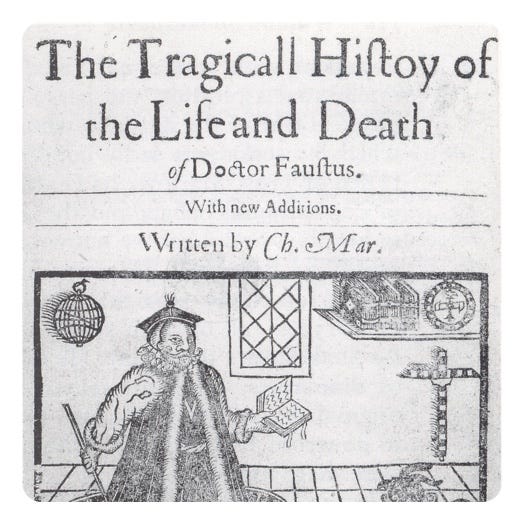
First written down as an English play by Christopher Marlow in the late 1500s, it was then written as a rhyming play in German by Goethe in the 1770s. From wikipedia:
Faust (/faʊst/ FOWST, German: [faʊst] ⓘ) is a tragic play in two parts by Johann Wolfgang von Goethe, usually known in English as Faust, Part One and Faust, Part Two. Nearly all of Part One and the majority of Part Two are written in rhymed verse. Although rarely staged in its entirety, it is the play with the largest audience numbers on German-language stages. Faust is considered by many to be Goethe’s magnum opus and the greatest work of German literature.[1]
It was made into an opera by Charles Gounod in French in the 1850s. I love the music, played it in an orchestra as a child. Here it is.
The 1958 movie Damn Yankees was a highly Americanized version of the story.
Here is the story in a nutshell. https://en.wikipedia.org/wiki/Faust
Faust (/faʊst/ FOWST, German: [faʊst] ⓘ) is the protagonist of a classic German legend based on the historical Johann Georg Faust (c. 1480–1540). The erudite Faust is highly successful yet dissatisfied with his life, which leads him to make a deal with the Devil at a crossroads, exchanging his soul for unlimited knowledge and worldly pleasures. The Faust legend has been the basis for many literary, artistic, cinematic, and musical works that have reinterpreted it through the ages. “Faust” and the adjective “Faustian“ imply sacrificing spiritual values for power, knowledge, or material gain.[1]
The Faust of early books – as well as the ballads, dramas, movies, and puppet-plays which grew out of them – is irrevocably damned because he prefers human knowledge over divine knowledge: “He laid the Holy Scriptures behind the door and under the bench, refused to be called doctor of theology, but preferred to be styled doctor of medicine“.[2] Chapbooks containing variants of this legend were popular throughout Germany in the 16th century. The story was popularised in England by Christopher Marlowe, who gave it a classic treatment in his play The Tragical History of Doctor Faustus (c. 1592).[3] In Goethe’s reworking of the story over two hundred years later, Faust seduces a pious girl who then dies by suicide, but after many further adventures Faust is saved from damnation through the intervention of penitent women, including the girl whose life he ruined.
Summary of the story
Faust is unsatisfied with his life as a scholar and becomes depressed. After an attempt to take his own life, he calls on the Devil for further knowledge and magic powers with which to indulge all the pleasure and knowledge of the world. In response, the Devil’s representative, Mephistopheles, appears. He makes a bargain with Faust: Mephistopheles will serve Faust with his magic powers for a set number of years, but at the end of the term, the Devil will claim Faust’s soul, and Faust will be eternally enslaved.
During the term of the bargain, Faust makes use of Mephistopheles in various ways. In Goethe‘s drama, and many subsequent versions of the story, Mephistopheles helps Faust seduce a beautiful and innocent young woman, usually named Gretchen, whose life is ultimately destroyed when she gives birth to Faust’s illegitimate son. Realizing this unholy act, she drowns the child and is sentenced to death for murder. However, Gretchen’s innocence saves her in the end, and she enters Heaven. In Goethe’s rendition, Faust is saved by God via his constant striving – in combination with Gretchen’s pleadings with God in the form of the eternal feminine. However, in the early versions of the tale, Faust is irrevocably corrupted and believes his sins cannot be forgiven; when the term ends, the Devil carries him off to Hell.