Strengthening the Biological Weapons Convention: the US returns to the table after essentially a 25 year hiatus
Strengthening the Biological Weapons Convention: the US returns to the table after essentially a 25 year hiatus
It seems the Trump administration plans to breathe new life into the Biological Weapons Convention. Fingers crossed.

During the Clinton administration, an international, 7 year process of adding needed provisions for inspections and other forms of treaty verification, which had been left to the future when the treaty was originally negotiated in the early 1970s, was about to conclude.
Then in 2001 the Bush 2 administration came in and scuttled the plans. Since I didn’t recall the details of how this happened and what excuses the US used, I asked AI for help with the following query:
Why did the US negotiators WALK OUT OF the Biological Weapons Convention Review Conference in 2001?
In 2001, US negotiators essentially “walked away” from two distinct but related events concerning the Biological Weapons Convention (BWC): first from the Ad Hoc Group (AHG) negotiations in July, and later from the Fifth Review Conference in December.
The primary reason was the George W. Bush administration’s total rejection of a proposed “Verification Protocol”—a legally binding document intended to create an inspection regime to ensure countries were not secretly developing biological weapons.
1. The July 2001 Withdrawal (The Protocol)
After seven years of multilateral negotiations, the US announced it would not support the draft protocol. The US delegation, led by Ambassador Donald Mahley, cited three main reasons:
Ineffectiveness: The US argued the protocol would not actually catch “cheaters.” Because biological research is “dual-use” (the same equipment can make vaccines or weapons), the US believed rogue states could easily hide illicit activity from inspectors.
Commercial Risk: The US biotechnology and pharmaceutical industries were deeply concerned that international inspectors would gain access to trade secrets and proprietary information, costing American companies billions.
National Security: The US argued that intrusive inspections of its own biodefense labs could reveal sensitive vulnerabilities or secret (but legal) defensive research to foreign entities.
2. The December 2001 Collapse (The Review Conference)
The situation escalated during the Fifth Review Conference in Geneva. Following the September 11 attacks and the subsequent anthrax mailings, the US took an even harder line:
“Naming Names”: In a departure from diplomatic tradition, Undersecretary of State John Bolton publicly accused several countries—specifically Iraq, North Korea, Iran, Libya, and Sudan—of violating the BWC.
The Ultimate Dealbreaker: On the very last day of the conference, the US demanded that the mandate of the Ad Hoc Group (the body tasked with creating the protocol) be permanently terminated. [Talk about chutzpah!!—Nass]
The Stalemate: Other nations, particularly the European Union and the Non-Aligned Movement (NAM), refused to kill the mandate, hoping to resume negotiations in the future. Because the conference required consensus, the US move effectively blocked a final agreement.
Summary of the US Position
The US shifted from a “multilateral arms control” approach to a “national security and compliance” approach. They believed that small, voluntary measures and bilateral pressure were more effective than a “fatally flawed” international inspection regime that might create a false sense of security.
OK. In the intervening 24 years, essentially the Biological Weapons Convention (BWC) was hung out to dry. Tepid meeetings and negotiations continued but didn’t really move any needles. And in order for the WHO Pandemic Treaty and IHR amendments to be accepted, it was necessary to pretend the BWC didn’t exist.
Because if it existed, why was the WHO trying to draft an entirely different approach to bioweapons? And what justification would the WHO have for designing an approach that was entirely different than the BWC’s anyway? Mightn’t the Pandemic Treaty ideaas on the pandemic pathogen library be prohibited by the existing BWC? Why did the WHO want the right to control what drugs and vaccines could be used by its member states? That does not control pandemics or biowarfare.
During my talk yesterday, I noted during the Q and A that “Global Public Health” had been moved into the State Department, and I did not know whether State would work to reinvigorate the BWC or whether it would try to build its own pathogen library, using bilateral agreements with African nations that sidestepped the WHO efforts but might be similar in intent.
Today I was able to read Robert Malone’s substack from yesterday and follow the links to see the latest regardng this issue.
Here is what the Dept. of State’s Undersecretary for Arms Control, Thomas DiNanno, said 5 days ago at the December 15-17 Meeting of States Parties (MSP) to the BWC in Geneva:
While it lacks specifics, the speech, titled “Modern Tools for Modern Threats: Towards Strengthening BWC Implementation, Verification, and Assurance” clearly and unequivocally states that the US position has changed, and we want a strengthened BWC.
This meeting followed on the heels of a related meeting: The seventh session of the Working Group of the Biological Weapons Convention (BWC) which went from Monday, 8 December 2025 until 12 December 2025. Delegations of States Parties were expected to examine the draft Final Report prepared by the BWC Working Group. I have not found any reporting on what occurred at either December meeting.
However, I did find this snippet on the last formal Review Conference to the BWC, which happens every 5 or 6 years. The article below is from 2022. It really makes you wonder how serious these UN/ negotiating people are… or whether this nonsense is a means to usurp the meeting time allotted and prevent meaningful debate on real issues. The below is from the The United Nations Institute for Disarmament Research, believe it or not. The globalist spin doctors are so devious.
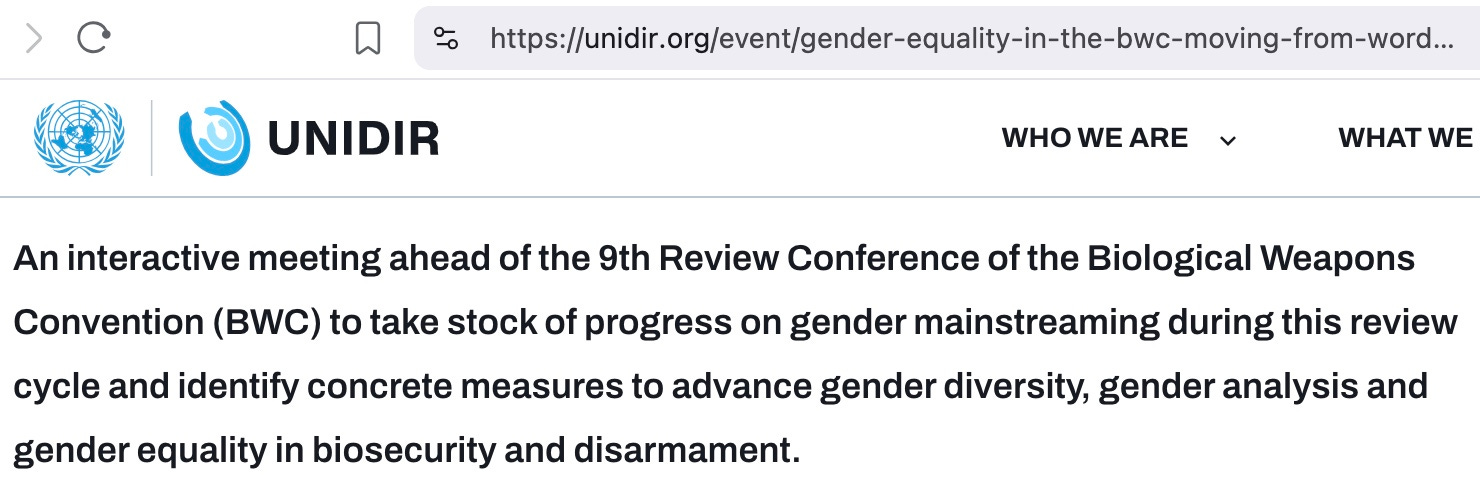
These people wanted to advance gender diversity in biosecurity? What is gender diversity? What is gender mainstreaming?
I hope that the gender nonsense disappears for good—we desperately need some comedians showing it up for what it is—a way to shut down thinking and make people afraid to question what is clearly nonsense, for fear of being labeled LGBTQ-phobic. People are afraid to say what they think. And then they stop thinking, cause it’s dangerous. Though this kind of talk is now verboten in the federal lexicon, a lot of the rest of the world is still under its evil spell.
Well, I will hope for the best from this biologial arms control effort. But I won’t be holding my breath. Fingers crossed that the US does not make any unseemly demands of the international negotiators again, and that we can craft some workable treaty amendments. And hopefully a strengthened BWC will be the final nail in the coffin for the WHO’s so-called BioSecurity Agenda. But I would be a fool to think this change in US policy might not come with some serious strings attached. Let’s see what happens.