I wanted to get this information about the Bayer pesticide Supreme Court case down very simply and clearly, as it unfairly weighs in Bayer’s favor
I wanted to get this information about the Bayer pesticide Supreme Court case down very simply and clearly, as it unfairly weighs in Bayer’s favor
Lawyers, if I have gotten anything wrong, please let me know.

Here is the docket for the case of Monsanto v Durnell:
https://www.supremecourt.gov/Search.aspx?FileName=/docket/docketfiles/html/public%5C24-1068.html
-
The attorneys for Durnell did not obtain a single amicus brief to support their case. I would have thought they would have been asking for such assistance with such an important case. Why are there no amici?
-
The attorneys for Durnell have not notified the Supreme Court that there was a serious mistake in the Solicitor General’s (DOJ) amicus brief. It claimed that the WHO’s cancer agency, the IARC, had found glyphosate to be a “possible” carcinogen, when in fact the IARC found glyphosate to be a “probable” carcinogen. The Durnell attorneys could not have missed this, because I emailed them about it twice, and spoke to the paralelgal on the case about this problem, and sent them all the relevant documents. Did Bayer/Monsanto get to Durnell’s lawyers?
-
While Bayer cites various regulators who have found only minor problems due to glyphosate, what is never mentioned is that Bayer/Monsanto cooked the important scientific studies that were used by regulators to come to their benign conclusions. Now we know those studies were ghostwritten or managed by Monsanto, so why are regulators still relying on them?
As noted here,
Internal Monsanto documents, investigative journalism and independent research have established that Monsanto used many tactics over decades to manipulate the scientific record on glyphosate, and that regulatory agencies relied on poorly conducted studies and insufficient data.
-
I am including the full article from Science published in December about the recent retraction of a pivotal study of glyphosate “safety,” below. Note that more retractions are expected. Why did it take 8 years and a formal retraction request from a Harvard academic to get this removed from the literature, after its phony provenance became known?
Monsanto’s fake science says glyphosate is safe, while independent science says it causes cancer. Why is there even a question about what the truth is?
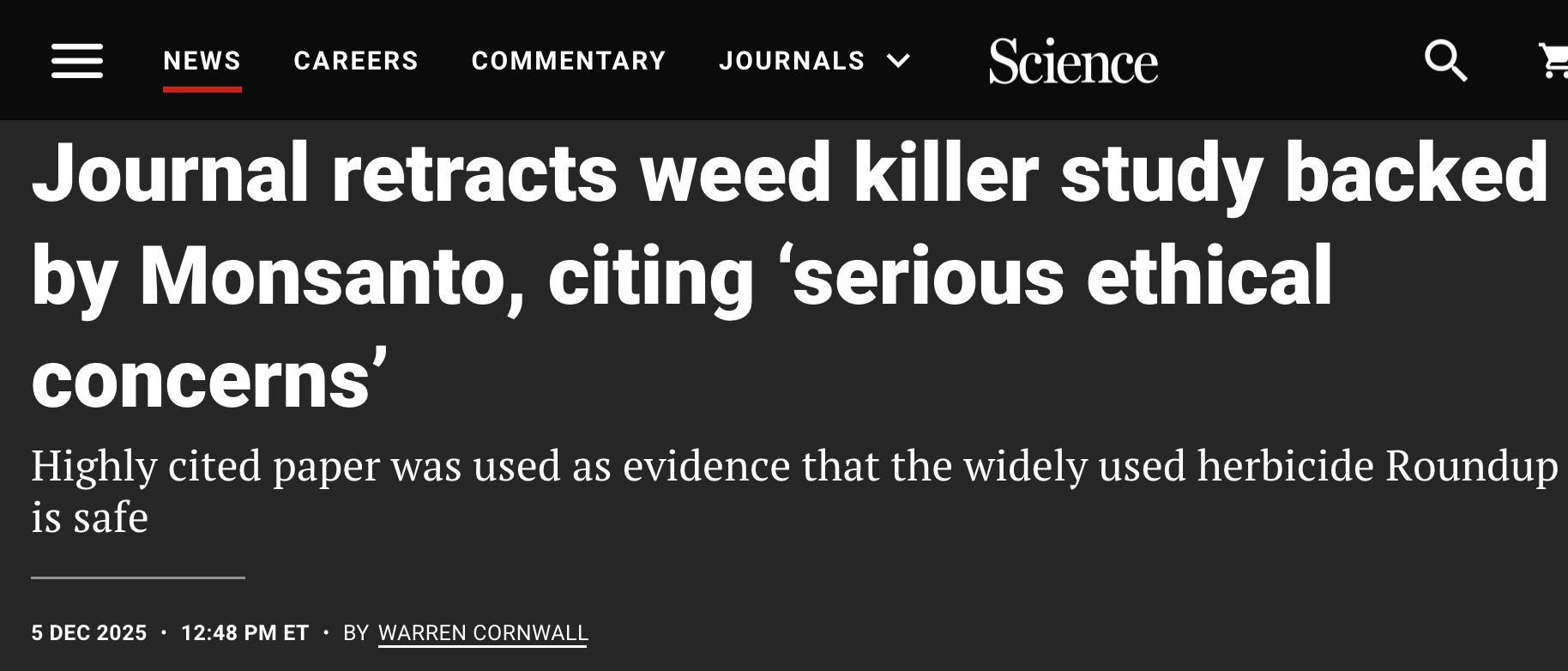
In 2017, a lawsuit uncovered internal emails from chemical giant Monsanto that suggested its employees helped ghostwrite an influential paper that claimed to find no evidence the company’s widely used glyphosate herbicide, Roundup, caused cancer. Now, the scientific journal that published the 2000 paper has announced it has been retracted.
The paper was withdrawn because of “serious ethical concerns” and questions about the validity of the research findings, toxicologist Martin van den Berg, co–editor-in-chief of Regulatory Toxicology and Pharmacology, wrote in a scathing retraction notice released on 28 November. “This article has been widely regarded as a hallmark paper in the discourse surrounding the carcinogenicity of glyphosate and Roundup,” wrote van den Berg, who works at Utrecht University. “However, the lack of clarity regarding which parts of the article were authored by Monsanto employees creates uncertainty about the integrity of the conclusions drawn.”
The decision, which came more than 8 years after the initial revelations, can be traced to the work of two scientists who this year filed a retraction request with the journal after documenting the staying power of the disputed paper. “My worry is that people will keep citing it,” says Naomi Oreskes, a historian of science at Harvard University who sought the retraction along with her then–postdoctoral researcher, Alexander Kaurov.
In July, the duo published an analysis showing that the now-retracted paper was in the top 0.1% of studies cited in glyphosate-related academic research. They found that citation rates barely budged after the revelations of Monsanto’s hidden involvement, and the paper continued to be used in policy documents. With the retraction, Oreskes hopes “the word will get out” that the study shouldn’t be used as a trusted source of information.
Questions about the paper emerged during a lawsuit against Monsanto, filed by people who claimed their non-Hodgkins lymphoma stemmed from glyphosate exposure. It brought to light internal company documents showing company officials debating how to respond to a 2015 finding by the International Agency for Research on Cancer (IARC) that glyphosate was a probable human carcinogen. One tactic they considered was to help academic researchers publish papers that supported the company’s claims that the chemical wasn’t a risk to people. One way to do that, a company executive wrote in an email, would be to approach scientists who would “have their names on the publication, but we would be keeping the cost down by us doing the writing and they would just sign their names so to speak.” The email notes that “this is how we handled” the now-retracted paper.
Gary Williams, the paper’s lead author and a former New York Medical College pathologist who retired in 2018, did not respond to a request for comment. The retraction notice states that Williams didn’t respond to the journal’s concerns about the paper. The two other authors, Robert Kroes and Ian Munro, are no longer alive.
In addition to the apparent involvement of Monsanto, the retraction announcement notes that the authors only reviewed unpublished studies produced by the company, and neglected to include a number of outside studies that were also not published in peer-reviewed journals. That could have skewed the study’s conclusions, van den Berg wrote.
The paper’s retraction could remove one hurdle for plaintiffs suing Monsanto, says Robin Greenwald, an attorney at the New York City–based law firm Weitz & Luxenberg who is overseeing glyphosate cases for hundreds of individuals. Monsanto “can’t rely on it anymore,” she says. “This is yet more evidence that we were right all along.”
Monsanto, which is now owned by Bayer, issued a statement saying the study was just one of many regarding the chemical’s safety. “The consensus among leading regulatory bodies worldwide is that glyphosate can be used safely as directed and is not carcinogenic,” the company stated.
Although IARC still lists glyphosate as a probable carcinogen, both the U.S. Environmental Protection Agency and the European Chemicals Agency have not come to that conclusion—with EPA saying it’s “unlikely” to be carcinogenic. Some juries, however, have been more sympathetic to sickened plaintiffs, awarding $1.56 billion in a Missouri case and $2.25 billion in Pennsylvania. (The judgments were reduced on appeal to $611 million and $400 million, respectively.)
There may be more retractions coming. Kaurov, who is now studying for a Ph.D. in science in society at New Zealand’s Victoria University of Wellington, says he and Oreskes recently submitted a retraction request to Critical Reviews in Toxicology for a 2013 paper published under the names of two other authors that doesn’t fully disclose the role Monsanto played in the paper. “It’s not the end of the story,” he says.