The Sierra Club tested 9 bags of commercial garden fertilizer and all contained at least 50% sewage sludge, seven 100%
The Sierra Club tested 9 bags of commercial garden fertilizer and all contained at least 50% sewage sludge, seven 100%
The website is no longer active, and I can’t find it with their search engine, but I saved a copy of the summary last year and am publishing it below

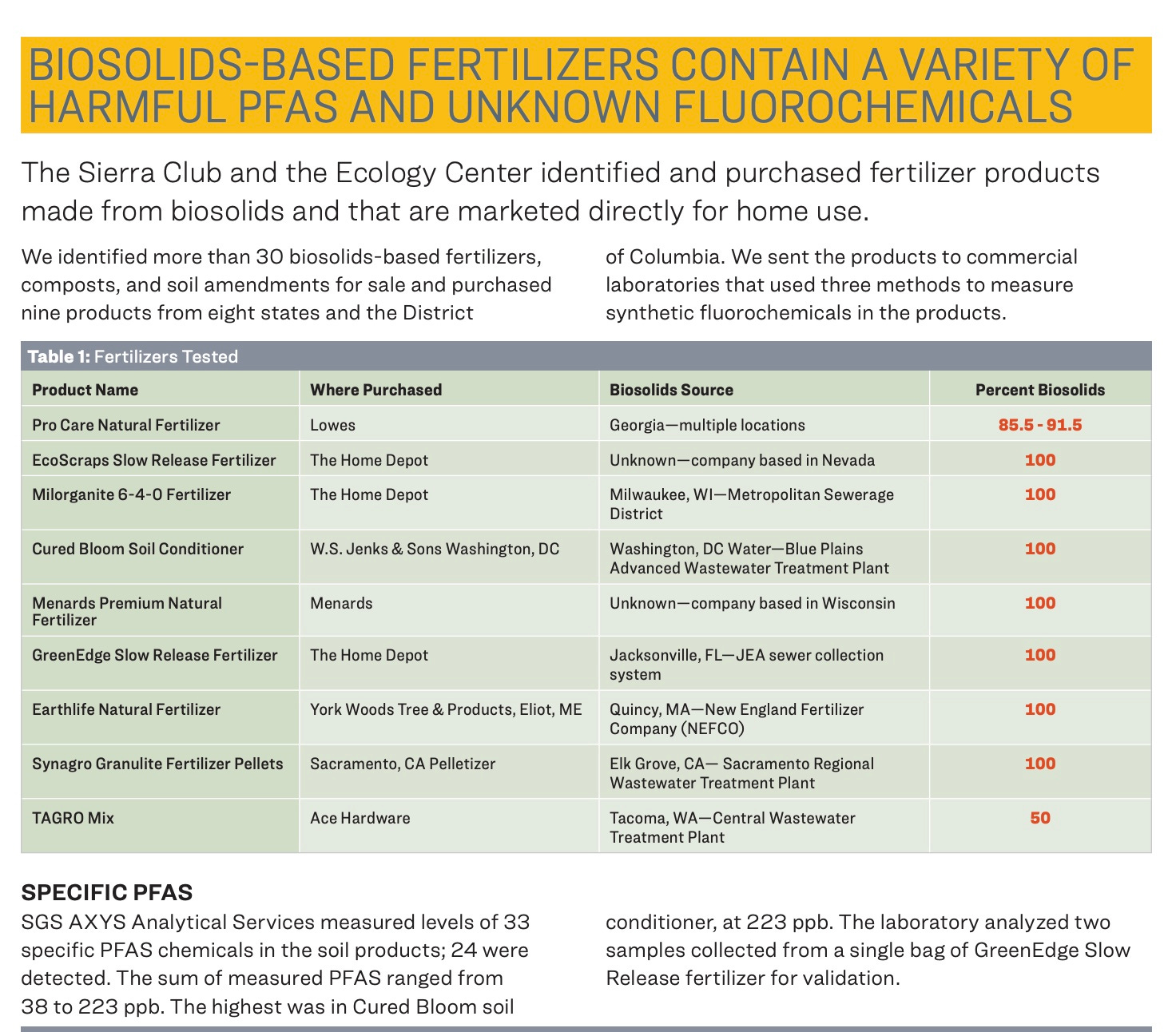
A reader found the link, and I reproduced the important table, above.
https://www.sierraclub.org/sites/default/files/PFA-Garden-Sludge-Report.pdf
The brands are listed below.
The Sierra Club and Ecology Center tested bags of commercial garden fertilizers for PFAS “forever chemicals” and found toxic levels in 8/9 bags
https://www.sierraclub.org/sludge-garden-toxic-pfas-home-fertilizers-made-sewage-sludge
-
Executive Summary
Sierra Club and Ecology Center tested home fertilizers made out of sewage waste for toxic PFAS chemicals, and we found the chemicals in every product, and at levels that exceed a screening standard set for land application in the state of Maine, the state with the strictest safeguards for PFAS contamination of agricultural lands. -
Introduction
About half of the sewage waste generated in the United States is treated and then spread on land, including agricultural crops and dairy land for disposal. The treatment doesn’t break down persistent chemicals like PFAS, which pose a threat to food crops and waterways. -
Recommendations
EPA, states, the chemical industry, and wastewater treatment plants must all act with urgency to keep PFAS out of the sewer system. Fertilizer companies should clearly label products as made from sludge so gardeners can avoid using them on home crops. -
The Fate of PFAS in Wastewater Systems, Agricultural systems, and the Food Supply Challenges of Biosolids Disposal
Our tests measured PFAS, precursor chemicals as well as unknown synthetic fluorine-based chemicals in much higher amounts than PFAS themselves. -
The Fate of PFAS in Wastewater Systems, Agricultural Systems, and Food Supply
PFAS are legally washed down sewer drains from homes and industry. EPA and states can limit pollution from industry, but the only way to end PFAS from homes and commercial businesses is to stop using the chemicals in consumer and industrial products. -
Challenges of Biosolids Disposal
Persistent chemicals like PFAS are not broken down during sewage treatment, and also create problems when burned in sludge incinerators. Even lined landfills eventually leak and release PFAS and other persistent chemicals back into the environment.
Executive Summary
Many home gardeners buy compost or commercial soil amendments to enhance soil nutrition. But new tests reveal concerning levels of toxic chemicals known as PFAS in fertilizer products which are commonly made from sewage sludge. These “forever chemicals” were found in all of the nine products tested by the Ecology Center of Michigan and Sierra Club and marketed as “eco” or “natural” and eight of the nine exceeded screening levels set by the state of Maine. PFAS in fertilizers could cause garden crops to be a source of exposure for home gardeners.
PFAS are per- and poly-fluoroalkyl substances, a class of widely used industrial chemicals, that persist for decades in the environment, many of which are toxic to people. In most places, industries are currently allowed to flush PFAS-containing waste into wastewater drains that flow to treatment plants. The chemicals are not removed during sewage treatment and instead settle in solid materials that are separated out from liquids in the treatment process.
Americans generate massive quantities of sewage waste each day. Nearly half of sewage sludges are treated to kill pathogens and then spread on farms, pastures, and wildlands for disposal, where nutrients like nitrogen improve soil productivity. The wastewater industry and EPA call these “biosolids.” Unfortunately, biosolids carry a variety of persistent and toxic chemicals, in addition to PFAS, which can threaten our food supply and contaminate water sources.
The Sierra Club and the Ecology Center identified dozens of home fertilizers made from biosolids. We purchased nine fertilizers:
-
Cured Bloom (Washington DC)
-
TAGRO Mix (Tacoma, Washington)
-
Milorganite 6-4-0 (Milwaukee, Wisconsin)
-
Pro Care Natural Fertilizer (Madison, Georgia)
-
EcoScraps Slow-Release Fertilizer (Las Vegas, Nevada)
-
Menards Premium Natural Fertilizer (Eau Claire, Wisconsin)
-
GreenEdge Slow Release Fertilizer (Jacksonville, Florida)
-
Earthlife Natural Fertilizer (North Andover, Massachusetts)
-
Synagro Granulite Fertilizer Pellets (Sacramento area, California)
Our tests reveal that American gardeners can unwittingly bring PFAS contaminants home when they buy fertilizer that is made from sludge-biosolids. Eight of the nine products exceeded screening limits for two chemicals—PFOS or PFOA—set by Maine, the state with the most robust action on PFAS in biosolids. The chemicals were measured at levels that would not be acceptable for the state’s agricultural soils. Of the 33 PFAS compounds analyzed in the products, 24 were detected in at least one product. Each product contained from 14 to 20 detectable PFAS compounds. Additional tests showed they also contained two to eight times greater mass of precursor compounds and hundreds to thousands of times more unidentifiable synthetic fluorine compounds.
Our testing provides a snapshot of PFAS levels in complex wastewater systems. The findings are in line with national surveys of PFAS in sludge-biosolids, and academic studies testing biosolids-based fertilizers and composts. Available evidence suggests that PFAS and related chemicals in sewage sludge could jeopardize the safety of the commercial food supply and home gardens. We recommend home gardeners do not purchase biosolids-derived fertilizers for use on fruit and vegetable beds. For the large-scale problem of disposing of sewage waste, however, simple solutions are elusive. The federal government and most states have done little to study the issue, let alone address it.
Our test results suggest that urgent changes are needed to halt the unnecessary uses of PFAS in commerce and minimize the amounts that are discharged into our wastewater system. EPA Administrator Michael Regan has pledged immediate action to reduce the threats posed by PFAS uses, but the agency’s anemic responses to date, as well as structural barriers created by key environmental laws, make quick action unlikely and hinder even the most common-sense measures to contain the chemical crisis.
The EPA and states must take immediate action to keep PFAS and other persistent chemicals out of the wastewater system, biosolids, and the food supply. This means preventing industrial polluters from discharging PFAS in their wastewater drains. Agencies must survey the hazard of food production on highly contaminated soils and regulate land application of biosolids with high levels of PFAS and other chemicals. Industry must pay for the damages that PFAS production and use poses to people and the environment, including costly cleanups of contaminated places. The most efficient and effective way to protect people from the growing threat of PFAS exposure is to end the use of PFAS, with limited exemptions.
Introduction (excerpts)
· Treated sewage sludge or “biosolids” are commonly applied to farmlands and sold directly to home gardeners as compost, soil amendment or fertilizer. We identified at least 30 different commercial fertilizers made from sewage sludge and sold at retailers like Lowe’s, The Home Depot, Ace Hardware and Menards or direct from manufacturing or wholesale sites. Many bear terms like “eco,” “natural,” or “organic” on the label. While biosolids are not allowed to be applied on farms growing certified organic fruits, vegetables or dairy products (USFDA 2013), one of the biosolids-based fertilizer we tested is used in school gardens in Washington, D.C.
· EPA regulates pathogens and heavy metals like lead, cadmium and mercury in biosolids, but does not set limits for other chemical contaminants that accumulate in sewage and wastewater, including PFAS (per- and poly-fluoroalkyl substances), which are a diverse group of synthetic (meaning human-made) fluorochemicals used widely for their useful qualities of thermal and chemical resistance and persistence. PFAS are generally not well regulated under national air, water, chemicals or waste laws, but widely understood to pose a serious health risk to people, wildlife and the environment (Kwiatkowski 2020, Fenton 2020).
· Treated sewage sludge, or “biosolids,” are commonly applied to farmlands and sold directly to home gardeners as compost, soil amendment, or fertilizer. We identified at least 30 different commercial fertilizers made from sewage sludge and sold at retailers like Lowe’s, The Home Depot, Ace Hardware, and Menards, and direct from manufacturing or wholesale sites. Many bear terms like “eco,” “natural,” or “organic” on the label.
· We tested a sample of nine products marketed to home gardeners for PFAS. Most products contained 100 percent sludge-biosolids. But none bear any warnings about the potential inclusion of PFAS or most other chemical contaminants. Just one had a warning about molybdenum for forage crops.
· Shoppers can check the “Guaranteed Analysis” section of the product label that discloses the source of the fertilizer. If purchasing compost or topsoil, check product information for terms like “biosolids,” “residuals,” or “municipal waste,” which could indicate it is made from sewage.
· But quick fixes are more elusive for the threat sludge-based biosolids pose to the commercial food supply. The EPA requires biosolids be tested for phosphorus, pathogens, and nine heavy metals before land application in its Rule 503, but does not set any limits for any PFAS compounds (USEPA 1994). The EPA provides an annual update about the number of unregulated chemicals that have been detected in the materials (USEPA 2021a). In a 2018 report, the EPA’s Inspector General raised concerns about gaps in its oversight of biosolids materials (USEPA 2018). It cautioned that the agency should consider the cumulative hazards posed by other persistent contaminants in biosolids and revise its public messages about biosolids safety (USEPA 2018).
· Despite being highly persistent, bioaccumulative, mobile, and toxic to people, PFAS chemicals are virtually unregulated. Three PFAS chemicals—PFOS, PFOA and PFHxS—are in the process of being phased out of commerce under the global United Nations Stockholm Convention, but thousands more are commonly used in a variety of consumer and industrial products.
· The EPA stalled listing these clearly harmful chemicals under the nation’s clean air and water and waste laws, and continued to approve new, poorly studied PFAS chemicals as alternatives to PFOS and PFOA. In the meantime, industries like metal plating, paper, and textile manufacturing continue to legally dump the chemicals into wastewater drains.
· The Clean Water Act allows the EPA to set contaminant limits for biosolids, and the agency has pledged to do a safety screening for the hundreds of unregulated contaminants detected in biosolids in the next two years (USEPA 2019).
· After discovering high levels of PFAS in milk produced from dairy cattle feeding on contaminated fields, Maine is measuring the amount of PFAS in biosolids and ensuring that the materials do not contaminate agricultural lands (Maine 2021). When biosolids exceed screening levels, the state requires modeling or testing to ensure the repeat application has not pushed agricultural fields over the screening level of 2.5 ppb for PFOA and 5.2 ppb for PFOS. Maine’s testing of one contaminated dairy found that the PFOS and PFOA levels in milk exceeded the concentrations it measured in the soils themselves.