The Hugel Mound and the quick and dirty Nass mound, aka raised bed filled with detritus from the garden
The Hugel Mound and the quick and dirty Nass mound, aka raised bed filled with detritus from the garden
And raspberries for breakfast. Tips and tricks from a lazy gardener.

I just finished breakfast, and I have a similar breakfast every day since it is quick, easy, I don’t have to think about it and it is good for me and tasty. And I am telling you this because this is how I enjoy my garden all year long.
I had yogurt mixed with newly ground flax seeds (for fiber), flax oil (7 grams of omega 3 alpha linolenic acid per Tbl oil, a raspberry puree I made last summer from my raspberry patch and some nuts. This is better raspberry puree than you will be able to buy anywhere. Even if the berries don’t look or even taste perfect, they will still make a dynamite puree or jam.
The raspberry patch needs very little work. I weed it once or twice a year. Some years I mulch. Add some manure yearly. Remove the spent branches. (In gardening parlance they are called canes). Raspberries grow a new cane one year. The next year that cane will produce raspberries. After that you get rid of it—it turns gray and is done. The main problem with raspberries is that they keep expanding outward into your other plantings and the compost heap.
If you want to collect the fruit, you must cover the patch with plastic netting to keep out the birds, once berries appear or before. The birds are clever, so the netting must extend to the ground and be pegged down with garden staples. You can reuse the netting for years. Otherwise you will only get what the birds are too full to consume.
I have metal poles in the corners of the patch, and I run string around the poles to fence in the canes—its very cheap and it’s all you need to create a fence to keep the canes in line—just poke them back inside the enclosure as needed.

Ideas that have been in vogue in recent years are the “lasagna” garden and the Hugel mound, or Hugelkultur.
The lasagna garden instructions tell you how much of this to layer over how much of that, along with newspaper or cardboard. It works but it’s too restrictive.
Basically, the concept is that you don’t actually need to wait for compost to mature, which if you are lazy like me and fail to turn and water your compost heap, takes a number of years. Instead, if you take the leaves, branches, logs and the remains of your garden plants at summer’s end, and bury them, they will become the equivalent of compost a lot faster, while feeding your plants for years. No turning of compost, no watering, etc. Farmer Mark Fulford says maple leaves have enough nitrogen that you don’t have to worry about the carbon/nitrogen ratio. With oak leaves that might be an issue. Here are two diagrams for building kugelmounds. I find them too prescriptive, but they provide a good idea of successful ways of building your bed.
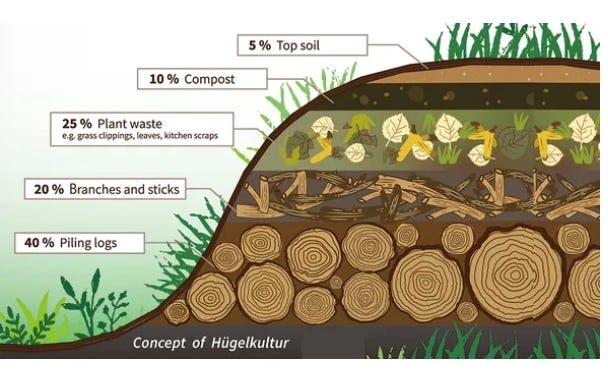
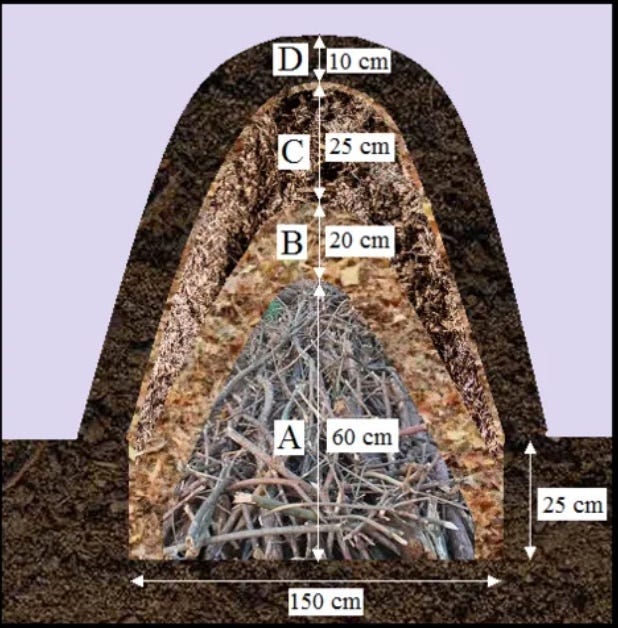
The traditional Hugelkultur method uses a big, deep mound with full sized logs as the bottom layer(s). You can start it inside a hole, as the second illustration did, or not. I have not.
I have not used logs or built deep mounds (but I will in my next home, which has lots of downed trees). Instead, I just created a mound using branches, leaves and whatever I would have put on a compost pile, in no special order, and then covered it with soil. I also did this in two newer raised beds with metal borders.
Who has enough dirt to fill those 4’ x 8’ by 12’‘ raised beds? But when you throw in the stuff you might otherwise throw away: branches, sticks, leaves, dead plants and even weeds (bury the weeds deeply so they don’t come back), then suddenly you don’t need that much dirt. As the stuff decomposes, your dirt becomes luscious soil. The beds were filled in the fall and I planted in them the next spring, and my plants did beautifully. The soil critters break everything down for you.
You can obtain much of the dirt you need to cover everything by digging out the paths around the bed. The soil under grass is quite good, as many grasses are nitrogen fixers, though if you have some wooded property I especially like that topsoil for topping off my beds.
The idea is that if you start with logs at the bottom of your mound, the decay will continue for many years, giving you a continuous release of carbon and a sponge to hold moisture in the bed. In my mounds, without logs or fat branches, everything had turned to (very good) soil in about a year. Expect beautiful plants growing out of these mounds.