Ebola epidemic in eastern Congo, as spun by former USAID official in the NYT: another case of “all the news that fits, we print”
Ebola epidemic in eastern Congo, as spun by former USAID official in the NYT: another case of “all the news that fits, we print”

https://www.nytimes.com/interactive/2026/06/09/opinion/ebola-outbreak-africa-usaid.html
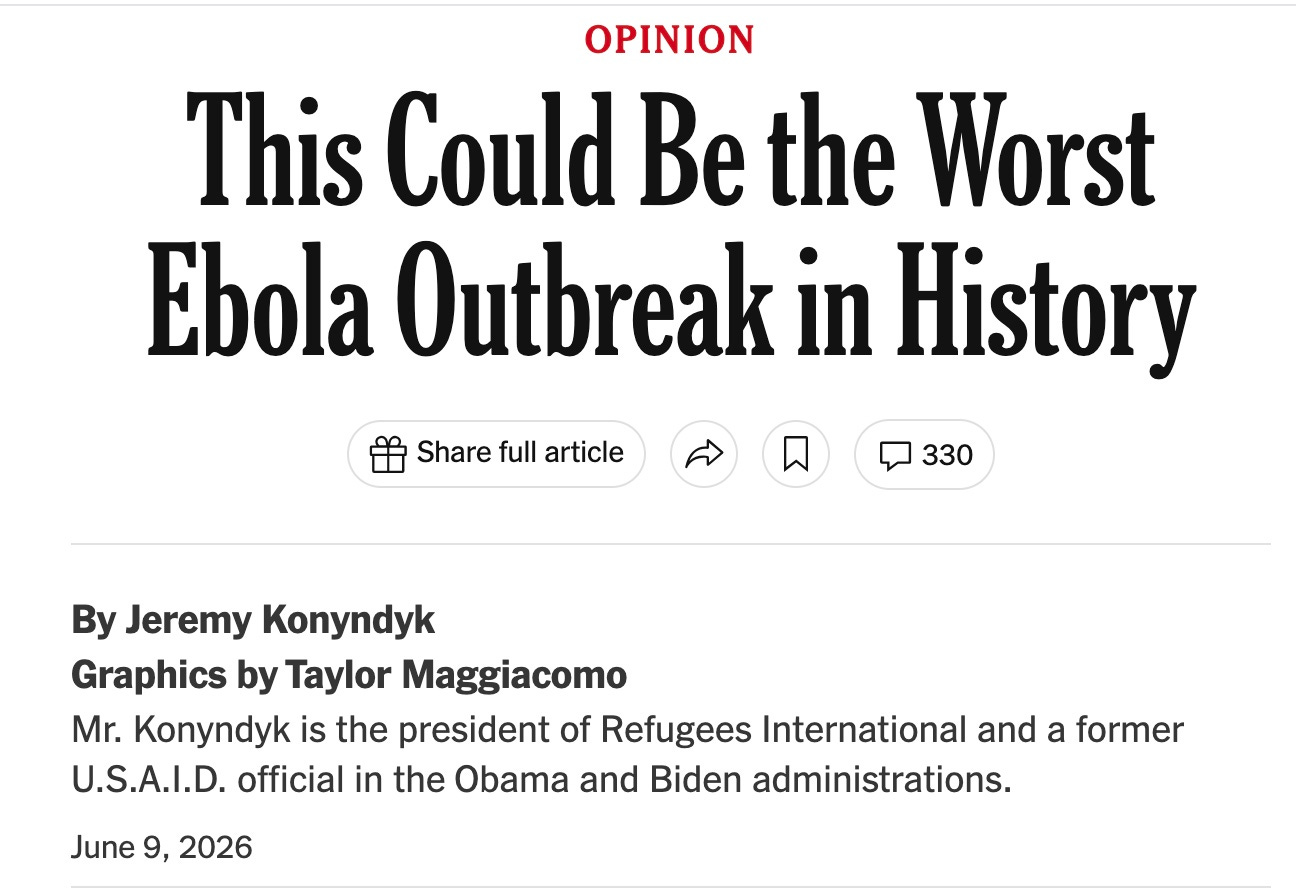
The author, who is reported to have played a critical role in the 2014 west African Ebola response, includes telling mistakes and omissions in his opinion piece.
-
He fails to mention that it took 8 months for the international community/WHO to respond to the largest Ebola epidemic in history, in 2014. Was there a population control agenda then? According to Google Gemini (in italics):
The 8-month gap between the true start of the outbreak in December 2013 and the PHEIC declaration in August 2014 became a focal point of independent expert panels. Subsequent internal reports and external reviews concluded that bureaucratic delays within WHO’s regional and central structures severely hampered the early operational scaling required to contain the epidemic before it reached major metropolitan areas.
-
The author fails to explain the reasons why health staff were attacked during the 2018-2020 (2nd largest) Ebola epidemic in eastern Congo, nor does he learn any lessons from that 2 year outbreak. Yet it is exactly that outbreak, occurring near today’s outbreak, which needs to be studied—for it occurred under exactly the same conditions as the current outbreak:
a) being in a war zone with multiple militias
b) a population estranged from a national government 1,000 miles away
c) a “securitized” (military) approach to the local population
d) a 67% mortality rate despite “treatment”—the highest ever for an Ebola outbreak
From Gemini again:
Why Did the [2018-2020 Ebola] Response Stall?
The delay in effectively containing the virus was not due to a lack of awareness, but rather due to a structural disconnect between standard epidemiological protocols and the reality of an active war zone.
-
The “Perfect Storm” of Active Conflict: The outbreak took place in an area controlled by dozens of armed rebel groups. Frontline health workers faced frequent violent attacks, [over 300—Nass] and facilities were burned down. This regularly ground contact tracing and ring vaccination to a halt.
-
The “No Regrets” Backfire & Securitization: Determined not to repeat the sluggishness of 2014, the international community adopted an aggressive, top-down “no regrets” deployment model. To protect health assets, the WHO and the Ministry of Health relied heavily on state security apparatuses and armed escorts.
-
The “Ebola Business” and Community Mistrust: The massive influx of foreign international aid, paired with aggressive government security forces, alienated local populations. The response was perceived as a predatory “Ebola Business” designed to enrich state actors while ignoring other long-standing crises like malaria and conflict. This deep-seated mistrust led to widespread community resistance, hidden cases, and unsafe burials, which kept fueling transmission despite the availability of advanced medical tools.
-
The author emphasizes the rapidly growing case numbers in eastern Congo today, failing to mention that we don’t actually know when the epidemic started, probably April, and his curves almost certainly exaggerate the rate of increase in cases and therefore project a more devastating future.
-
Need I say more? The author is correct that this could be the worst Ebola outbreak yet—who knows?—but his conclusion is that what is needed is to send money. This avoids the much more fraught issues that will have to be faced and solved, which I laid out above. These are the predictable, uninformative final sentences from our former USAID official:
-