The WHO’s annual meeting, termed the World Health Assembly, is happening this week
The WHO’s annual meeting, termed the World Health Assembly, is happening this week
And you have to laugh at what they want to pull off, with the help of public health globalists like Tom Frieden, former CDC director who copped a plea on a sexual assault a few years back.

The WHO does not want to let any nations leave. You may remember that the US entered a stipulation when it joined the WHO (which the US was. central in forming) in 1948—that it could leave the organization after 1 year’s notice as long as its dues were paid up.
I’ve read that the WHO Constitution (the joining document) deliberately did not offer an exit plan, based on experience with countries leaving the League of Nations.
But you may also remember that there is a “treaty of treaties” from 40-some years ago that gives nations an exit ramp from any treaty they feel no longer serves their interests. I wrote about this issue back in 2023.
Apparently the WHO, in conjunction with Tom Frieden’s “Think Global Health” NGO, wants its member states to think there is no way out for them. So the following article got published last week, in preparation for the meeting.
https://www.thinkglobalhealth.org/article/argentina-the-who-and-an-exit-door-that-doesnt-exist
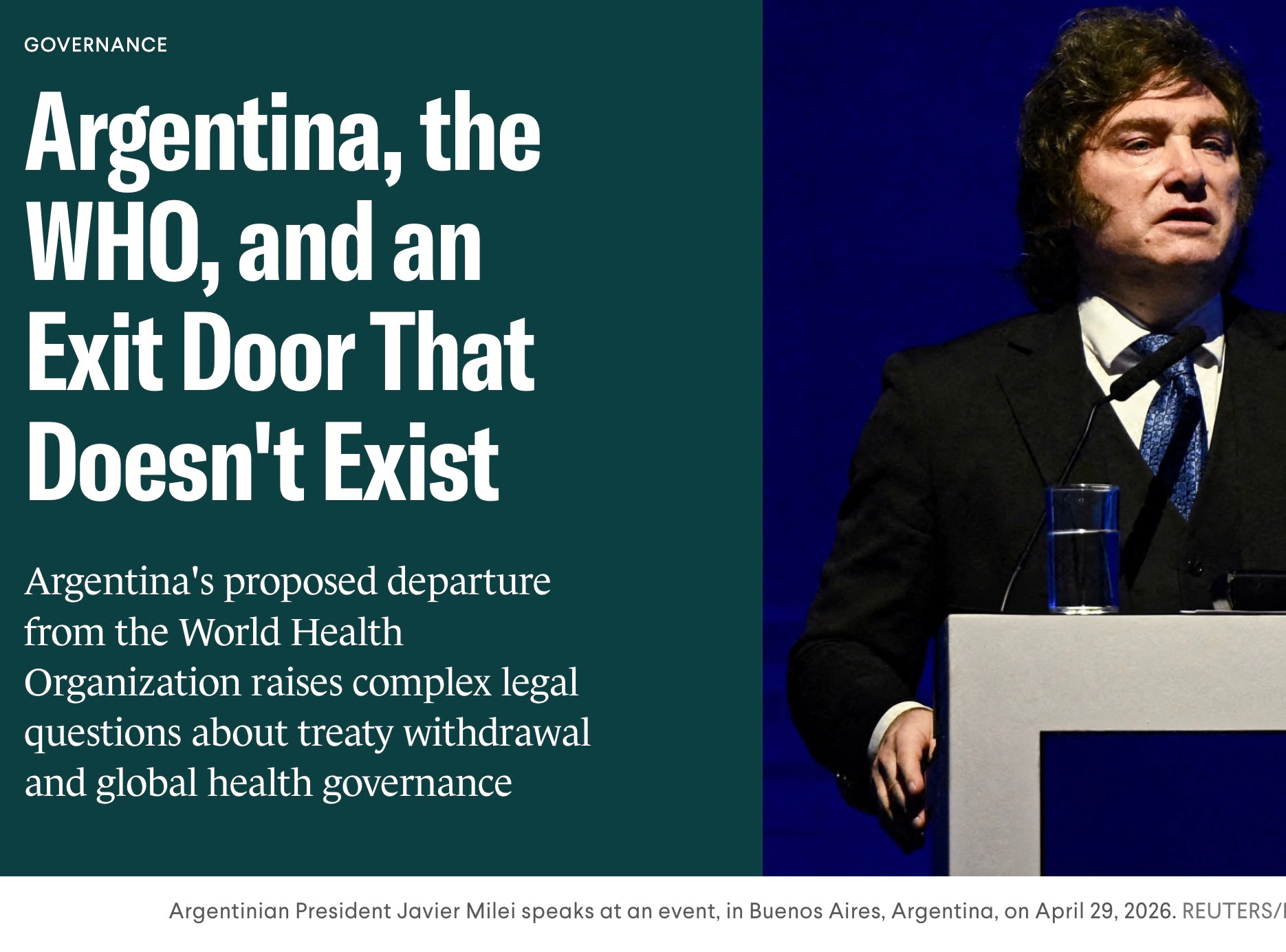
In January 2025, the United States submitted a notice of withdrawal from the World Health Organization (WHO) to the UN secretary-general, and Argentina followed on March 17. Exactly one year later, Argentinian Foreign Minister Pablo Quirno confirmed via social media that the South American country had completed the withdrawal process, portraying the move as an assertion of national sovereignty and criticizing politically motivated health guidance. The optics of these withdrawal notices appear identical, shaped by shared rhetorical vocabulary, timelines, skepticism of multilateral institutions, and criticism of the WHO’s handling of COVID-19.
Yet the downstream consequences differ substantially, most critically in their legal foundation: the United States exercises a withdrawal right it explicitly reserved at the first World Health Assembly, whereas Argentina, holding no such provision, has invoked the Vienna Convention on the Law of Treaties, a basis the WHO director general has already rejected as legally invalid.
Ahead of the seventy-ninth World Health Assembly, which begins May 18, this gap in constitutional legitimacy will raise fundamental questions about compliance, sovereignty, and voluntary adherence. The larger implications of these moves will extend beyond Buenos Aires and Washington, threatening existing mechanisms for infectious-disease surveillance and containment, and raising complex legal questions about treaty withdrawal and global health governance.
What Are the Rules for an Exit?
Adopted at the 1946 New York Conference, the WHO constitution avoided codifying a formal withdrawal process. The primary assumption was that international health cooperation would be cumulative and that ties would deepen over time. Instead, the constitution included only a declaratory statement permitting withdrawal if a member found a later constitutional amendment unacceptable.
In 1948, the constitution came into force but was amended to include a sole exception secured by the United States at the first World Health Assembly. Washington obtained a unilateral right of withdrawal [PDF], reserved exclusively to itself, provided that all financial obligations to the organization are met for the current fiscal year. No other founding member, nor any subsequently joining member, obtained a comparable provision. In fact, when seven Soviet bloc states attempted to withdraw between 1949 and 1950, the WHO classified them as “inactive,” declining to acknowledge their withdrawal as legally valid.
As a member with no such reservation, Argentina has based its withdrawal on the Vienna Convention on the Law of Treaties, particularly Articles 54 and 56 [PDF], whereby withdrawal is permissible when a treaty does not specify termination procedures, provided reasonable notice is given. In his report to the WHO executive board issued on January 20, 2026, WHO Director General Tedros Adhanom Ghebreyesus stated firmly that “the purported notification of withdrawal by Argentina should not be accepted as effective.”
Nevertheless, at its February 2026 session, the executive board chose not to follow its own legal advice. Instead, a draft decision was adopted [PDF], proposed by Argentina and co-sponsored by Israel, recommending that this month’s World Health Assembly acknowledge the withdrawal as effective as of March 17, 2026. The assembly is thus invited to confirm an action that is already being treated as settled, based on a disputed legal argument and without precedent.
Should it be endorsed, the decision would elevate practice into precedent, and the WHO, which has historically relied on procedural stability, will recognize an informal exit mechanism that could disrupt the organizational balance without altering the constitution….
Yada yada yada. The WHO hoped to become Geneva’s Hotel California, but its members aren’t buying it. I anticipate they will reject Tedros’ claim this week.
Remember that the WHO and UN wanted to be able to tax the public directly—and of course, digital money would potentially allow them to charge you directly, with or without your compliance. So I am guessing that the idea of “health taxes,” proposed in mid 2025, is likely to be brought up this week. WHO never says who actually gets to spend this new source of income, but they do talk about using it for universal health coverage (which has never been defined by WHO in the 4 years I have observed them push it, because they want you to think it is health care, while it is really insurance) and for the SDGs.
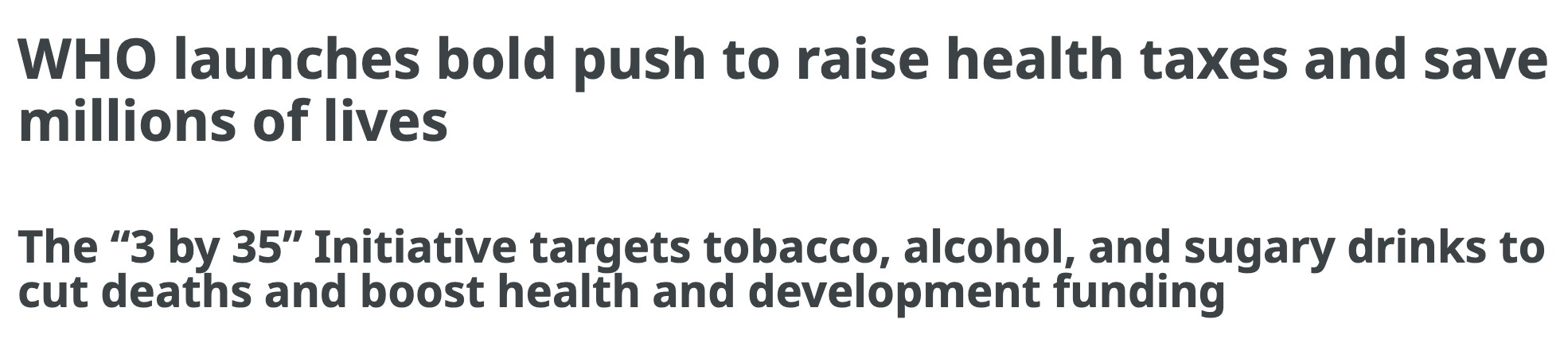
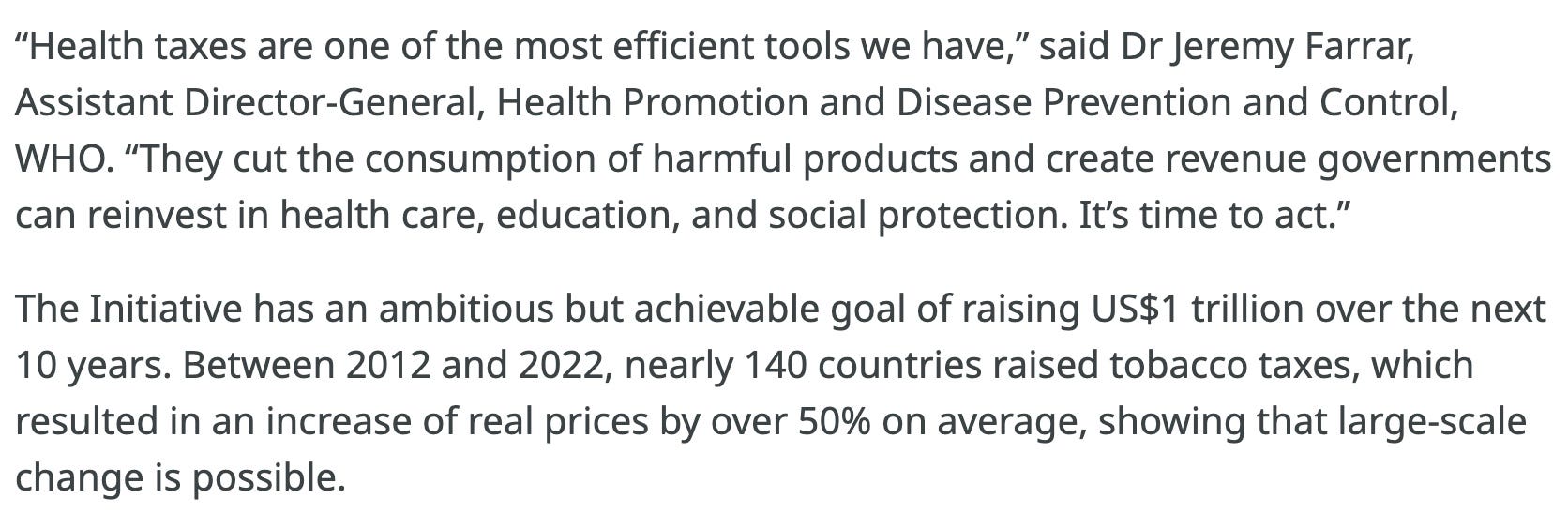
Our friend spooky Jeremy Farrar OBE (007: licensed to overdose), who as head of Wellcome Trust helped design and fund the HCQ overdose trials in 2020, and who has been pushing out a tale about the dire threat of bird flu since 2003, is currently flogging health taxes. You should know by now that anything he promotes, you should run away from as fast as you can. Usually it has to do with spending pots and pots of other peoples’ money. Or killing generic drugs to advantage newly patented vaccines.
