The EPA is not our friend. Nearly 100 pesticides *banned* in other countries are being used in the US. Now EPA wants to re-register Bayer’s Dicamba, despite 2 courts having determined otherwise.
EPA has been stuffed with political appointees who are chemical industry shills. Should EPA go the way of USAID? How do we fix this?
EPA has been in the pocket of Big Chemical/Big Pesticide for many decades. But it has never faced a MAHA policy effort at the federal level. Will EPA continue to encourage the poisoning of America, or will the MAHA movement have enough influence to reengineer this supposedly “protective” agency and redirect it to improving our health?
https://biologicaldiversity.org/w/news/press-releases/united-states-uses-85-pesticides-outlawed-in-other-countries-2019-06-06/
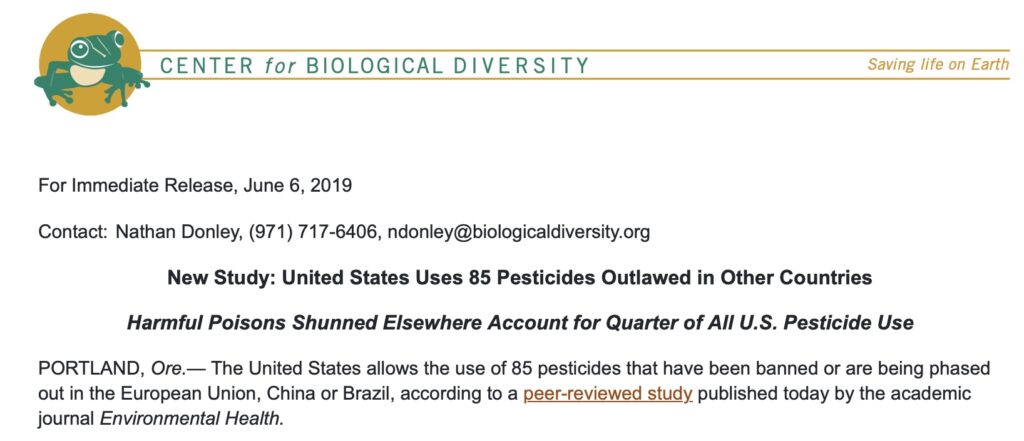
The U.S. is still using many pesticides that are banned in other countries
Donley (of the Center for Biological Diversity, above) reviewed the approval status of over 500 pesticides that have been used in the United States. Currently, 72, 17 and 11 pesticides approved in the United States are banned or being phased out in the EU, Brazil and China, respectively. These include chemicals that have been implicated in pesticide poisonings in the United States, like chloropicrin and paraquat (SN: 3/26/11, p. 26). Only two, three and two pesticides banned in the United States are approved in the EU, Brazil and China.
Using the U.S. Geological Survey’s record of estimated annual pesticide use, Donley determined how much U.S. agriculture uses pesticides outlawed elsewhere. Of the 544 million kilograms of pesticides used in the country in 2016, 146 million, 12 million and 18 million kilograms comprised chemicals banned in the EU, Brazil and China.
Since the EPA was formed in 1970, 134 pesticides have been discontinued in the United States. The EPA prohibited 37 of those, and only five in the last 18 years. Pesticide manufacturers voluntarily withdrew the other 97. In many cases, this is likely because the pesticides sold poorly, and it’s expensive to maintain EPA approval, Donley suggests. Several chemicals showed a steep decline in usage before cancellation….
According to the Center for Food Safety, in an email today:
EPA has tried and failed repeatedly to reduce [dicamba] drift [beyond the farm where it is laid down] with various application restrictions. Incredibly, the new proposal would weaken even these inadequate measures, for instance by eliminating time-of-day restrictions and cutoff dates intended to reduce volatility.
Our team at CFS has twice beaten EPA in court, winning court-ordered bans on dicamba in 2020, then again after re-approval in 2024. And we can do it again! But only with your help.
The public comment period is our chance to demand that EPA follow the evidence, and we need a massive response showing that Americans won’t stand for putting corporate profits ahead of farmers, families, and environmental protection. Will you join us?
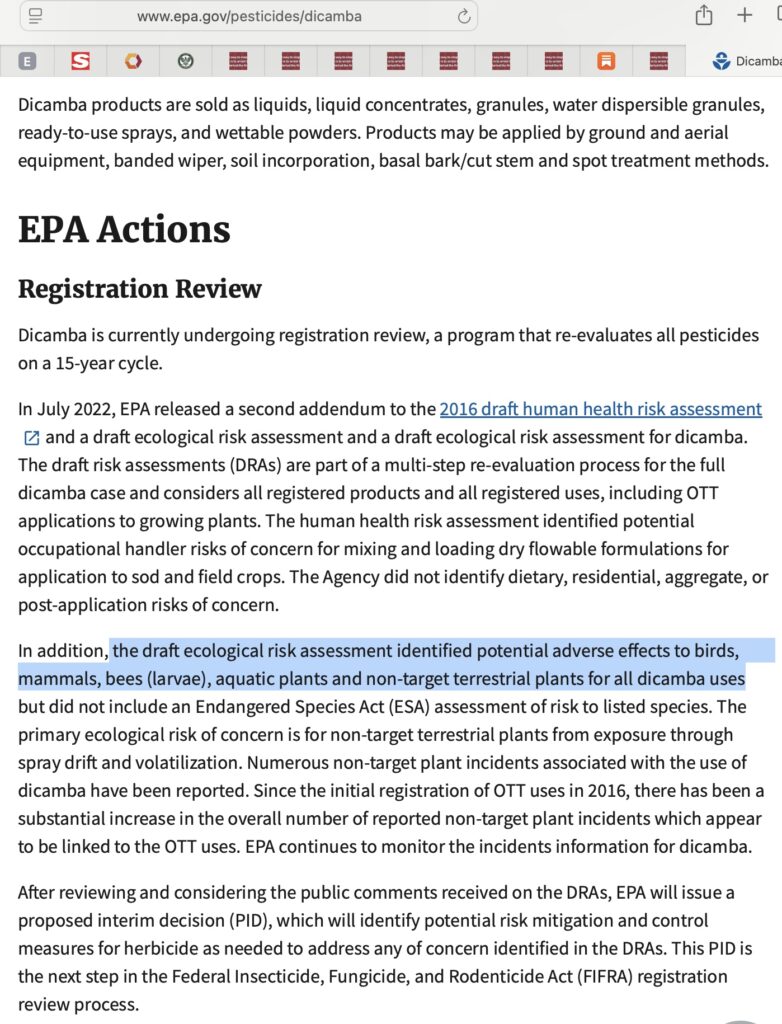
Here is what EPA itself admits about Dicamba. It is harmful for all animals (birds, bees, mammals and plants) except it is fine for humans to consume. Hello? Who’s fooling who?
https://www.epa.gov/ingredients-used-pesticide-products/registration-dicamba-use-dicamba-tolerant-crops
Registration of Dicamba for Use on Dicamba-Tolerant Crops
-
Formerly-Registered Dicamba Products – Frequently Asked Questions
-
Dicamba Training FAQs
On July 23, 2025, EPA announced the proposed registration decision for three end-use dicamba products for broadleaf weed control in dicamba-tolerant cotton and dicamba-tolerant soybean. EPA has conducted a robust human health risk assessment for these proposed products and has not identified any human health or dietary risks of concern. Additionally, the agency is proposing to put several measures in place to protect against the ecological risks found in EPA’s assessment. To read more about the proposed registration of dicamba and to comment, see docket ID EPA-HQ-OPP-2024-0154 at www.regulations.gov. Read EPA’s announcement.
On February 14, 2024, EPA issued an Existing Stocks Order for Dicamba Products Previously Registered for Over-the-Top Use on Dicamba-Tolerant Cotton and Soybean. This Order addresses use of the formerly- registered dicamba products and authorizes limited sale and distribution of dicamba products that are already in the possession of growers or in the channels of trade and outside the control of the pesticide companies.
Read the Existing Stocks Order for Dicamba (pdf) (655.25 KB)
On February 6, 2024, a ruling by the U.S. District Court of Arizona vacated the 2020 registrations for OTT dicamba products – XtendiMax, Engenia, and Tavium. As of February 6, 2024, these products are unregistered, and sale or distribution of these products is unlawful except as provided in EPA’s February 2024 existing stocks order.
On February 16, 2023, EPA approved labeling amendments that further restrict the use of OTT dicamba in Iowa, Illinois, Indiana and South Dakota. The Iowa, Illinois and Indiana amendments were requested by product registrants following discussion with those states. The South Dakota amendment was proposed by the state to the registrant. All amendments are intended to reduce risks from the use of over-the-top dicamba. For Iowa, the February 2023 amendment supersedes the March 2022 amendment.
On March 15, 2022, EPA approved label amendments that further restrict the use of OTT dicamba in Minnesota and Iowa. The amendments, requested by pesticide registrants in consultation with those states, are intended to reduce risks from the use of OTT dicamba by avoiding application on days with high temperatures. Read EPA’s announcement.
On December 21, 2021, EPA published a report on the nature and extent of dicamba-related incidents that caused damage to non-target crops during the 2021 growing season. Despite the control measures implemented in EPA’s October 2020 dicamba registration decision, these incident reports showed little change in number, severity, and/or geographic extent of dicamba-related incidents when compared to the reports the Agency received before the 2020 control measures were required.
Read EPA’s statement and FAQs about the report.
On October 27, 2020, EPA announced the registration of two end-use dicamba products and extended the existing registration for one other dicamba product, all for applications only on dicamba-tolerant cotton and dicamba-tolerant soybeans. These products will automatically expire in December 2025 unless EPA takes further action to amend the registrations. The new registrations include label changes that further restrict the use of OTT dicamba applications compared to the 2018 registrations. Read the press release and FAQs about this action.
View the documents supporting this decision:
-
Registration decision
-
Effects determination
-
Benefits assessment for DT cotton production
-
Benefits assessment for DT soybean production
On June 8, 2020, EPA issued a final cancellation order providing farmers with needed clarity following the Ninth Circuit Court of Appeals’ June 3, 2020 vacatur of three dicamba registrations. This cancellation order outlined limited and specific circumstances under which existing stocks of the three affected dicamba products could be used for a limited period. EPA’s order advanced protection of public health and the environment by ensuring use of existing stocks follows important application procedures.
On June 3, 2020, the Ninth Circuit Court of Appeals issued an order vacating three of EPA’s pesticide registrations containing the active ingredient dicamba….
Is EPA actually the Environmental Degradation Agency? The Environmental Pretend to Protect Agency? The Environmental Punishment Agency? The Environmental Perception Agency?
What can we do to get this agency (with a long, terrible history—read David Lewis’ Science for Sale: How the US Government Uses Powerful Corporations and Leading Universities to Support Government Policies, Silence Top Scientists, Jeopardize Our Health, and Protect Corporate Profits) on track to protect humans, animals and the environment? Seeking good ideas. EPA needs to be turned around!