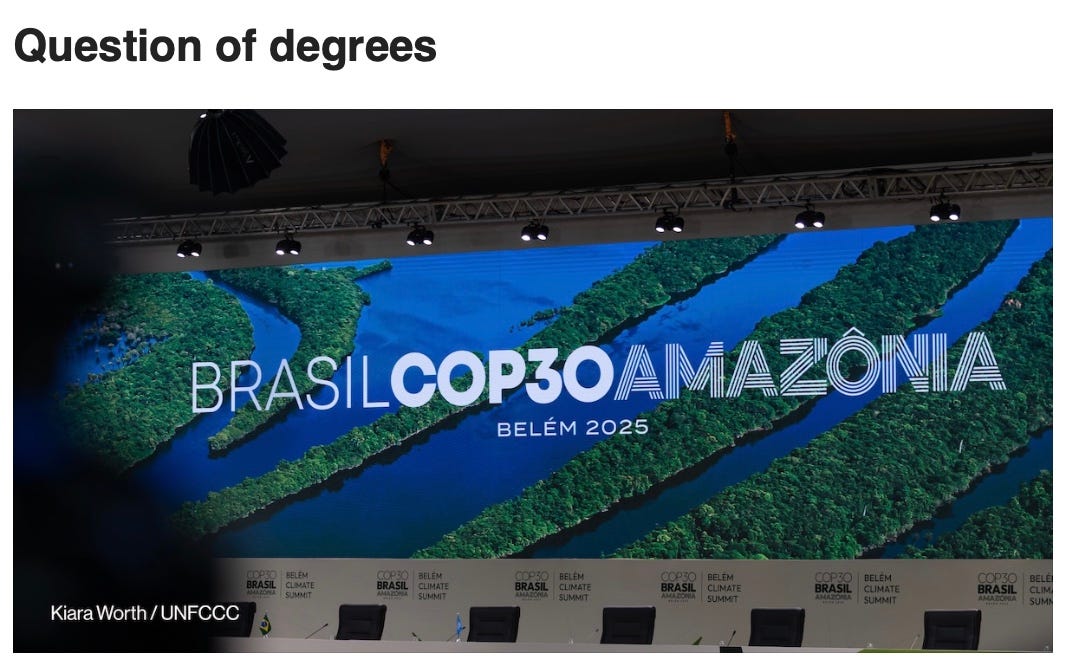
Still trying to extract a fortune for climate change at the UN’s Framework Convention on Climate Change’s COP30 that begins today
What will be interesting is what new financial tools or financial architecture they roll out as a means of getting us very indebted and forced to use electronic money
The 30th United Nations Climate Change Conference, or COP30, kicks off today in the heart of the Amazon. Devex reporters will be in Belém, Brazil, for the next two weeks to help you make sense of the stakes involved.
If there’s one thing you can count on at the U.N.’s climate change conferences, it’s predictability — not the reassuring kind, but the infuriating kind.
The dangers of climate change are spelled out, and heads nod in agreement that something must be done (the Trump administration notwithstanding). For lower-income countries, that something is money — a lot more of it — from wealthier counterparts who accumulated their wealth while heating up and destabilizing the planet. For those higher-income countries, that something doesn’t entail nearly as much money, though they’re quite generous with announcements and pledges.
That said, each U.N. climate gathering is distinct and does incrementally build off one another, warts and all. Yes, promises are routinely broken — along with all kinds of temperature records — but progress has not been completely absent over these 29 COPs, nor has hope completely dimmed for its 30th iteration.
Brazil, after all, is a heavy hitter for the global south. It’s also determined to make this COP more about concrete implementation than lofty commitments.
But success will not hinge on Brazil alone, my colleague Ayenat Mersie writes. During a Devex Pro Briefing, Marcene Mitchell of WWF and Karen Silverwood-Cope of World Resources Institute Brasil told her that countries involved must shift from long-standing rhetoric to urgency and action. That includes scaling up finance, agreeing on a forest finance facility, beginning to reckon with fossil fuels and subsidies, finalizing a way to measure adaptation – and finding a way to pay for it all.
There’s that predictable theme again: Money.
At COP29 in Baku, governments agreed to at least $300 billion per year in climate finance for low- and middle-income countries by 2035. Many said that it fell short. As a compromise, the final text acknowledged a broader aim — mobilizing $1.3 trillion annually. How to get from $300 billion to $1.3 trillion is what negotiators call the Baku-to-Belém road map.
Silverwood-Cope said the draft road map reflects prior discussions around reforming multilateral development banks, using innovative finance tools, and leveraging private capital. But she also warned that “we don’t know how it’s going to be rolled out, and what are the monitoring mechanisms.” Even if agreed to in Belém, the reforms would involve a major restructuring of the global financial system.
And by some estimates, even $1.3 trillion “is actually a very low bar,” Silverwood-Cope said.
That implies countries need to come up with an astronomical sum of money to fight climate change. But Mitchell tried to put it into perspective: “We as countries around the world put trillions — and I mean trillions with a T — into subsidies for fossil fuels,” she said. “If we could reallocate those subsidies … into the things we need for this energy transition and for stopping deforestation, we would be significantly down the road. So the money could be there. It’s having these hard conversations.”
Original URL: https://merylnass.substack.com/p/after-the-uk-parliament-we-went-to I was so glad that people are waking up about the attack on food. Our hats say, “No farms, no food” By the way, don’t forget that I produced an extremely interesting symposium last March with 17 speakers on the attack on food and farming and solutions. Learn more about this subject,…