The 15-point proposal, sent via Pakistan, reflects the Trump administration’s eagerness to find an offramp from the conflict as it grapples with its economic fallout, according to two officials briefed on the diplomacy.
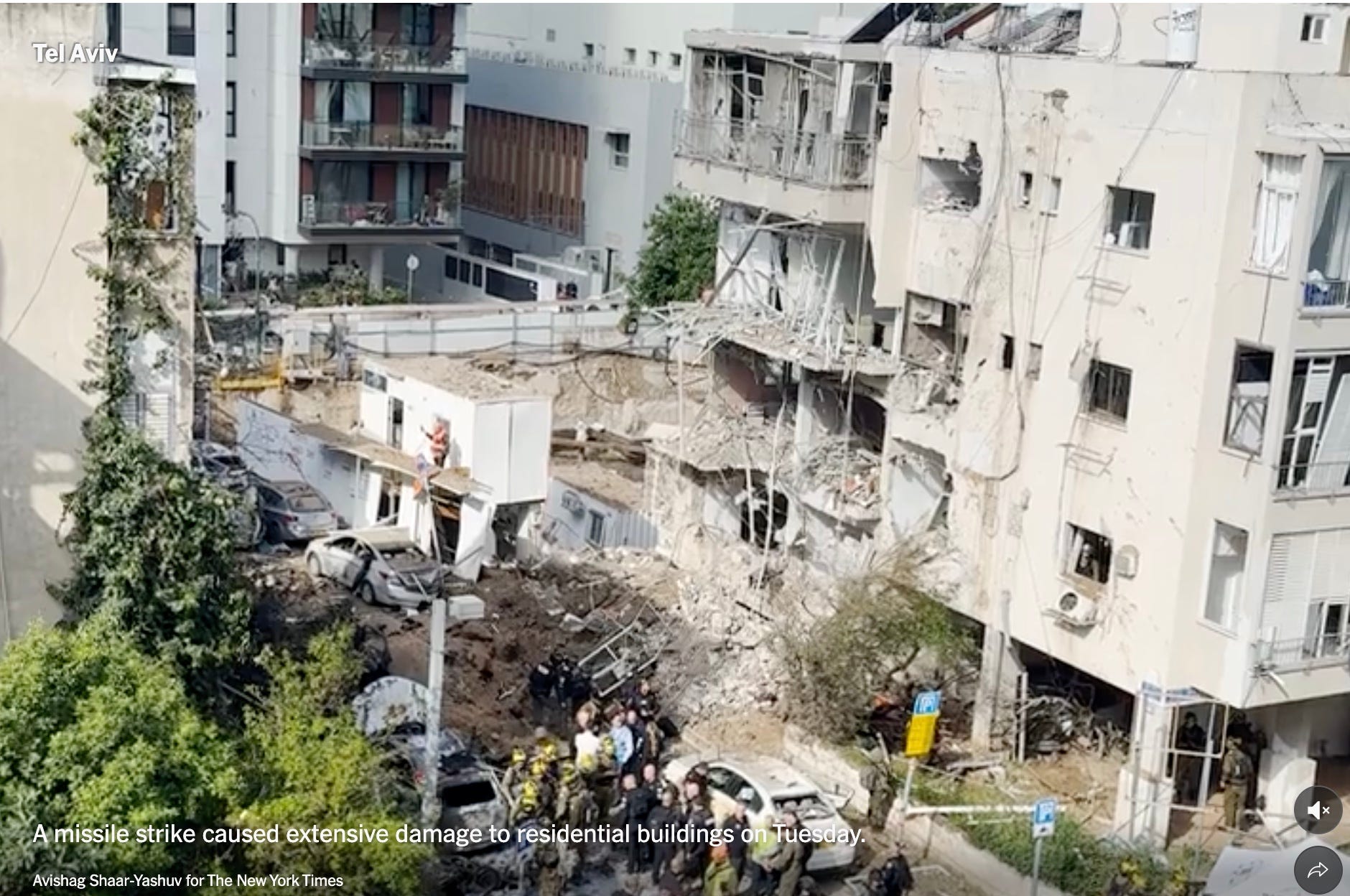
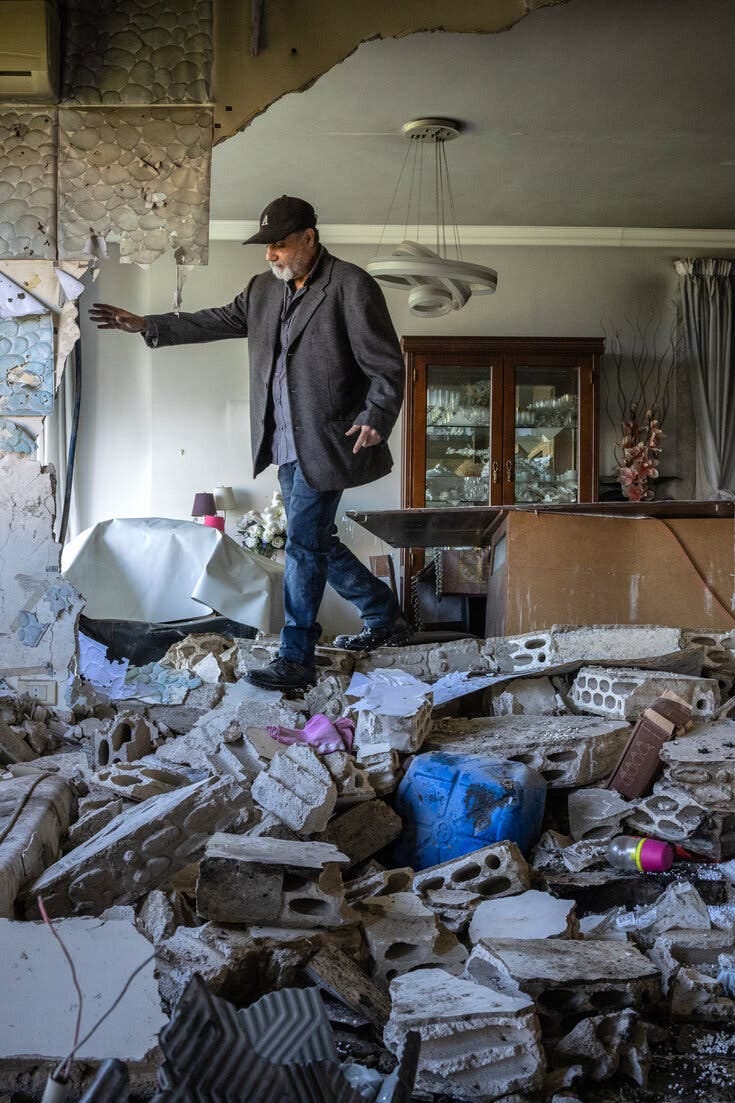
Below is a photo from Tel Aviv due to a strike today. Below that is a picture from a strike in Lebanon.
The United States has sent Iran a plan for ending the war in the Middle East, according to two officials briefed on the diplomacy, reflecting the Trump administration’s desire to find an offramp to a conflict that has deeply rattled the global economy.
It was unclear whether Iran was likely to accept the plan, sent via Pakistan, as a basis for negotiations, or whether Israel, which has been bombing Iran together with the United States for four weeks, was on board with it.
President Trump, speaking on a day in which Iran sent waves of missiles across the Middle East, said Tuesday that negotiations to end the war were already taking place and that the Iranians would like “to make a deal.”
Iran has maintained publicly that no negotiations are happening, but speaking to reporters in the Oval Office, Mr. Trump said not only that they were occurring but also that Vice President JD Vance and Secretary of State Marco Rubio were involved.
Mr. Trump cast Iran as a nation so near military defeat that it had little choice but to negotiate, but the Iranians made clear on Tuesday that they could still lash out across the region. Its missiles targeted Israel and Iraq, and Persian Gulf nations also reported new strikes — despite claims by American and Israel officials that the Iranian ballistic missile program has been severely battered.
The Israeli authorities said a direct hit in Tel Aviv caused extensive damage to at least three residential buildings. At least six people were treated for injuries in Tel Aviv, according to the national emergency service.
In the semiautonomous Kurdish region of Iraq, a volley of six Iranian ballistic missiles killed six Kurdish fighters and wounded 30 others, said the regional government, a U.S. ally.
And in Bahrain, an Iranian missile attack killed a Moroccan contractor working for the Emirati armed forces and injured five Emirati service members, the Emirati defense ministry said on Tuesday.
Mr. Trump, asked why he appeared willing to consider a cease-fire with the Iranians, told a reporter: “They’re talking to us and they’re making sense.”
Though Iran has taken a public stance denying that negotiations are taking place, according to four Iranian officials and an Iranian diplomat, Tehran and Washington have been exchanging messages through intermediaries about de-escalating the conflict.
Mr. Trump said that the vice president and the secretary state were joining negotiations that also include his son-in-law, Jared Kushner, and Steve Witkoff, one of his most senior advisers.
Mr. Trump dodged a question about a report in The New York Times that the Saudi crown prince, Mohammed bin Salman, was encouraging him to pursue the war. “He’s a warrior,” he said. “He’s fighting with us.”
Here’s what else we’re covering:
Lebanon:Israel’s defense minister said its military would expand its occupation of southern Lebanon, retaining control of territory south of the Litani River. The waterway has long served as a geographic boundary in conflicts between Israel and Hezbollah. It is unclear whether Israel would deploy troops across the entire area or rely on its air force for some parts.
Saudi Arabia: The kingdom’s de facto leader, Crown Prince Mohammed bin Salman, has been pushing Mr. Trump to continue the war against Iran, according to people briefed by American officials on the conversations.
Group of 7: Secretary of State Marco Rubio is set to travel to France on Friday to discuss the war and other topics with diplomats from the Group of 7 nations.
Death tolls: A Washington-based group, the Human Rights Activists News Agency, has reported that at least 1,443 civilians had been killed in Iran. More than 1,000 people in Lebanon have been killed, the authorities there said on Thursday. At least 15 people were killed in Iranian attacks on Israel, officials said. The American death toll stood at 13 service members. (I have little confidence in these numbers—Nass)
Energy crisis: Iran’s effective closure of the Strait of Hormuz, a conduit for a fifth of the world’s oil, along with recent attacks on oil and gas infrastructure in the Persian Gulf, had the international benchmark for crude oil trading above $100 on Tuesday. The Philippines declared a state of national energy emergency, and South Korea is urging people to take shorter showers and to avoid charging phones and electric vehicles at night.
Iran: A former Islamic Revolutionary Guards Corps general, Mohammad Bagher Zolghadr, has been named as Iran’s top security official, an aide to the Iranian president announced on Tuesday. He replaces Ali Larijani, who was killed in an Israeli attack last week.
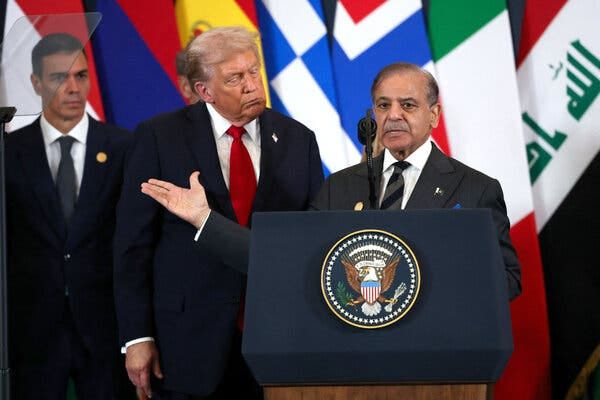
Prime Minister Shehbaz Sharif of Pakistan, right, with President Trump during last year’s Gaza peace summit in Egypt.Credit…Pool photo by Suzanne Plunkett
Prime Minister Shehbaz Sharif of Pakistan said on Tuesday that the country could host talks between the United States and Iran, its neighbor, as Pakistan’s government tries to capitalize on its standing with the leadership of both countries.
“Pakistan stands ready and honored to be the host to facilitate meaningful and conclusive talks for a comprehensive settlement of the ongoing conflict,” Mr. Sharif said in a post on X.
President Trump shared a screenshot of Mr. Sharif’s post on his platform, Truth Social.
And Pakistan’s army chief, Field Marshal Syed Asim Munir, has emerged as the key interlocutor between the United States and Iran.
The comments were a clear sign, amid growing speculation, of Pakistan’s eagerness to play a role as a mediator between the two countries, although no clear pathway to the talks has been detailed.
So far, Pakistan has mostly tried to stay above the fray. It has condemned the U.S.-Israeli strikes on Iran without naming the United States; vowed to defend Saudi Arabia under a mutual defense pact, but without retaliating against Iran; and maintained regular communications with Iranian officials, even as Iran’s strangling of the Strait of Hormuz has left the Pakistani economy battered.
Pakistan’s top government and military officials have nurtured a close relationship with Mr. Trump. They nominated him for the Nobel Peace Prize last year and offered partnerships with the United States on counterterrorism, critical minerals and crypto deals — what some Pakistani analysts have referred to as Pakistan’s “3Cs.”
That effort appears to have earned Mr. Trump’s good graces. Mr. Trump has referred to the army chief as his “favorite field marshal,” and U.S. military officials have called the counterterrorism partnership “phenomenal.”
While several countries have offered to serve as interlocutors with Iran, analysts say Pakistan brings several selling points as a potential mediator.
“They know Iran very well,” Mr. Trump said last year about Pakistan after a lunch with Mr. Munir at the White House in the midst of the 12-day war between Iran and Israel.
It is a non-Arab, Muslim country, like Iran, and it does not host a U.S. military base — sparing it from Iranian strikes, unlike countries in the Gulf. Pakistan shares a volatile, 560-mile border with Iran, and nearly a fifth of its 240 million people are Shiite Muslims, one of the largest Shiite communities outside Iran.
Pakistan has also managed to carefully balance its relationships in the Middle East during the conflict. The billions of dollars that Pakistani workers remit every year from Arab countries in the Gulf region are crucial for Pakistan’s economy. And with its economy heavily reliant on oil imports — 81 percent of which comes from the Gulf — it was among the first to provide military escorts for its ships through the Strait of Hormuz.
At the same time, Pakistani officials have indicated that they want to avoid a confrontation with Iran. Mr. Sharif has held regular calls and meetings with President Masoud Pezeshkian of Iran this year, according to Mr. Sharif’s spokesman, Mosharraf Zaidi.
Though no talks in Pakistan have been confirmed, even the speculation serves a useful purpose. Pakistan has sought to be perceived as a diplomatic power at the crossroads of Central Asia, South Asia and the Middle East. Shortly after it signed the defense agreement with Saudi Arabia, Pakistan renewed a long-term economic partnership with China.
While it seeks a larger diplomatic role, Pakistan is walking a fine line at home. Mr. Sharif’s government has faced criticism for wooing Mr. Trump, and protesters have in recent weeks demonstrated against the assassination of Ayatollah Ali Khamenei, chanting “Death to America.” On March 1, protesters tried to storm the U.S. consulate in Karachi, and 10 people were killed.
Pakistan is also engaged in a conflict with another neighbor, Afghanistan. Officials in Islamabad have been on high alert amid fears of an attack on the Pakistani capital in retaliation for Pakistan’s recent airstrikes on Afghanistan.
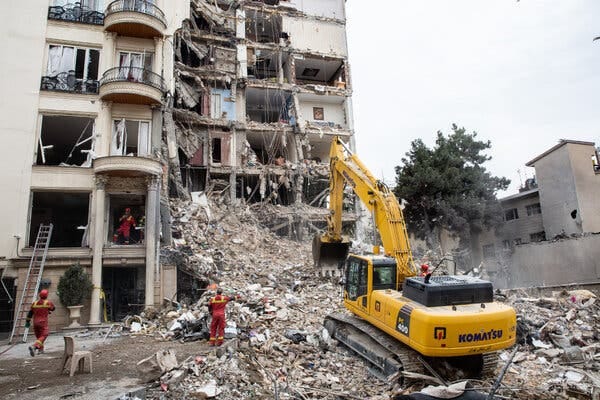
An apartment shattered by an airstrike in Tehran on Monday.Credit…Arash Khamooshi for The New York Times
The United States has sent Iran a 15-point plan to end the war in the Middle East, according to two officials briefed on the diplomacy, reflecting the Trump administration’s eagerness to find an offramp from the conflict as it grapples with its economic fallout.
It was unclear how widely the plan, delivered by way of Pakistan, had been shared among Iranian officials and whether Iran was likely to accept it as a basis for negotiations. Nor was it clear whether Israel, which has been bombing Iran together with the United States, was on board with the proposal.
But the delivery of the plan showed that the administration was ramping up efforts to conclude a war, now in its fourth week, that has drawn in several other countries.
The New York Times did not see a copy of the plan, but the officials, who spoke on condition of anonymity to discuss sensitive details, shared some of its broad outlines, saying that it addresses Iran’s ballistic missile and nuclear programs.
Israel and the United States have targeted Iran’s ballistic missiles, launchers and production facilities, and its nuclear program in the bombing campaign that began on Feb. 28. American and Israeli leaders have vowed never to allow Iran to possess a nuclear weapon.
But Iran has continued to fire missiles at Israel and neighboring Arab countries and still holds 440 kilograms of highly enriched uranium in its territory.
The plan also discusses maritime routes, one of the officials said. Since the beginning of the war, Iran has effectively blocked most Western ships from safely passing through the Strait of Hormuz, the strategic waterway in and out of the Persian Gulf, cutting the global supply of oil and natural gas, and sending the prices soaring.
For now, there is no indication that the war will let up imminently; Israeli officials have said they expect it to continue for weeks. In a statement, Karoline Leavitt, the White House press secretary, acknowledged diplomacy was underway, but said, “As President Trump and his negotiators explore this newfound possibility of diplomacy, Operation Epic Fury continues unabated to achieve the military objectives laid out by the commander inchief and the Pentagon.”
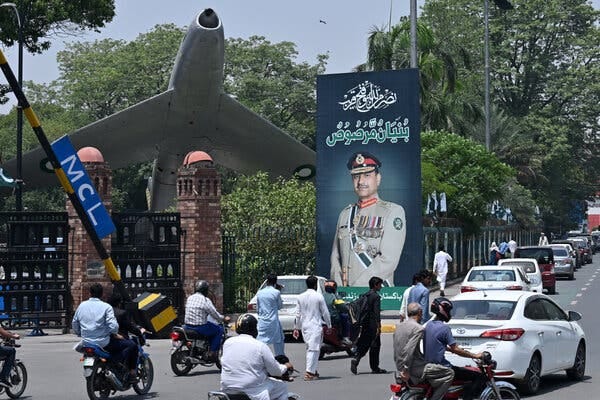
Pakistan’s army chief, Field Marshal Syed Asim Munir, has emerged as the key interlocutor between the United States and Iran, with Egypt and Turkey encouraging the Iranians to engage constructively, the officials added. Field Marshal Munir is believed to maintain close ties to Iran’s Islamic Revolutionary Guards Corps, putting him in a position to pass messages between the warring sides, they said.
The Pakistani military chief, Field Marshal Syed Asim Munir, seen on a billboard in Lahore last year, has emerged as the main intermediary between Iran and the United States.Credit…Arif Ali/Agence France-Presse — Getty Images
He recently reached out to Mohammad Bagher Ghalibaf, the speaker of Iran’s Parliament and a former Revolutionary Guards commander, proposing that Pakistan host talks between Iran and the United States, said an Iranian official and a Pakistani official, who spoke on condition of anonymity to discuss the sensitive communications.
Field Marshal Munir met twice in 2025 with President Trump, who has showered praise on him, saying he was his “favorite field marshal.”
On Tuesday, Prime Minister Shehbaz Sharif of Pakistan wrote on social media that his country “fully supports ongoing efforts to pursue dialogue to end” the war in the Middle East.
“Subject to concurrence by the US and Iran, Pakistan stands ready and honoured to be the host to facilitate meaningful and conclusive talks for a comprehensive settlement of the ongoing conflict,” he wrote.
Iran may have trouble delivering a quick response to American outreach. Senior Iranian officials have been struggling to communicate internally and they worry that Israel could bomb them if they meet in person, the officials added.
On the first day of the war, Israel struck an Iranian leadership compound in Tehran, killing Iran’s supreme leader, Ayatollah Ali Khamenei, and many other top officials. Who now holds the power to make decisions on diplomacy, war and peace remains to be seen.
But the eagerness of the White House to negotiate suggests that Mr. Trump would be willing to leave the current regime in place, at least for now, albeit in a weakened and more pliant state. He and Prime Minister Benjamin Netanyahu of Israel have vacillated on whether their demands for the war included regime change.
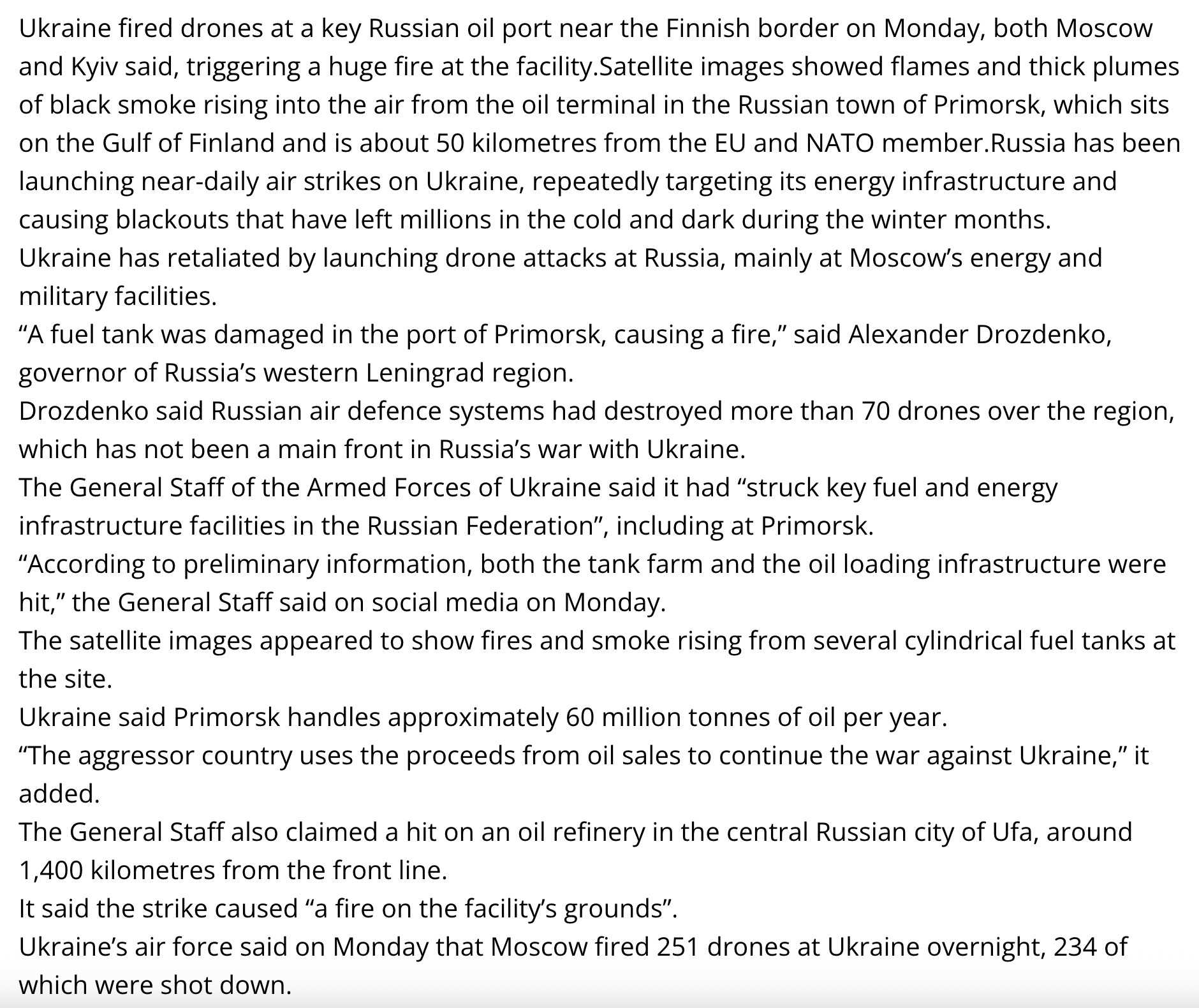
Meanwhile, back in eastern Europe, Russia’s energy infrastructure was attacked today.
…As long as your country has signed and ratified international conventions. And while they have been trampled on, knowing you have them is the first step to regaining them
Original URL: https://merylnass.substack.com/p/2-new-interviews-with-daniel-horowitzDaniel Horowitz: (I am on the second half of the show and I did not say a word about abortions) Mike Farris: https://rumble.com/v35lbye-coffee-and-a-mike-episode-655-with-dr.-meryl-nass-her-new-organization-who-.html or https://podcasts.apple.com/us/podcast/coffee-and-a-mike/id1436799008?i=1000623792983