The “skinny farm bill”: not so skinny after all.
The “skinny farm bill”: not so skinny after all.
here is a summary of some of it, but there is still no final farm bill language posted, so I will probably need to update this article later.

First off, there was a heated discussion about whether the bill was bipartisan. it is a “must pass” bill and is supposed to be bipartisan for that reason, and the fact that we all eat food. GT Thompson, the House Ag chairman, claimed there had been 150 listening sessions conducted by the committee specifically to address farmers’needs.
OTOH, the Dems said that practically everything they wanted had not found its way into the bill and they were not consulted.
A huge number of amendments were offered, at least 50, and many were adopted. This included an “en bloc” vote favoring 24 different amendments that got approved all together in one vote. I don’t know what they were.
Other amendments were approved by voice vote or by recorded vote. Notable was the amendment of Anna Paulina Luna to get rid of 3 sections that provided the pesticide immunity shield. First it got a voice vote, and the voices that wanted to repeal these sections were much louder than the voices who wanted to retain them. Yet an initial claim was made that the amendment failed. Luna then asked for a recorded vote, and it was 280 to repeal them versus 142 to retain them. This seemed like theater—did Bayer pay someone to get the statement that a voice vote failed? Did Bayer hope no one would notice and ask for a recorded vote?
In the end, the roll call vote for the amended farm bill overall was 224 in favor, 200 opposed. One independent, 14 Democrats and 209 Republicans voted in favor of the bill. Three Republicans and 197 Democrats voted against.
Everyone knows this will not be the bill offered in the Senate, which requires 60 votes to pass. Probably the only reason this controversial bill actually got a floor vote was pressure placed on the members due to the dire situation farmers are finding themselves in, and the farmers needed to know what the gov’t was going to be giving them and taking away. It has been 3 years since the farm bill should have been completed in 2023—instead Congress kicked this can down the road yearly for 3 years. And it is not clear whether the Senate will be able to pass a bill that the House can agree with.
Sen. Boozeman, head of the Senate Ag committee, says he will release a Senate version of the Farm Bill in weeks.
One issue that held things up was allowing E15, a corn “gasahol“ mix, to be sold year round, instead of only during certain months. Corn states want it passed and oil states want it squashed. It was stripped out and is to be considered the week of May 11.
An amendment to stop requiring certain emissions scrubbers on farm equipment passed narrowly by 2 votes.
The EAT-Save our Bacon Act passed. This is bad. California’s Proposition 12 went into effect a couple of years ago, and it gave small hog farmers a major leg up. It made it illegal for pork to be sold in California if pigs were maintained in tiny crates, in which they could not move or turn around. The end of pigs in crates made it less economical to raise pigs on industrial farms, and it helped the pigs by requiring a minimum area for them to live in. It really helped small farmers compete.
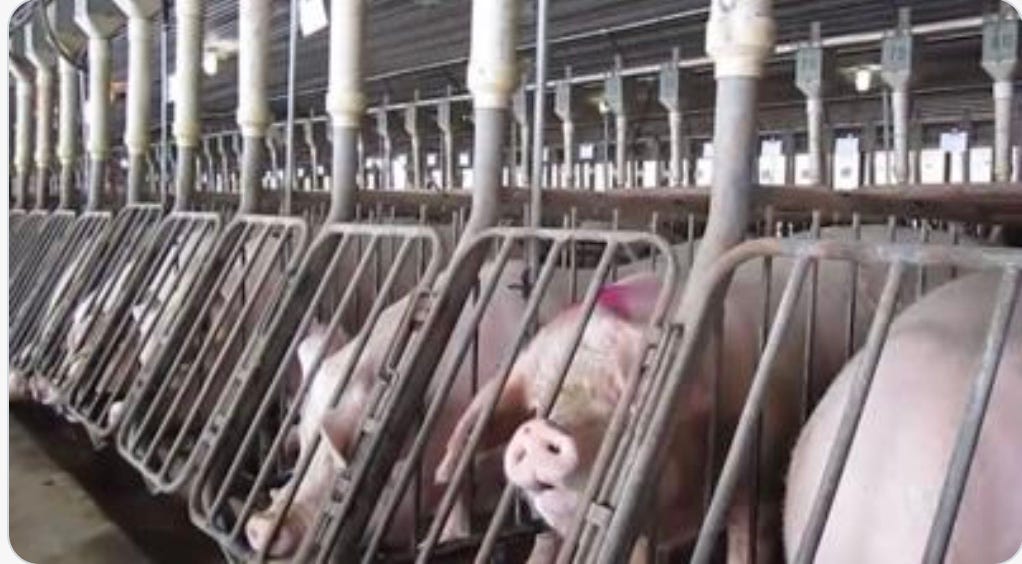
Well, Congress decided that states have no right to pass animal welfare laws that are stricter than federal laws. Another blow against federalism-states’ rights. Another blow against animal welfare.
Cuts to food stamps (SNAP) made in the OBBB were retained in this bill.
Adversarial nations (think China) will now be prohibited from buying US agricultural land.
An attempt to remove soda from the list of foods that can be purchased using food stamps failed. Food stamp recipients will also be allowed to buy prepared, hot rotisserie chicken with their benefits.
Door to Freedom does NOT support the requirement that cows crossing state lines must have electronic ear tags, as well as the old visible ear tags. This requirement, which went into effect in 2024 after decades of trying, makes small farmers purchase equipment they don’t need, and it gives federal authorities information about how many cows farmers have and what they do with them, which the feds don’t need to have. An attempt to repeal the electronic ear tag failed by a vote of 69 to 355. This is another example of how the members love to centralize more and more power in the federal government.
There were also bad provisions in the original farm bill that reduced the regulation of pesticides in other ways. I don’t know if these made it into the final version—I will let you know when I find out.
Now, some good news. Thomas Massie’s PRIME Act pilot program was included in the farm bill and it passed. This is a blow to the USDA stranglehold over meat sales in the US.
It would allow all states that want to do so, to allow 5 custom slaughterhouses (which do not have 24/7 USDA inspectors on site) in each state (which heretofore could process meat but not sell to consumers, only hand the meat back to the rancher to consume himself) to process and sell meat directly to the consumer, OR allow the rancher whose animal was processed to sell the meat to the consumer directly.
For states that choose not to participate, Ag Secretary Rollins can designate 10 custom slaughterhouses within those states (only 10 in the entire US) to sell directly to consumers or give the meat to the rancher to sell to consumers.
After two years, the number of custom slaughterhouses in the program can double.
After that, the hope is that the program can be widely expanded. Let’s see where this goes. USDA has now been put on notice that Congress does not want its stranglehold on meat to continue as it has been. This is a big boon to the New Hampshire bill that is making its way through the legislature, which would allow farmers to sell up to 3 cows, 5 pigs or 10 goats or sheep per month direct to consumers, with no USDA stamp of approval.
The high cost of meat has certainly played into this sea change. Fingers crossed this will be the start of more local control of food production and processing.