The System Is Failing Us: Why Real Change is Needed in U.S. Agriculture
The System Is Failing Us: Why Real Change is Needed in U.S. Agriculture
An incredible interview with my favorite Missouri farmer and former Lieutenant Governor, Joe Maxwell, which you can read about or watch

The Farm Action co-founder says it’s time for agriculture to face an uncomfortable truth. From cattle to crops, American agriculture must rebuild from the ground up or face a tough reality: U.S. agriculture no longer feeds the world.
Updated October 29, 2025 08:57 AM
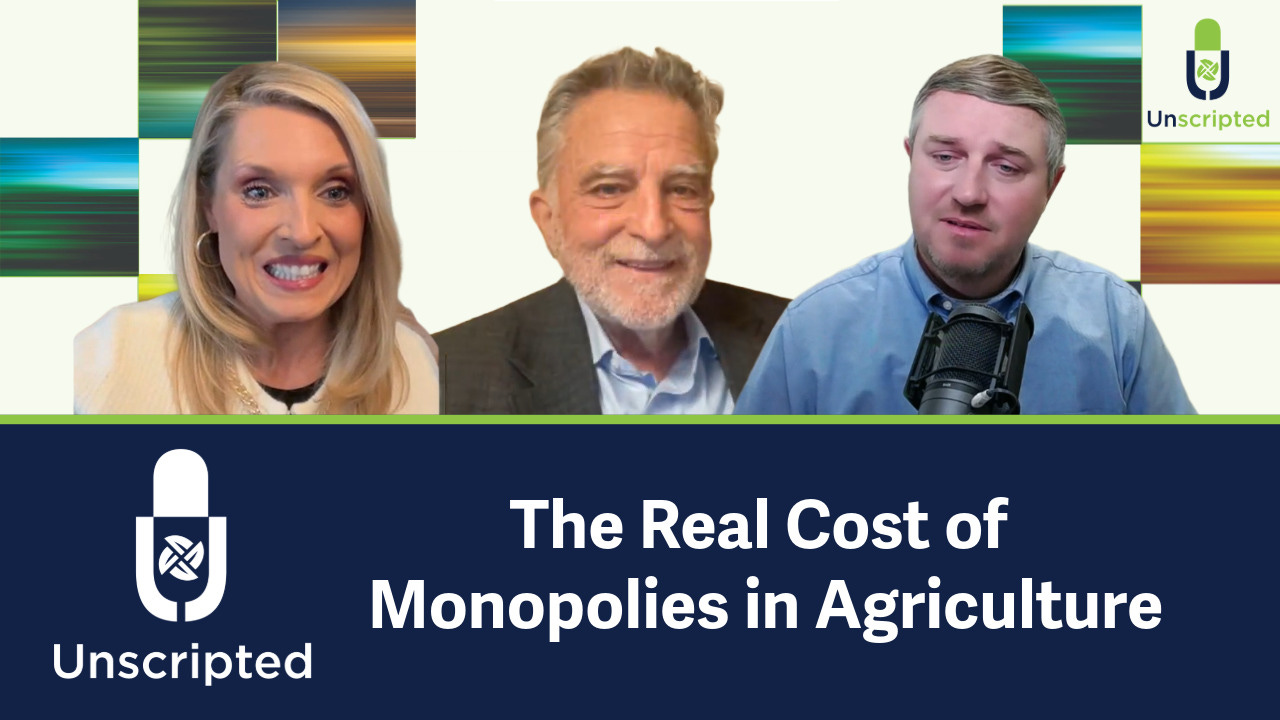
Joe Maxwell doesn’t pull punches — especially on the topic of the future of American agriculture.
“The system is failing us,” says Maxwell, co-founder of Farm Action, during a recent episode of “Unscripted.” “It’s failing the people. It’s failing family farmers and ranchers. And it’s failing consumers. We can’t keep pretending everything’s fine.”
The Missouri farmer and former lieutenant governor shares an uncomfortable truth: The economic model that has shaped U.S. agriculture no longer works for those producing America’s food.
Commodity prices remain under pressure, input costs stay stubbornly high and government payments — while keeping some farms afloat — often mask deeper structural problems.
“We’re on this hamster wheel,” Maxwell says. “Government sends out a bailout, input companies raise prices and the money flows right back up to them. We think we’re being helped, but really, we’re just passing the money through.”
From Missouri Roots to National Reform
Maxwell grew up on a family farm in Missouri and lived through the 1980s farm crisis. That experience shapes his conviction that policy, not luck, determines who survives in agriculture.
That belief lead him and Ohio farmer Angela Huffman to co-found Farm Action, a nonprofit working to “connect the dots” between policy decisions, corporate consolidation and on-farm economics.
“We see a need for a farm organization that looks up and down the entire food chain,” Maxwell explains. “Everyone’s focused on one part of the system — fertilizer here, seed prices there, meatpacking somewhere else — but no one connects them. Farm Action connects those dots and pushes for policy that works for independent producers again.”
“We Don’t Feed the World Anymore”
Maxwell challenges one of agriculture’s most familiar slogans.
“Let’s be honest — we don’t feed the world anymore,” he says. “We import 60% of our fruit, over a third of our vegetables and record amounts of beef. We have a $47 billion agricultural trade deficit. The world is starting to feed us.”
He argues that U.S. farm policy has become overly dependent on exports of feed and fuel crops, while overlooking food crops and livestock production that directly feed Americans. Maxwell calls for farm programs that reward food production rather than commodity production.
“Every year we lose up to 1.8 million acres of pasture to row crops,” he notes. “That’s a failure of policy. We make it easier and more profitable to grow corn for fuel than to raise beef or vegetables for food. That’s not national security — that’s national vulnerability.”
“Let’s quit lying to ourselves. We don’t feed the world anymore — the world is beginning to feed us.”— Joe Maxwell, Farm Action
The Growing Grip of Consolidation
Maxwell points to consolidation as the most dangerous — and least understood — threat facing independent producers. From fertilizer and seed to meatpacking and grocery shelves, he says control has concentrated into the hands of just a few corporations.
“The power dynamic in agriculture has flipped,” Maxwell explains. “Farmers used to have leverage. Now, a handful of companies control nearly every input we need to farm — and they set the prices we pay. Then they control the markets we sell into, and they set those prices, too. That’s not a free market — that’s corporate feudalism.”
He points to Farm Action’s Concentration Tracker, a public data hub that compiles market share information across the food system. It shows that:
-
Four companies control over 80% of beef processing.
-
Two companies dominate more than 75% of corn seed genetics.
-
Three firms hold the majority of fertilizer production capacity.
-
The top five grocery chains now capture nearly 65% of all food retail sales.
“When just a few players hold that kind of power, they don’t compete — they coordinate,” Maxwell says. “They can raise input costs and suppress farmgate prices, and farmers have no real alternative. That’s why our concentration tracker matters — it exposes what’s really happening behind the curtain.”
The problem, he says, isn’t just economic — it’s political.
“These corporations have so much money and influence they shape farm policy to fit their own balance sheets,” Maxwell adds. “When we go to Washington asking for help, they’re already there, writing the rules. Until we restore fair competition and transparency, every bailout, every policy tweak is just feeding the beast.”
Farm Action’s data shows concentration doesn’t just hurt farmers — it hurts consumers, too. From fertilizer to feed to food, fewer companies mean higher costs for everyone.
“You see it every time you go to the grocery store,” Maxwell says. “Beef prices are high, but cattlemen aren’t seeing that profit. Fertilizer prices spike, but farmers don’t control the market. Consumers pay more, farmers earn less, and the middle consolidates the wealth. That’s not sustainable for anybody.”
It’s a concept gaining national traction. Just this week, the Senate Judiciary Committee held a hearing on the soaring costs of inputs.
Sen. Charles Grassley (R-Iowa) also introduced legislation to address the rising costs of inputs, called the Fertilizer Research Act. But the hearing brought together the larger issue of rising costs across the board for farmers.
“This hearing is focused on competition issues. However, there is something that the Trump administration can do right now to help ease the burden for farmers: lowering the countervailing duties on phosphate from Morocco. In 2024, the Biden administration increased duties on Moroccan phosphate to 18%,” said Grassley in his opening statement. “The Biden phosphate duties have only hurt farmers by boxing out access to this important market on an essential input with no substitute. I’m calling on the Trump administration to help American farmers and get rid of the Biden phosphate duties.”
The Beef Debate: “We’re Blindsided”
For ranchers, the issue of consolidation has long been a point of contention. But recent comments by President Trump sparked a renewed push for change and a probe into who and what really controls the prices consumers are paying.
When the White House signaled it will allow more beef imports from Argentina, Maxwell says many ranchers feel blindsided.
“Our cattle herd is at a 70-year low,” he says. “Ranchers finally see light at the end of the tunnel — and then Washington steps in to import more beef. That’s not just a policy mistake, it’s a psychological one.”
He argues that the frustration isn’t only about imports; it’s about the perception that the administration doesn’t understand the complexity of the cattle market.
“Cattle producers don’t set the price they’re paid — packers do,” Maxwell explains. “So when the president talks about lowering prices for consumers without addressing packer control, he’s aiming at the wrong target.”
“We’re finally seeing the light of day. Then government puts its hand back on our backs.”— Joe Maxwell on the U.S. cattle market
“It’s Time for DOJ to Step In”: Why the Beef Industry Needs an Investigation
He says instead of the Trump administration focusing on cattle prices, Farm Action thinks what happened in the egg industry during past price spikes is exactly what needs to happen now in beef: a full federal investigation.
“Two companies control 90% of hatcheries in the U.S. egg industry,” Maxwell explains. “When egg prices exploded, Farm Action presented evidence to the Department of Justice showing that those companies were profiting at historic levels while blaming avian flu. And you know what happened? DOJ opened an investigation. That’s what accountability looks like.”
Now, he says, the same pattern is playing out in beef.
“We’ve already seen price-fixing cases in the cattle sector,” he says. “Two of the major packers admitted it back in 2019. We shouldn’t have to spend years in court to prove what every rancher already knows — that a handful of companies are manipulating the market.”
The so-called “Big Four” — Tyson Foods, JBS, Cargill, and National Beef (controlled by Brazil-based Marfrig) — control roughly 85% of U.S. beef processing capacity. That concentration, Maxwell argues, allows them to influence both the price paid to producers and the price charged to consumers.
“It’s an abusive system,” Maxwell says. “They squeeze ranchers on one end and shoppers on the other, and everyone in between gets caught in the middle. The packers are the only ones guaranteed to make money, no matter what happens to the market.”
He calls for the Department of Justice to launch a new, comprehensive investigation into price manipulation and anti-competitive behavior within the beef industry — similar to what Farm Action pushed for with eggs.
“We need DOJ to do in beef what it finally did in eggs,” he says. “Follow the money, follow the profits, and hold these corporations accountable. Because right now, the people who produce our beef — the ranchers who’ve weathered drought, inflation, and decades of consolidation — are getting crushed while multinational packers report record margins.”
Maxwell says the Biden administration has taken small steps, but much more needs to be done.
“It’s not enough to tinker at the edges,” he warns. “We need enforcement — real enforcement — of the Packers and Stockyards Act, the Sherman Act, the Clayton Act. The laws are already on the books. What’s missing is the will to use them.”
Country-of-Origin Labeling: A “No-Brainer”
Maxwell says Farm Action is pushing hard for mandatory Country of Origin Labeling (M-COOL) as part of the upcoming USMCA review in 2026.
“Consumers deserve to know where their beef comes from,” he insists. “The president could fix this tomorrow by negotiating M-COOL into the trade deal. That one move would give American ranchers a fair shot.”
He dismisses claims that M-COOL violates WTO rules.
“WTO is dead in the water,” Maxwell argues. “There’s no functioning tribunal to even hear a case. The only people fighting this are the packers — JBS, Tyson, Cargill, Marfrig — because they profit when foreign beef gets a U.S. label.”
Structural Change, Not Another Bailout
When asked whether Farm Action supports another round of USDA bailouts for struggling producers, Maxwell doesn’t hesitate.
“We recognize farmers are in crisis,” he says. “We don’t want to see our neighbors driven off the farm. But we can’t just keep sending out checks without fixing the system. One day those bailouts won’t come, and then it’ll look just like the 1980s. We have to demand structural change.”
Those changes, he says, should include:
-
Capping farm subsidies to slow consolidation.
-
Rebalancing insurance and incentive programs toward food production.
-
Rebuilding local and regional processing capacity to compete with the “Big Four” packers who control 80–85% of the cattle market.
-
Stronger enforcement of antitrust laws like the Packers and Stockyards Act and the Sherman Act.
Rebuilding from the Ground Up
Despite his criticism, Maxwell frames his message as one of hope — if farmers and ranchers take the lead.
“We can’t sit back and wait for Washington to fix this,” he says. “We have to step up, be part of the conversation, and demand policies that keep family farms in business.”
He supports Rep. Thomas Massie’s Prime Act, which would expand small-scale meat processing and let states regulate local slaughterhouses directly.
“We’ve got the infrastructure,” Maxwell adds. “We just need to give it life again. Let’s rebuild local processing so farmers can sell directly to consumers and keep value in their communities.”
Why It Matters Now
Fresh data from the Farm Journal Ag Economists’ Monthly Monitor shows that 76% of agricultural economists expect conditions to persist or worsen over the next year. Many see echoes of the 1980s — though they warn today’s crisis is more complex.
“It’s not the 1980s all over again,” says Unscripted host Tyne Morgan. “But the pain is real. Economists say the situation could worsen in 2026 if structural issues aren’t addressed. That’s what makes conversations like this so important.”
A Call to Action
As the conversation wraps up, Maxwell’s tone shifts from urgency to determination. His message to rural America is both a warning and an invitation.
“We have to lead,” he says, pausing before adding, “because no one else is going to do it for us.”
He says the future of U.S. agriculture depends on whether farmers choose to engage in these hard conversations — the ones about fairness, policy, and the future of independent family farms.
“Look, we can’t afford to sit on the sidelines and hope someone in Washington suddenly understands our way of life,” Maxwell says. “Every farmer, every rancher, every person who believes in feeding people instead of feeding systems has a role to play. It starts at the local level — showing up, speaking up, refusing to accept that the current model is the only way forward.”He continues:
“This isn’t about right or left, or about politics at all. It’s about survival — for the people who feed this country. We can’t keep patching the same broken system and expecting it to serve us. If we want a food system that’s fair, resilient, and rooted in our rural communities, we’ve got to build it ourselves, together. That’s the hard truth — and the hopeful one.”
Maxwell’s words linger long after the conversation ends — a challenge, but also a call for courage. Change, he insists, isn’t something that happens to farmers. It’s something that must happen through them.
Listen to the Full Conversation
Listen to the full interview: “Unscripted” with Tyne Morgan and Clinton Griffiths featuring Joe Maxwell, available on Farm Journal’s YouTube channel and anywhere you stream podcasts.