The government needs to know the true cost of the products it’s purchasing to avoid getting fleeced by unscrupulous suppliers
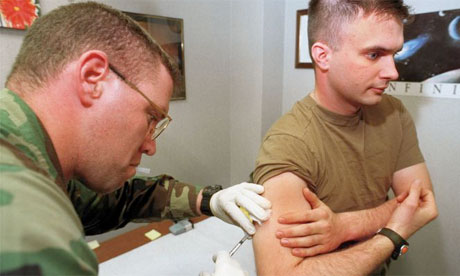
A soldier being inoculated for anthrax in 2000.
The Pentagon has paid the manufacturer of BioThrax $1.3bn, for a vaccine that an independent report calculates cost only $250m to produce. Photograph: AP/Dave Bowman
An anthrax vaccine of contested quality has paid out over $1bn in profit to a small company in Maryland, despite the fact that the company neither invented the product nor built the production facilities. A new report by Scott Lilly, my colleague at the Centre for American Progress in Washington, has the details: Emergent BioSolutions has billed the Pentagon $1.3bn for BioThrax, which he calculates cost the company roughly just $250m to manufacture. Lilly comments:
“It is hard to imagine that any attempt to reduce federal outlays and shrink the size of the budget deficit will be credible if it does not address the issue of government contracts that pay extraordinary profit margins.”
… BioThrax is considered a “commercial item” – despite the fact that consumers cannot buy it on the open market. Originally developed by military scientists at Fort Detrick, Maryland, in the 1960s, the state of Michigan public health service obtained a licence to produce the vaccine in 1970. At the time, BioThrax was used to help protect mill workers in the textile industry who processed animal hair contaminated with naturally-occurring anthrax.
In 1998, the state of Michigan sold off the facility for an effective cash price of $2.25m – including 28 buildings containing 250,000 square feet of floor space; 59 acres of land and the government licence to manufacture BioThrax.
Today, it has become very clear that BioThrax is both old and very inadequate. A 2002 review of the vaccine by the Institute of Medicine concluded that BioThrax caused swollen arms and muscles, as well as joint pain. According to some campaigners, it may even have resulted in the death of some individuals.
The new owners, which are now a publicly-listed company named Emergent BioSolutions, have three in-house and 24 contract lobbyists. (Lilly explains that, to put Emergent’s lobbying in perspective, one might compare it with Merck, one of the most heavily represented companies in Washington, with close to 40 registered lobbyists. To have the same ratio of lobbyists to revenues as Emergent, Merck would have to hire more than 4,000 additional lobbyists.)
Merrill Goozner discusses a BMJ article by Nigel Hawke about Britain’s National Institute for Health and Clinical Excellence, and how it might help those of us in the less-regulated medical world to get useful information on pharmaceuticals. Excerpts: The global pharmaceutical industry considers Great Britain’s National Institute for Health and Clinical Excellence (NICE) about as…
Narcolepsy has been in the news the past 10 days. Severe disabilities in 31 affected Irish children were reported; 70-100 Finnish children were reported with the disorder after receiving Pandemrix; 86 Norwegian claims have been made; now 170 Swedish children are affected, according to Sweden’s health minister. A Swedish study found the relative risk of…
A major report on Gulf War Illness written by the VA Research Advisory Committee on Gulf War Veterans’ Illnesses (RAC) was made public on November 17. This is the most important document yet produced on Gulf War illnesses. About 1800 references are cited. The report gets it right about how many have developed the syndrome…
From the NY Times, Sept. 21, 2005 – Just as governments around the world are stockpiling millions of doses of flu vaccine and antiviral drugs in anticipation of a potential influenza pandemic, two new research papers published today have found that such treatments are far less effective than previously thought. “The studies published today reinforce…
https://merylnass.substack.com/p/is-sir-doctor-jeremy-james-farrar Was Jeremy’s Daddy an agent of the British government, too? And surprise! the head of One Health and the Frozen Food theory at WHO has been fired. Three weeks ago Jeremy was still in line for the job, due to start today. But so far (and it is 3:30 pm in Geneva right now)…